

Girl with cat, Spitalfields, 1912
Via Spitalfields Nippers as photographed by Horace Warner.
I chatted about the mystery novel Nairobi Heat by Mukoma wa Ngugi at The Criminal Element this week.
“You keep using that word. I do not think it means what you think it means.”



I’m going to have to do another post’s worth…there are simply too many in this category!
I took these examples of revisions from a story I’m still working on. The first version is dated August 15, 2010. The second version is dated February 26, 2011. Between those two versions, I began changing this piece from a novel to a much shorter story, though that probably won’t be evident in these small examples. What will show is how, as I read over my previous work, I often make small edits along the way, before I start on a new section. Sometimes I’m barely conscious I’m making these changes, but they’re very close to changes I make deliberately, usually working from a printed copy of the manuscript.

8/15/10:
Tanneken Claes stabbed the German guard deep in the heart. Her strike was clean; he made a choked sound and collapsed forward, his helmet sliding from his head and his rifle from his hands.
Edited:
Tanneken Claes stabbed the Boche guard deep in the heart. Her strike was clean; he made a choked sound and collapsed, his spiked helmet sliding from his head and his rifle from his hands. Blood bloomed on his gray uniform.
I removed forward because it weakened the verb collapsed. I changed German to Boche because the latter is more in character, and is a cue to the time period. I added spiked as an additional historical detail. I added a sentence to change the paragraph’s rhythm as well as indicate that the uniform is gray, another historical detail.
8/15/10:
Two men sat at the table. The elderly bearded one froze with his hand in the air, a rook dangling from his fingers. “Who are you?” He had the sense to speak quietly. From his shabby wool suit, she guessed him to be the town’s schoolmaster.
Revised:
Two men sat at the table. The old bearded one froze with a rook dangling from his gnarled fingers. “Who are you?”
He had the sense to speak quietly. From his shabby wool suit, she guessed him to be the town’s schoolmaster. It was his misfortune that respectable persons such as he were most often taken hostage by the Boche, to ensure the good behavior of their towns.
I split this paragraph into two, to emphasize the line of dialogue and set it apart from its sequel, which is Tanneken’s thoughts upon the old man. I added a sentence to provide additional historical information. I also tightened the second sentence, removing a clause that weakened it, changing a word to better fit the pov character’s voice, and added an additional indicator of the man’s age.
These examples demonstrate two of my most frequent revision issues. When drafting, especially when I’m writing very fast, my sentences tend to ramble more. A little thought can usually tighten or clarify a great deal of what I’ve already got down. And when I’m writing historical or fantastical worlds, or for that matter any genre, I’m always looking for opportunities to unobtrusively slip in more relevant, distinctive detail that will make the story richer.
To a Soldier in Hospital
Courage came to you with your boyhood’s grace
Of ardent life and limb.
Each day new dangers steeled you to the test,
To ride, to climb, to swim.
Your hot blood taught you carelessness of death
With every breath.
So when you went to play another game
You could not but be brave:
An Empire’s team, a rougher football field,
The end—perhaps your grave.
What matter? On the winning of a goal
You staked your soul.
Yes, you wore courage as you wore your youth
With carelessness and joy.
But in what Spartan school of discipline
Did you get patience, boy?
How did you learn to bear this long-drawn pain
And not complain?
Restless with throbbing hopes, with thwarted aims,
Impulsive as a colt,
How do you lie here month by weary month
Helpless, and not revolt?
What joy can these monotonous days afford
Here in a ward?
Yet you are merry as the birds in spring,
Or feign the gaiety,
Lest those who dress and tend your wound each day
Should guess the agony.
Lest they should suffer—this the only fear
You let draw near.
Greybeard philosophy has sought in books
And argument this truth,
That man is greater than his pain, but you
Have learnt it in your youth.
You know the wisdom taught by Calvary
At twenty-three.
Death would have found you brave, but braver still
You face each lagging day,
A merry Stoic, patient, chivalrous,
Divinely kind and gay.
You bear your knowledge lightly, graduate
Of unkind Fate.
Careless philosopher, the first to laugh,
The latest to complain,
Unmindful that you teach, you taught me this
In your long fight with pain:
Since God made man so good—here stands my creed—
God’s good indeed.
–Winifred M. Letts
On my recent overnight trip to New York City, it turned out that one of my tourist desires matched up with the places I needed to go, so I stayed at The Jane Hotel.
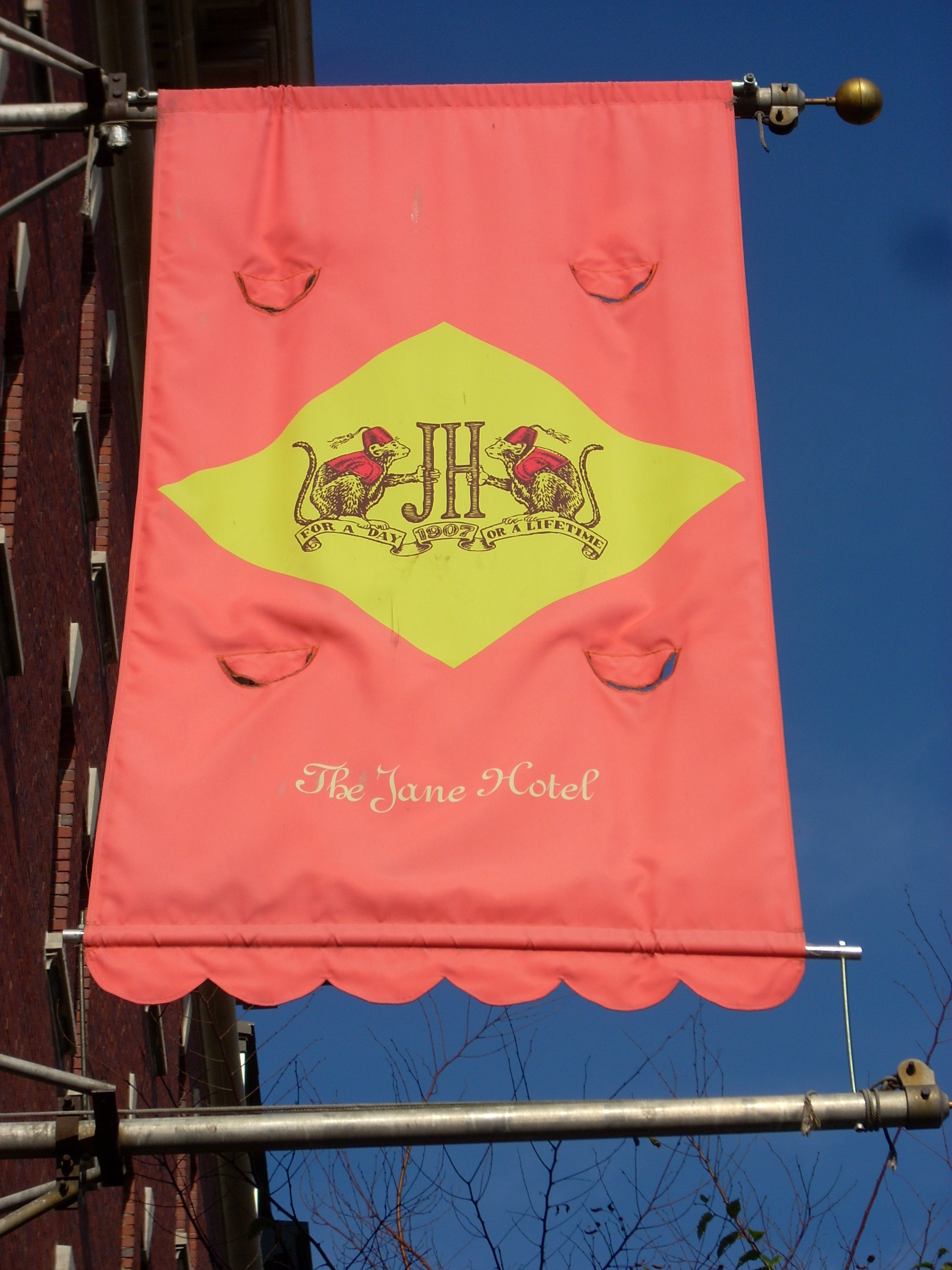
“Completed in 1908, the American Seaman’s Friend Society Sailors’ Home and Institute was designed by William A. Boring, the architect renowned for Ellis Island’s immigrant station. Originally built as a hotel for sailors with cabin-like rooms, the landmarked hotel was lovingly restored on its centennial in 2008.
In 1912, the survivors of the Titanic stayed at the hotel until the end of the American Inquiry into the ship’s sinking. The surviving crew held a memorial service at the hotel four days after the ship sank.”
Besides the general coolness, I also wanted to stay there because of The Duke and The Pirate Queen…after all my research into ships, it just seemed appropriate!

I had one of the very tiny “cabin” rooms. It’s a good thing I’m not taller, or the bunk would have been too short! Though the bathrooms are shared for those rooms, the fixtures were exceptional, especially the shower, and I didn’t have to wait at all for my turn.
The bunk had two drawers and an open space beneath it; a rod with brass hooks hung on each wall, so it was easy to hang up clothes in the narrow space; there were also brass hooks on the back of the door. An old-fashioned (only in design) fan was attached to the wall, near the ceiling, and the air conditioner was concealed behind a carved wooden screen. All of the wallpaper and colors had a turn-of-the-century feel, and a support post was wrapped in rope, presumably to add nautical flair.



Here’s a cool NY Times article on the hotel.
I have a new post up at The Criminal Element on a nonfiction book about a serial killer in WWII Paris, David King’s Death in the City of Light.
I recently re-read Lois McMaster Bujold’s A Civil Campaign, which is dedicated to “Charlotte, Jane, Georgette, and Dorothy,” who are of course Charlotte Brontë, Jane Austen, Georgette Heyer, and Dorothy Dunnett. There are elements of all those authors in the story, but this time around I particularly noticed the Austen moments. Please note, there are spoilers ahead (but neither of these books is new!).

In particular, I was struck by many references to Pride and Prejudice. A Civil Campaign is about marriage, and all that marriage means. Bujold shows a whole range of courtships as well as established marriages. Most notably, she pairs off the Koudelka sisters (Delia, Olivia, Martya, Kareen) in four very different ways; I don’t know why it had never struck me before that they could be examined against the Bennett sisters who are paired off at the end of their novel (Jane, Elizabeth, Lydia) and Elizabeth’s friend, Charlotte.
At the beginning of A Civil Campaign, the eldest sister, Delia, is already engaged to Duv Galeni, a former scholar and career officer. Delia easily mirrors Jane in the way she gets along well in society and follows, so far as her parents know, proper social practices.
Olivia, next eldest, becomes angaged to Lord Dono Vorrutyer, who was recently Lady Donna Vorrutyer, but had her sex changed in order to inherit her brother’s title (and prevent a hated cousin from inheriting, instead). Dono’s plot, despite the science fictional aspects (related to him having viable sperm, not the sex change itself) ought to be familiar to romance readers because it revolves around inheritance issues. The Dono-and-Olivia plot is a little less Austen on the surface, but does reflect Austen’s concerns about appropriate spouses. Olivia, by marrying Dono, will move up in society. This plot is also very familiar from modern romance novels set in Georgian and Victorian England.
Martya, the most cranky and managing of the sisters, sets her cap for unworldly genius Enrique Borgos; though they are not yet engaged by the end of the novel, it’s clear that’s her plan and that she will succeed. Martya’s practical choice makes her a good comparison with Charlotte Lucas, who weds Mr. Collins. Though Borgos is a brilliant scientist, he lacks social skills and business sense, which Martya can provide; thus, there will be economic benefit for both, and social benefit to Enrique who gains a buffer or perhaps an interpreter between him and society.
Finally, Kareen begins the novel as the lover of Mark Vorkosigan, but discovers that she cannot bring herself to tell her family. The comparison of Kareen to Lydia is more contrast than correspondence, but both womens’ stories do deal with relationships that are unconventional by the standards of their family. Lydia elopes with an unsuitable man who turns out to be much worse than initially thought; Kareen has begun a sexual relationship with an emotionally damaged man while away at school on another planet, when in her parents’ eyes, she should have remained a virgin until marriage. Unlike Wickham, though, Mark is financially very well off and has solid familial support.
While Lydia is portrayed as flighty, with little concern for her family’s and her own reputation or for her own future, Kareen is almost too concerned with these issues; she hides her relationship with Mark until it’s revealed at the worst possible moment. Lydia’s problem is solved, as well as it can be, by an outsider, Mr. Darcy. Kareen takes several actions on her own behalf, and with Mark, enlists the help of Cordelia Vorkosigan to negotiate with her parents. In the end, she decides to let her relationship remain unconventional by the standards of her parents.
Bujold’s heroines have many more options than Austen’s did.
I was offline this weekend when my post on romance in the Vorkosigan novels went live at Heroes and Heartbreakers, but it looks like it’s getting plenty of comments.
