
I’m out of town at the moment – I traveled to northern New Jersey with a friend to see the German metal band Rammstein in concert, and am staying overnight.
Here are a couple of videos to give you a taste:
I’m out of town at the moment – I traveled to northern New Jersey with a friend to see the German metal band Rammstein in concert, and am staying overnight.
Here are a couple of videos to give you a taste:
Read a pirate book in May! You know you want to!

A few weeks ago someone brought up the idea on Twitter of reading a pirate book during the month of May. Then everyone in the discussion apparently forgot about it, except me.
That means I get to pick the rules, right? So, to play: read a pirate book you haven’t read before. Then talk/write about it. I was thinking romances, but classics that aren’t romances might be cool, too – for instance, I’ve never read Treasure Island.
If you read a pirate book this month and comment about it in your blog, comment on this post with the book’s title and a link, and I’ll compile a list for another post next month. Or you can just comment with “Arr!” or “Matey” or “Merchant and pirate were for a long period one and the same person. Even today mercantile morality is really nothing but a refinement of piratical morality” (Nietzsche) if you are so moved.
Me, I’m off to read The Sublime and Spirited Voyage of Original Sin by Colette Moody. I think Geena Davis would be great in that! If I finish that in time, I will also try out Laura London’s classic, The Windflower, and if I finish that, then I’ll go for a re-read of Rafael Sabatini’s Captain Blood.
Happy release day to Dream Lover: Paranormal Tales of Erotic Romance, edited by Kristina Wright!

My story in this anthology is titled “Vanilla,” and I noticed it had a mention in one of the Amazon.com reviews: “After finishing the book, I think my favorite is “Vanilla.” –L.M. Tanaka
Here’s a small excerpt of my story:
Devlin had flour on the tip of his nose.
Louisa stopped in the communal kitchen’s doorway and watched him absently brush his nose with one floured knuckle. He’d spilt flour on the counter, and was scraping it into a paper towel. Flour puffed into the air like tiny coded smoke signals, and settled on his black t-shirt, just over his stomach.
She recognized eggs and butter, but not the long, thin black item–seemingly organic–that he’d placed next to one of his mixing bowls. His supplies were arrayed on the island counter in the center of the research facility’s kitchen.
“What’s up?” Devlin asked, intent on what he was doing, but apparently recognizing her without looking up, almost as if he was a telepath, like her.
#
Table of contents:
“Love Resurrection” by Justine Elyot
“Dreaming by the Sea” by Delilah Devlin
“Devil’s Food” by Shanna Germain
“Rainmaker” by A.D.R. Forte
“Shattered Belle” by Craig J. Sorensen
“Living Off Lovers” by Kristina Lloyd
“Where The Heart Is” by Saskia Walker
“Freeing The Demon” by Sacchi Green
“Old Fashioned Glamour” by Nikki Magennis
“Moongirl Meets The Wolfman” by Alana Noel Voth
“Vanilla” by Victoria Janssen
“For Humans Love’s All About Weight” by Lana Fox
“Succubus Comes Home” by Lucy Felthouse
“Folly” by Kate Pearce
“Lust As Old As Us” by Madeline Moore
“The Eye Of Pearl” by Ericka Hiatt
“Thief Of Dreams” by Kristina Wright
Here are links to some essays by by Joanna Russ (1937 – 2011).
Towards an Aesthetic of Science Fiction: “Science fiction, like medieval painting, addresses itself to the mind, not the eye. We are not presented with a representation of what we know to be true through direct experience; rather we are given what we know to be true through other means—or in the case of science fiction, what we know to be at least possible. Thus the science fiction writer can portray Jupiter as easily as the medieval painter can portray Heaven; neither of them has been there, but that doesn’t matter. To turn from other modern fiction to science fiction is oddly like turning from Renaissance painting with all the flesh and foreshortening to the clarity and luminousness of painters who paint ideas. For this reason, science fiction, like much medieval art, can deal with transcendental events. Hence the tendency of science fiction towards wonder, awe, and a religious or quasi-religious attitude towards the universe.”
Pornography and the Doubleness of Sex for Women.
Joanna Russ passed away yesterday, after being in poor health for many years. Sarah Monette reminded me of this poem.
Dirge Without Music
I am not resigned to the shutting away of loving hearts in the hard ground.
So it is, and so it will be, for so it has been, time out of mind:
Into the darkness they go, the wise and the lovely. Crowned
With lilies and with laurel they go; but I am not resigned.
Lovers and thinkers, into the earth with you.
Be one with the dull, the indiscriminate dust.
A fragment of what you felt, of what you knew,
A formula, a phrase remains,—but the best is lost.
The answers quick and keen, the honest look, the laughter, the
love,—
They are gone. They are gone to feed the roses. Elegant and curled
Is the blossom. Fragrant is the blossom. I know. But I do not
approve.
More precious was the light in your eyes than all the roses in the
world.
Down, down, down into the darkness of the grave
Gently they go, the beautiful, the tender, the kind;
Quietly they go, the intelligent, the witty, the brave.
I know. But I do not approve. And I am not resigned.
–Edna St. Vincent Millay
I’ve been doing some blogging for a new mystery/crime novel site, The Criminal Element, and it’s finally launched this week!

My first post for the site is Crime’s Couples: Barbara Hambly’s Benjamin January and Rose Vitrac, from her series of historical mysteries set in 1830s New Orleans.
“Macmillan announces the launch of a new crime and mystery-focused community website with a focus on sharing and enriching the experience of crime story fandom…the site will highlight different areas of the genre, from noir to cozies and everything in between.
The site will feature pre-release excerpts, original short stories from various authors in the space, topical blog posts, and will eventually be offering downloads and podcasts.
Much like its successful sister sites, science fiction community Tor.com and romance community HeroesandHeartbreakers.com, CriminalElement.com is “publisher neutral,” meaning that it will include author participation from all publishers and other content creators, and is not exclusive to Macmillan authors.”
I’ve been reading through a lot of Regencies in my TBR lately, and one thing I notice frequently is the diction. I go back and forth a lot on the issue of historical diction.

To me, diction is the base layer of historical fiction. It’s the foundation, or perhaps the foundation garment (heh). If the diction is right, or sounds like it’s right, the reader is more likely to trust in the “reality” of what she’s reading. And isn’t that one of the main goals of fiction? For me, it is.
But there are a lot of different ways to approach diction in a historical novel. It’s something the writer has to think about, how accurately she tries to reproduce the actual speech and style of the time she’s portraying. She’s writing for a modern audience; no matter how much research into vocabulary she does, and how many primary source documents she reads, she cannot escape that she is a modern person with modern speech patterns. How much time should she devote to accuracy? And does strict accuracy always serve the story?
Personally, I don’t think it’s possible to be completely accurate. Even if the writer was completely accurate, how many people would be able to tell? (Aside from the time travelers who stopped by the 21st century to purchase reading material.)
I’m not sure you should have pitch-perfect diction for a goal when you’re trying to tell a story, not if it gets in the way of the story. The difficulty is deciding where inaccuracies do get in the way of the story.
Diction slips are more likely to catch me when I’m reading dialogue. It’s easier for me to overlook very modern words in narration because I can consider that part of the author’s voice, if I squint (or without squinting, if the author’s voice is strong enough). The characters’ voices are a different matter. I don’t expect a Regency gentleman to say, “Dude! That sucks!” Even though I haven’t done a lot of research into the Regency, and haven’t read huge amounts of the contemporary literature (Jane Austen being a notable exception), even I can often tell when the diction shifts in time.
Some readers, however, are infuriated by diction mistakes, even rare ones. It’s a fine line to walk for both writer and reader.
What’s your opinion on the matter?
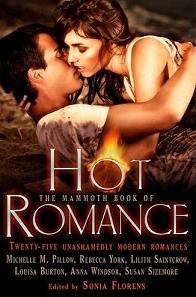
[Edited to correct release date]
The American edition of The Mammoth Book of Hot Romance is available for pre-order! Official release date is now August 23, 2011.
My story in the anthology is called “Crimean Fairy Tale.”
Here’s a snippet:
Private Jonas Weston survived Balaclava without a scratch, then things got worse. He emerged from the brutal battle at Inkerman Heights with a shallow lance wound over a broken rib, bad dreams, and hands that would never quite stop shaking. Three nights after the battle, when he’d once again woken screaming, Sergeant Jennings told him, “I’ve a certain cure for the shakes, lad.”
Weston took another swig of coarse arrack and coughed into the embers of their shared campfire. It tasted miles worse than rum, but was thankfully stronger, and it helped numb the sharp pain in his side. If only he could get enough to make him sleep. He feared there wasn’t enough in the world. “Need more of this,” he said, shaking the flask.
“Not a bit of it. You need to dock a bobtail.”
#
Curious? Did I mention I had fun doing research? I had some lists of naughty Victorian slang, and I used as much of it as I could. Possibly too much, though I hope the meanings are reasonably clear from context.
These two books were my main sources for details of the Crimean War itself and what it was like for the soldiers: The Thin Red Line: An Eyewitness History of the Crimean War by Julian Spilsbury and Death Or Glory: The Legacy Of The Crimean War by Robert Edgerton, which has some interesting comparisons to the American Civil War.
It’s an especially interesting war because of the influence of journalism. Reporters like William Howard Russell for the Times sent despatches via telegraph, and even soldiers’ personal letters were sometimes printed in the English newspapers. Artists like William Simpson provided lithographs of the conflict, precursors of the photographers of the American Civil War. These accounts of the front are credited with being partially responsible for Florence Nightingale’s journey to the Crimea and her subsequent improvement of hospital conditions for the wounded soldiers. The Crimean War: As Seen by Those Who Reported It collects a number of period reportage and looks to be an excellent resource on this topic.
I am really, really interested in giving this volume a look, too: The Crimean War in the British Imagination.
Stand-to: Good Friday Morning
I’d been on duty from two till four.
I went and stared at the dug-out door.
Down in the frowst I heard them snore.
‘Stand to!’ Somebody grunted and swore.
Dawn was misty; the skies were still;
Larks were singing, discordant, shrill;
They seemed happy; but I felt ill.
Deep in water I splashed my way
Up the trench to our bogged front line.
Rain had fallen the whole damned night.
O Jesus, send me a wound to-day,
And I’ll believe in Your bread and wine,
And get my bloody old sins washed white!
–Siegfried Sassoon, The Old Huntsman and Other Poems, 1918
I’ve got a new post up at Heroes and Heartbreakers: Just a Gigolo…Romance Hero?
#
Out of curiosity, I recently did a search on the phrase “romance novels.” This was prompted by a conversation I had with Magdalen of Promantica, who’d recently heard the term “Harlequin romances” used as a generic disparaging term. So I went on an internet search to see what I could see, eavesdropping, as it were.

1. And, well, I am a girl, and I can’t always read deep, noble, thoughtful books, so I have my fair share of fluffy romance novels under my belt, too..