Pics – Arisia 2012

Photos from Arisia 2012, in Boston, Massachusetts.

Need some dice?

This stormtrooper? Is cake.

No, really, he was cake. People ate him.

Need some steampunky specs?

Among my favorite costumes of the con – cross-gender casting of Holmes and Watson.

Posted in arisia, images, steampunk | Tagged | 2 Comments

Animals in Historical Romance

I have a new Top 5 post up at Heroes & Heartbreakers – Animals in Historical Romance.

Posted in writing | Comments Off on Animals in Historical Romance

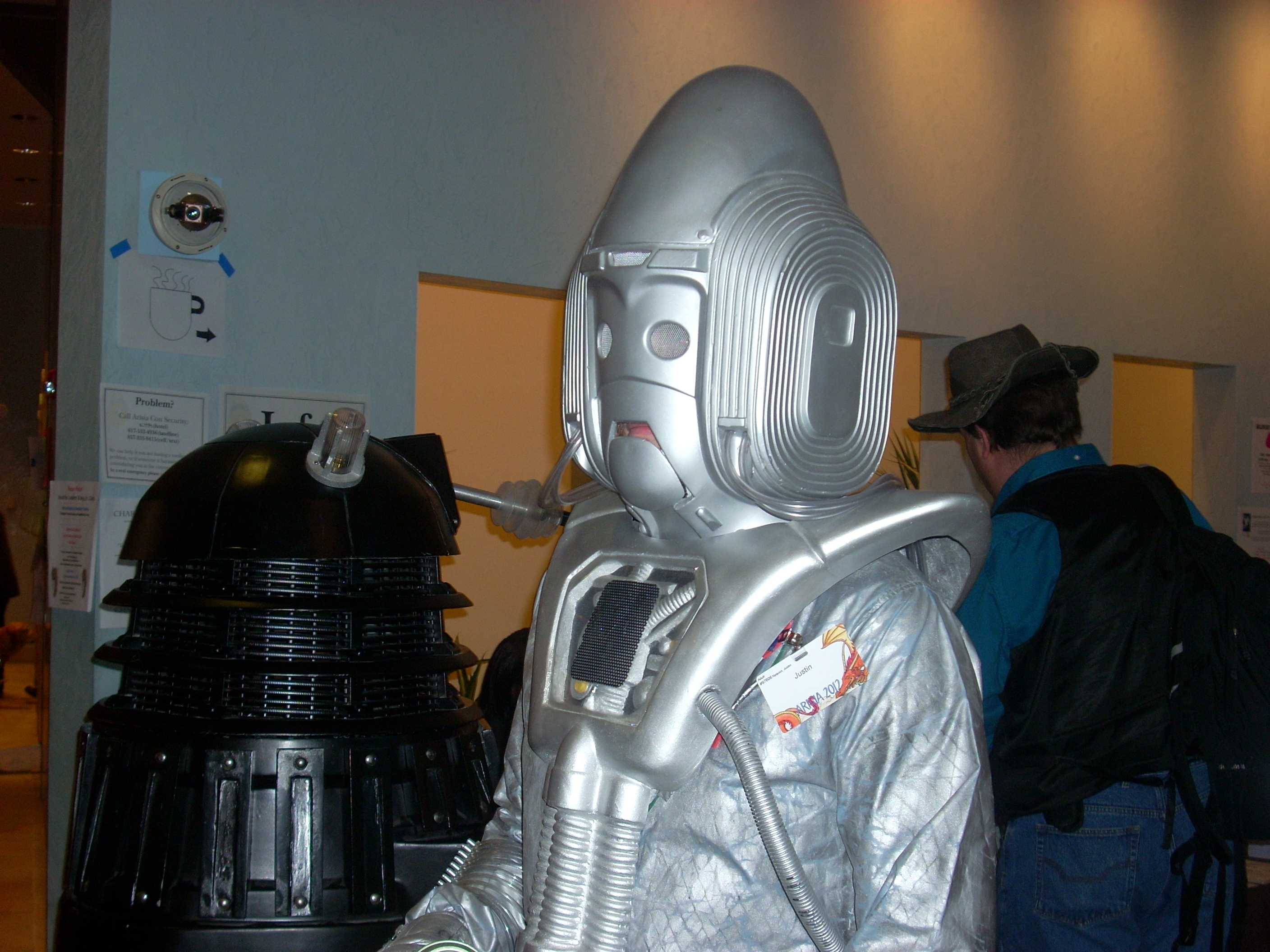
Dr. Who Pics – Arisia 2012

I’m on my way home from Boston today. Here are a few Dr. Who-related photos from Arisia. (I didn’t take photos of the people costumed as The Doctor, because I wouldn’t have been able to stop – there were at least a dozen that I saw, most of them dressed as the Eleventh Doctor, in brown blazer, bow tie, and fez.)
Here’s a Dalek with a Cyberman. The Dalek was in the Masquerade on Saturday night; the Cyberman was fortuitous.

And a closeup.

Here’s a full view of the dalek, wearing the scarf of his chief enemy.

The Dalek resting in pieces.

And another interpretation of a Dalek.

Posted in arisia, conferences, images | Tagged , | 2 Comments

“The Journey,” Grace Fallow Norton

The Journey

I went upon a journey
To countries far away,
From province unto province
To pass my holiday.

And when I came to Serbia,
In a quiet little town
At an inn with a flower-filled garden
With a soldier I sat down.

Now he lies dead at Belgrade.
You heard the cannon roar!
It boomed from Rome to Stockholm,
It pealed to the far west shore.

And when I came to Russia,
A man with flowing hair
Called me his friend and showed me
A flowing river there.

Now he lies dead at Lemberg,
Beside another stream,
In his dark eyes extinguished
The friendship of his dream.

And then I crossed two countries
Whose names on my lips are sealed…
Not yet had they flung their challenge
Nor led upon the field

Sons who lie dead at Liège,
Dead by the Russian lance,
Dead in southern mountains,
Dead through the farms of France.

I stopped in the land of Louvain,
So tranquil, happy, then.
I lived with a good old woman,
With her sons and her grandchildren.

Now they lie dead at Louvain,
Those simple kindly folk.
Some heard, some fled. It must be
Some slept, for they never woke.

I came to France. I was thirsty.
I sat me down to dine.
The host and his young wife served me
With bread and fruit and wine.

Now he lies dead at Cambrai–
He was sent among the first.
In dreams she sees him dying
Of wounds, of heat, of thirst.

At last I passed to Dover
And saw upon the shore
A tall young English captain
And soldiers, many more.

Now they lie dead at Dixmude,
The brave, the strong, the young!
I turn unto my homeland,
All my journey sung!

–Grace Fallow Norton

Posted in wwi poetry | Tagged | Comments Off on “The Journey,” Grace Fallow Norton

I’m at Arisia

I am at Arisia in Boston this weekend; my first panel is this evening, and my last one is Sunday afternoon. My full schedule of panels. I’ll try to post some photos when I get a chance, depending upon the hotel wireless capacity. If you’re there, feel free to say hi! If not, you can still check out the program schedule here.

Also, Love Is in the Details: Patricia Gaffney’s Crooked Hearts is live at Heroes & Heartbreakers, in which I look at the author’s characterization techniques.

Posted in arisia | Comments Off on I’m at Arisia

“War Horse” – WWI Challenge


This review contains spoilers.

I’ve never read the novel War Horse by Michael Morpurgo; all of my comments are based on the Spielberg movie. I imagine the novel is a much different experience, because it allows for narration from the horse’s point of view. In the movie, the horse is not given a voice.

As someone who’s done a lot of reading about World War One, I really enjoyed the visuals of this movie, particularly the trenches and No Man’s Land. Some of it looked so familiar, I suspect I’ve seen some of the research photos that were used. In particular, I liked how accurately the British and German trenches were differentiated. In general, the German trenches were larger, better-constructed, and more comfortable; this is clearly shown in a scene during the Somme offensive when the lead character, Albert, makes it into a German trench before being gassed.

One of the small early tanks made it into the movie. I wish I’d had a better look at the 1918-style grenades that were used in the Somme scenes. I was also pleased that a few colonial soldiers were shown in one scene, and quite a few female nurses in a hospital scene, though only two women had any sort of role in the story (Albert’s mother Rosie and a French girl named Emily).

I noted that when soldiers were executed for desertion, and when horses were shown hauling heavy artillery, the perpetrators in both cases were German, despite the British doing the same thing; ditto the early failed attempts at cavalry charges, which both sides briefly thought would be effective. Since the story was fictional, I assumed this was the British author’s choice. At another section of the movie, the German soldiers steal/commandeer foodstuffs and other useful items from a French family. It’s not stated if this farm was part of the lands they occupied in northern France and Belgium (which were eventually pillaged of pretty much everything) or lands they only held temporarily. In 1914, territory shifted more rapidly. Anyway, I found that scene had a very realistic feel, after reading several books about life in the occupied territory. The forced labor seemed accurate to me, as well.

I thought it was accurate when Albert is shown in a regiment with other men from Devon in 1918; it’s not clear when he joined up, but it might have been in the period when groups from the same town, or the same club, were encouraged to go to war together in the “Pals” regiments (often with tragic results if a single regiment was decimated).

So far as the story goes, I confess I found it a bit melodramatic, full of miraculous coincidences; but then again, the literature surrounding WWI is full of strange and miraculous events, as people attempted to make some kind of sense of the carnage, of why some people survived and others died.

The central conceit of the story, that Joey, a horse from Devon, makes his way through a whole range of danger on both sides of the conflit before again meeting with his beloved partner, Albert, is a sort of wish-fulfillment, at least for Albert; most of the other people who come into possession of Joey end up dead. I suspect those who watch this movie (or read the book) are expected to feel an emotional reward as, despite all the war’s horror, at least one thing is eventually put right. I found that I couldn’t feel that sort of emotion; perhaps coming to the story as an adult was the culprit, or perhaps that I’d read too many real stories of WWI that did not end happily to believe in this one, even for a few moments. I found it interesting that Albert’s father is a veteran of the Boer War, and still suffers from his experiences as well as the wound he suffered; is he meant to be an indicator that war leads only to pain and futility? I am wondering how different the film is from the movie, so far as themes go.

The day after I saw the movie, I began to think about its theme. Albert, as protagonist, doesn’t actually do much beyond train Joey and plow a field (important as that act was to his family). True, he’s shown in the Somme offensive rescuing a comrade and tossing a grenade into a machine-gun nest, but those actions felt to me like required acts of heroism, a bit rote, despite the actor’s excellent portrayal of Albert’s terror and desperation. Albert goes to France in search of Joey; but he would have eventually been drafted and sent anyway. Albert is reunited with Joey; but the actions of others enable him to actually take the horse home with him. Perhaps all that was meant to be the point; it isn’t the acts of individuals, but the collective good that is important. Individuals die (all over the place, in this movie!) but love survives. Albert isn’t rewarded with his horse because of his acts on the battlefield, but because he and Joey have a bond of love.

Overall, I enjoyed the film and was glad I saw it.

Postscript: what the hell was up with the orange filtering on the final scene? I got that it was meant to be the light of sunset, but…it was more like somebody had applied a bad fake tan to the screen.

The WWI Challenge.

Earlier this week, The Criminal Element posted my preview of Gone West by Carola Dunn, newest in a mystery series in the aftermath of World War One – this particular one is set in 1926.

Posted in movies, wwi | Tagged , | 2 Comments

A World War One Reading Challenge

For the first time ever, I’ve decided to participate in a reading challenge. War Through the Generations is hosting a 2012 challenge to read “fiction, nonfiction, graphic novels, etc. with WWI as the primary or secondary theme.

Books can take place before, during, or after the war, so long as the conflicts that led to the war or the war itself are important to the story.”

Challenge information and sign-up are here.

I signed up at the “wade” level, 4-10 books. Since I’m not very far into it, I’m going to count Sites of Memory, Sites of Mourning: The Great War in European Cultural History by Jay Winter as my first book, even though I began reading it at the end of 2011.

Because I set a novel (The Moonlight Mistress) during World War One, and have an upcoming Spice Brief also set in that period, my collection of research books is rather…large. Truthfully, I buy far more books than I actually need. I don’t always read the books from cover to cover, particularly during the process of writing, when I’m more likely to dip in, find what I need, and move on. So I have a wide selection to choose from for this challenge. The difficulty will be choosing which books to read and review.

Here are a few books that are at the top of my To Be Read list:

Good-Bye to All That: An Autobiography by Robert Graves
A Diary Without Dates by Enid Bagnold
1915: The Death of Innocence by Lyn Macdonald

Posted in reading, wwi | Tagged , | Comments Off on A World War One Reading Challenge

“Headquarters,” Gilbert Frankau

Headquarters

A league and a league from the trenches–from the traversed maze of the lines,
Where daylong the sniper watches and daylong the bullet whines,
And the cratered earth is in travail with mines and with countermines–

Here, where haply some woman dreamed (are those her roses that bloom
In the garden beyond the windows of my littered
working room?) We have decked the map for our masters as a bride is decked for the groom.

Fair, on each lettered numbered square–crossroad and mound and wire,
Loophole, redoubt, and emplacement–lie the targets their mouths desire;
Gay with purples and browns and blues, have we traced them their arcs of fire.

And ever the type-keys chatter; and ever our keen wires bring Word from the watchers a-crouch below, word from the watchers a-wing:
And ever we hear the distant growl of our hid guns thundering.

Hear it hardly, and turn again to our maps, where the trench lines crawl,
Red on the gray and each with a sign for the ranging, shrapnel’s fall–
Snakes that our masters shall scotch at dawn, as is written here on the wall.

For the weeks of our waiting draw to a close…. There is scarcely a leaf astir
In the garden beyond my windows, where the twilight shadows blur
The blaze of some woman’s roses….
“Bombardment orders, sir.”

–Gilbert Frankau

Posted in frankau, wwi poetry | Tagged | Comments Off on “Headquarters,” Gilbert Frankau

My Arisia 2012 Schedule

Arisia 2012 is taking place January 13-16, 2012, at the Westin Boston Waterfront hotel. Here’s where you can find me during the convention:

Schools for Magicians
Douglas, Friday 5:30 PM
Cecilia Tan (mod.), Mary Catelli, Frances K. Selkirk, Victoria Janssen, Ken Schneyer
A Hogwarts degree isn’t the only path from mundanity to magehood. Let’s consider how writers have portrayed schools, including Roke, Unseen University, Brakebills, and more. Why a school setting? Is it due to the innate familiarity for both reader and writer? Having a built-in rationale for info-dumps? How do these fantastical academies compare to SF’s schools for space cadets. As we look outside of Harry Potter, we’ll examine the continuing fascination with such sorcerous scholastic settings.

Paneling 101: A Primer
Revere, Friday 8:30 PM
Jonathan Woodward (mod), Ann Crimmins, Christopher Davis, Victoria Janssen, Hugh Casey
A panel on doing panels, for noobs and the plain unaware. Etiquette, preparing, benefits, the role of the moderator, how to moderate, how to handle a rogue panelist, how to handle a rogue audience member.

Anne McCaffrey Memoral Panel
Griffin, Saturday 5:30 PM
Victoria Janssen (mod), Dennis McCunney, Twisting Star, Mary Catelli
The late Anne McCaffrey was a highly popular writer of SF and romance. A generation of fans discovered SF through Anne’s work. She is best known for the Dragonriders of Pern series. She was a Grandmaster of the Science Fiction and Fantasy Writers of America, a winner of the Hugo, Nebula, and British Fantasy awards, and her Pern novel The White Dragon became the first SF book to appear on the New York Times bestseller list.

Point of View
Douglas, Sunday 1:00 PM
Elaine Isaak (mod), Michael A Ventrella, David Sklar, Victoria Janssen, Joshua Palmatier
The use of different points of view can reveal or obscure elements of your story from the audience. Do certain points of view only work with certain types of stories? What are the strengths and weaknesses of each form?

Posted in arisia, conferences, writing | 1 Comment

A Collation of Guest Posts

I had a number of guest posts go live at Heroes and Heartbreakers and at The Criminal Element over the holiday season. I’ve collected the links in case you want to check them out!

Golden Age Sidekicks: The Heirs of John Watson.

Fresh Meat: R.A. MacAvoy’s Death and Resurrection.

“I Behaved Abominably”: Mary Balogh’s Christmas Beau.

Fresh Meat: Marissa Meyer’s Cinder.

Marjorie Liu’s Dirk and Steele, or Why I’m a Dirk and Steele Fangirl.

Fresh Meat: Val McDermid’s The Retribution, newest in a series.

Fresh Meat: Carla Kelly’s Enduring Light. This is the second of her historicals about a Mormon family.

Posted in links | Comments Off on A Collation of Guest Posts