Edmund Blunden, "After the Bombing"

After The Bombing

My hesitant design it was, in a time when no man feared,
To make a poem on the last poor flower to have grown on the patch of land
Where since a gray enormous stack of shops and offices reared
Its bulk as though to eternity there to stand.

Moreover I dreamed of a lyrical verse to welcome another flower,
The first to blow on that hidden sites when the concrete block should cease
Gorging the space; it could not be mine to foretell the means, the hour.
But nature whispered something of a longer lease.

We look from the street now over a breezy wilderness of bloom,
Now crowding its colours between the sills and cellars,
hosts of flames
And foam, pearl-pink and thunder-red, befriending the makeshift tomb
Of a most ingenious but impermanent claim.

–Edmund Blunden

Posted in blunden, wwi poetry | Tagged | Comments Off on Edmund Blunden, "After the Bombing"

Research – When to Stop

I actually stole this topic from a discussion I read…somewhere, a while back. The question was, “when do you stop researching?” I have two answers.
My first answer is never. You never stop researching because everything you read or look at might eventually find its way into your fiction. If you stop researching, I think your stories can grow stagnant.

My second answer is to stop when you have what you need for the story. It’s very tempting to read every book you can find, watch every documentary series in its entirety, read a whole decade’s worth of newspapers on microfiche. And you can do that, if you have infinite time available to you, or are a really, really fast reader. But for most writers’ purposes, all that isn’t necessary; research should be secondary to story, or else no one will want to read your novel. Though they might use it as a research source….

I think there’s a difference between research for its own sake and research for the sake of fiction.

There are two facets to knowing when you’ve done enough. One is that there are things the writer needs to know that the reader doesn’t need to see. I think of a lot of that as preliminary research: reading general books on the time period, making notes of possible items of interest.
After that, specificity is key. (Yeah, I know, I say that a lot.) When I’m writing about World War One, it helps me to know the political background of the countries in which the story is set, but the reader is more concerned with the lives of my original characters, and the details that are related to them. I think of it as a matter of focus.

Research what you’re going to use, as much as you can; I skim through books, marking necessary details with post-it notes, or cut and paste from websites into a single document. I try not to research small items until I know for sure I’m going to include them in the story; instead, I keep a list of details I need to check, so I can search for all of them at once, perhaps on a day when I’m not writing.

I have to admit, I am constantly reining myself in. I buy research books related to a current project that I know for a fact I have no time to read until the novel is finished. I don’t recommend it. Unless your apartment is bigger than mine.

Related posts:

Historical Detail in Fiction.

Reading for the Writer.

Synergy in Writing and Research.

The Research Book Dilemma.

Posted in historical fiction, research, writing craft | Comments Off on Research – When to Stop

Steampunk Worldbuilding Questions

I’m in the early stages of creating a world in which a steampunk Western can take place. Here are some of the questions I’m asking myself. Some of them I answered promptly; some of them I’m still pondering.

1. Alternate history or alternate world fantasy? How close will my world be to the “real” world? Is geography the same as in the real world?

2. Overall mood: is it utopic, dystopic, or somewhere in between? How is the world organized politically?

3. Technology, magic, technology that might as well be magic, or some other variant?

4. How are women and people of color positioned? What plot opportunities does that create?

5. What are the boundaries of technology? What can be done? What can’t be done, and why? What plot opportunities does that create?

Posted in sf/f, steampunk, western, writing process | 5 Comments

My New Steampunk Project

It’s been an eventful couple of weeks for me.

For the last few months I’ve been working on a sequel to my World War One werewolf novel, but my next published novel for Spice will be a different project instead: a steampunk Western. The tentative release date is spring/summer 2012.

I don’t have a title yet, but I do have characters! The men include a Native American scientist who’s also a bit of a diplomat/spy; a down-on-his-luck younger son of a British aristocrat, who was thrown out of Cambridge for his scientific experiments; and a charming gambler/con man who happens to be an extraordinary mechanic. The women are an airship pilot who bears a bit of resemblance to Han Solo in personality, and an east coast bluestocking engineer who’s fleeing marriage.

I’ve already begun collecting research materials. This won’t be a historical; rather, it’s an alternate universe with a few ties to “real” history and a whole variety of extrapolations. I’m really excited to work out the details!

Posted in business of writing, steampunk, writing process | 31 Comments

WWI Wheels

French soldiers with a bicycle.

A bicycle ambulance.

Belgian soldiers on motorcycles.

Posted in images, research, wwi | Comments Off on WWI Wheels

Novelists, Inc. Guest Post


I’m a guest poster today at the Novelists, Inc. Blog on “I Like Being Reviewed. Really.”

Please drop by and check it out!

Posted in guest | Comments Off on Novelists, Inc. Guest Post

Wilfrid Wilson Gibson, "Hill-born"


Hill-born

I sometimes wonder if it’s really true
I ever knew
Another life
Than this unending strife
With unseen enemies in lowland mud;
And wonder if my blood
Thrilled ever to the tune
Of clean winds blowing through an April noon
Mile after sunny mile
On the green ridges of the Windy Gile.

–Wilfrid Wilson Gibson

Posted in gibson, wwi poetry | Tagged | Comments Off on Wilfrid Wilson Gibson, "Hill-born"

Charles Sorley, "Such, Such Is Death"

Such, Such Is Death

Such, such is Death: no triumph: no defeat:
Only an empty pail, a slate rubbed clean,
A merciful putting away of what has been.

And this we know: Death is not Life, effete,
Life crushed, the broken pail. We who have seen
So marvellous things know well the end not yet.

Victor and vanquished are a-one in death:
Coward and brave: friend, foe. Ghosts do not say,
“Come, what was your record when you drew breath?”
But a big blot has hid each yesterday
So poor, so manifestly incomplete.
And your bright Promise, withered long and sped,
Is touched, stirs, rises, opens and grows sweet
And blossoms and is you, when you are dead.

–Charles Sorley

Posted in sorley, wwi poetry | Comments Off on Charles Sorley, "Such, Such Is Death"

Music Linkgasm

And now for something completely different!

I thought I’d share a few of my favorite MP3 music blogs. It was hard, but I limited myself to five.

1. The Hype Machine is a blog aggregator – it’s a great place to find links to a huge range of music blogs.

2. Motel de Moka has long been one of my favorite music blogs. Posts are organized into playlists, usually by mood or theme. The bloggers choose from a huge range of genres, including rhythm and blues, jazz, pop, ambient, indie, world music, and classical. I love that you’re never sure what you’re going to get in the next post.

3. The Hood Internet is a lot of fun. It’s a blog of mashups, and sometimes of mixes. Amusing mashup photos of the two artists illustrate the posts.

4. I like Said the Gramophone for the stream-of-consciousness narratives that accompany the downloads.

5. Cover Lay Down is one of my favorite blogs ever. It features folk musicians covering, usually, pop or rock songs. I love hearing different interpretations of songs, and since the blogger often groups covers by original artist, it can be a really interesting experience to listen to all the different ways one artist’s songs can sound. (Sometimes, the covers are all performed by a single artist, which is also fun.) I find a lot of interesting new-to-me folk artists here.

Let me know if you enjoyed these links, and I can do another post later on.

Posted in links, music | 4 Comments

Writing for Women, Writing for Men

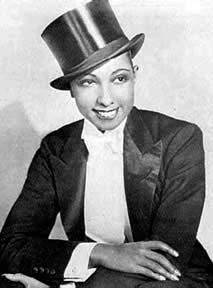
I read about a workshop at the RWA Conference whose topic, I think, was writing for women versus writing for men. I didn’t attend, so the actual title didn’t stick in my mind. However, it sparked thoughts, and I of course had to pour those thoughts into a blog post. With a hot picture of Josephine Baker wearing a top hat.

I write for women. At least I think I do. The line that publishes my novels, Harlequin Spice, is aimed at a female audience, so by default that says I write for women, right? I’m not sure what that means, exactly, beyond “books most women will like,” which to me also suggests “books some men will also like.”

I’ve had reports from a few men who’ve read either The Duchess, Her Maid, The Groom and Their Lover or The Moonlight Mistress or both. Most have been boyfriends or husbands of female friends who’d bought the book. All of the men whom I’ve heard from, about five, so it’s not a large sample, have liked the books; most commented not only on the stories, but on the erotica. They commented very favorably on the erotica; more so than some female readers who told me they were uncomfortable with the language I used.

I didn’t really expect to hear anything from male readers, especially not that they’d liked the sex scenes. Possible factors include 1) these particular men like reading erotica in general, and are willing to talk about it; 2) my direct language in the sex scenes appeals to men; and 3) they were just being nice.

I don’t really have any conclusions. Though I do wonder how I might market my books more effectively across genders.

Thoughts? Comments?

Posted in business of writing, erotica, writing, writing craft | 4 Comments