Steampunk Bronze

I recently attended Arisia, a Boston-area science fiction/fantasy/a lof of other things conference. I got permission from Butch Honeck, one of my favorite sculptors in bronze, to post some photos from his dealer room at the convention.

Here’s a steampunk-style pistol he built (bonus sepia for bonus steampunk-ness!). You can’t tell from the photo, but it has moving parts – gears and a chain – that make warm whirring sounds. He let me play with it without making me buy it. He had several pistols with different features.

Here he is checking out one of his larger sculptures, also with moving parts. Note the magnifying lenses attached to his glasses. He sells those for steampunk afficionadoes, but apparently they’re quite functional.

Pretty dragons. I’ve enjoyed looking at his work for years, and own three bronze turtles from his line of miniature animals as well as a pair of earrings.

A wider view of one of his display tables at Arisia. The woman in costume is examining pocket watches, some of them of the “real” hand-wound type.

Learn more here.

Posted in arisia, conferences, images, steampunk | Comments Off on Steampunk Bronze

Grasping Tentacles of DOOOOOM

There’s a stage in writing when I’m too busy writing, and thinking about the specifics of the novel, to think about the task of writing itself.

Of course I am thinking about writing. I have to be, because I’m doing it. By the time I reach the point I’m describing, I’m writing intuitively, and I feel like I’m using so many skills at once that I can’t describe what I’m doing except with bizarre hand-waving gestures and metaphors that don’t make sense to anyone but me. *wiggles finger while waving left hand and looking expectant*

So, I have about ten days left to finish the manuscript of The Duke and The Pirate Queen. The draft is essentially complete, but I’m still doing a lot of things at once. I’m adding new material and editing old material to accomodate new ideas and doing some last-minute research and line editing and worrying. (I always worry, even if there’s nothing in particular to worry about.) I’m also not-doing: not reading as much, not paying attention to my surroundings, not seeing my friends with my usual frequency.

When I get to this point in a novel, I may know what I’m doing, but I still grasp for help with every limb, and will occasionally, at weak moments, return to favorite books on writing in the hope of…I’m not sure. It’s too late in the process for most of the advice to be useful. It might be reassurance I’m seeking; the knowledge that there are other writers in the world, and they had deadlines, and they figured out their manuscript issues in the end.

That, or it’s like gorging on carbohydrates – the more you eat, the more you want.

Today, I think I’ve moved beyond the grasping stage. I have a complete draft. It’s by no means perfect, but I can see the whole shape, and thus it’s a lot easier to see what else I need to add. I’ve printed out a copy, because sometimes I can see – or maybe I really mean think about – the novel better when I can look at it in a different way than before.

Besides all that, having a complete draft is a great balm to the spirit.

Posted in writing, writing craft, writing process | 10 Comments

Purposeful, Habitual, and Gratuitous

“As early as 1959 or ’60, I’d noticed that there was something terribly wrong with the female characters in most novels I was reading. Most of the writers (men and women) tended to conceive of their male characters as combinations of purposeful actions, habitual actions, and gratuitous actions. A female character, in contrast, would be all gratuitous action if it was a “good woman,” with no purposes and no habits; if it was a “bad woman,” she would be all purpose, with no gratuitous actions and no habits. This seemed silly. Very early on I tried to think about women characters in terms of all three — actions purposeful, habitual, and gratuitous.”

–Samuel Delany, interviewed in Alive and Writing: Interviews with American Authors of the 1980s,by Larry McCaffery and Sinda Gregory, University of Illinois Press, 1987, pp. 99-100.

Posted in quotes, writing craft | Comments Off on Purposeful, Habitual, and Gratuitous

Fun with Plot Generators

Recently, I went on an internet search for plot generators. Here are some of the most intriguing scenarios that popped up for me.

These came from Archetype Writing.
“The story starts when your protagonist opens the closet to find clothes that aren’t his/hers. Another character is an alchemist who believes your protagonist owes him/her money.”

“The story starts when your protagonist tries to overcome a personal fear. Another character is a bus driver who is your protagonist’s favorite musician.”

“The story starts when your protagonist breaks up with a romantic partner. Another character is a thief who is researching something terrible.”

And my favorite: “The story starts when your protagonist comes out of the closet. Another character is a school teacher who is psychic.”

Seventh Sanctum offers a tongue-in-cheek generator specifically for romance.

“In this story, a healer who is burdened with dark knowledge accidentally runs into a healthy druid. What starts as a professional relationship soon turns into infatuation.”

“This story takes place in a planetary imperium in a solar-system-spanning syndicate. In it, a clinging media personality runs into a xenobiologist who is a crossbreed of two species. What starts as hate soon turns into love – all thanks to someone pretending to be someone else.”

My favorite is “In this story, a just watchman falls madly in love with a grim cartographer.”

I love the Plot Twist Generator in particular.
“At this point a paranoid aviator arrives, bleeding from multiple stab wounds.”

“Just then a penniless female impersonater arrives and shoots your protagonist’s mother.”

“The scene changes, and a domineering vampire arrives, carrying a backpack.”

And the best one, “Only penguins can save this story.”

Posted in writing | 7 Comments

Louise Glück, "Parable of Flight"

Parable of Flight

A flock of birds leaving the side of the mountain.
Black against the spring evening, bronze in early summer,
rising over blank lake water.

Why is the young man disturbed suddenly,
his attention slipping from his companion?
His heart is no longer wholly divided; he’s trying to think
how to say this compassionately.

Now we hear the voices of others, moving through the library
toward the veranda, the summer porch; we see them
taking their usual places on the various hammocks and chairs,
the white wood chairs of the old house, rearranging
the striped cushions.

Does it matter where the birds go? Does it even matter
what species they are?
They leave here, that’s the point,
first their bodies, then their sad cries.
And from that moment, cease to exist for us.

You must learn to think of our passion that way.
Each kiss was real, then
each kiss left the face of the earth.

– Louise Glück, Meadowlands

Posted in gluck, poetry | Comments Off on Louise Glück, "Parable of Flight"

The Duchess, Her Maid, The Groom and Their Lover Excerpt – Animals

#

Perhaps an hour later, Camille heard hooves approaching, a horse at a gallop. She ran to the doorway, bridle in one hand and cleaning cloth in the other, determined to see. From a distance it was clear there was no danger; Henri rode Rhubarb, bareback, jumping him over a small bush here and some plant clippings there, letting the stallion burn off some of his energy. Camille found herself smiling. His seat was not just secure, but a thing of beauty.
He saw her from across the paddock and cantered up to the barn door, grinning hugely. He had no idea, Camille knew, how lovely his smile was; he had no trace of vanity. After knowing so many preening courtiers, she felt this was one of his most attractive traits.

“Your Grace,” he said. “He’s glorious! Would you like to ride him? He’s well-mannered.” He flushed. “Oh. He’s really yours, you can ride him whenever you wish.”

Camille hung the bridle and cloth on a hook, and picked up the man’s hat Sylvie had given her as a disguise. With that and her loose jacket, from a distance she ought to be safe from curious eyes. She now knew she’d hear another horse’s approach, and any guards would come in a group. After quickly covering her hair and pulling on her gloves, she walked into the yard. The mares and gelding were far across the pasture, too far to go to just now. She would visit with them later. Now, she would ride. Her heart beat faster with excitement. “Give me a hand up.”
Henri gingerly held out one hand and extended his foot, to give her a step. He blushed furiously. Camille hoisted her habit’s skirt in one hand and in a few moments was astride a horse, for the first time in four years.

She gloried in the minute shifts of muscle beneath her, in the hum of living power along the stallion’s skin. The aroma of horse rose up around her. Laughing aloud, she clasped her arms firmly around Henri’s slender waist. She could feel his muscles shifting, too. His smell reminded her of mulled wine. “Glorious!” she agreed.

#

c. Victoria Janssen, 2009

Buy The Duchess, Her Maid, The Groom & Their Lover from Amazon.com.

More excerpts.

More Snippet Saturday:
McKenna Jeffries
Taige Crenshaw
Ashley Ladd
Shelley Munro
Mari Carr
Jody Wallace
Shelli Stevens

Posted in free read, promo, the duchess | 2 Comments

Arisia 2010

I’m at Arisia this weekend. Here’s my schedule:

Saturday, 11:30 am, Paul Revere B
Broad Universe Reading
90 minutes

Saturday, 2:00 pm, Crispus Attucks
“Jack the Ripper and the Historical Character”
Katherine Crighton (mod.), Victoria Janssen, Gardner Dozois, Susan Casper, Sarah Clemens

Saturday, 10:00 pm, Paul Revere B
“The History of Fandom
Victoria Janssen (mod.), Don Sakers, Marlin May, A. Joseph Ross, Paula Lieberman

Sunday, 11:00 am, Paul Revere B
“My Fandom’s Not Dead Yet!”
Melissa Honig (mod.), Victoria Janssen, Daniel Miller, Cindy Shettle, James Zavaglia

Sunday, 7:00 pm, Crispus Attucks
“The Timeless Story”
Eric Van (mod.), Victoria Janssen, Peter Maranci, Karl Heinemann, Terry Franklin

About Arisia.

Posted in conferences | Comments Off on Arisia 2010

For Further Reading

This is a Post of Pimping. I really enjoy these blogs, to the point that I’m excited when there’s a new post, and think some of you might like them, too.

Racy Romance Reviews. Great thoughtful reviews, and some wonderful discussions of romance novels from an ethics point of view.

Promantica. “After nearly a half-century of reading romances, I thought I’d write about them.” And she does it really, really well.

Isn’t It Romance. I enjoy reading her opinions on books, and her reading often overlaps with mine.

The Misadventures of Super Librarian. Source of many useful recommendations for category romances.

Two Nerdy History Girls – authors Loretta Chase and Susan Holloway Scott. “We talk about who’s wearing what and who’s sleeping with whom. We try to sort out rumor or myth from fact. We thought there must be at least three other people out there who think history’s fascinating and fun, too. This blog is for them.”

Posted in links, romance novels | Comments Off on For Further Reading

Werewolves in WWI? Why Not?

This post was written for Harlequin’s Paranormal Romance Blog.

For The Moonlight Mistress, I combined a historical novel with paranormal elements. As you probably know already if you read this blog regularly, the book is set during the early days of World War One, and begins with a romance between Lucilla, an English chemist and nurse, and Pascal, a French scientist. They’re trapped in Germany when war is declared and must escape together.

I could have gone from there to write a straightforward wartime adventure novel, but instead I established that Pascal is only in Germany because he’s investigating rumors of a werewolf held captive by an amoral scientist. Soon, two werewolf characters are introduced, one a soldier and the other a spy, and their role in the war and their relationship is woven into the novel’s main plot.

I love historical romance, but I love historical science fiction and fantasy even more, particularly when there are romantic elements. To me, mixing genres is a way to avoid the same-old, same-old of historical romance.

For example, the plot of a historical romance might be: hero and heroine meet, family/money/status/scandalous past/amnesia keep them apart, then they must resolve their issues to be brought together romantically. For me, those plot complications and their resolutions become more compelling if the family issue is that a werewolf needs to marry another werewolf or she can’t have werewolf children, or if the scandalous past results from the heroine not being human and not having human standards of behavior. Not knowing what to expect makes the journey more fun.

I’ve been asked, more than once, why World War One? Why werewolves?

I’m fascinated by World War One and the period immediately before and after. It might be because I grew up reading Dorothy Sayers’ Peter Wimsey mysteries, or might be because my school history classes rarely spent much time on those decades, and that made me more curious rather than less. Regardless, I have several shelves of reference books on the period and love to read about it even when I’m not writing it. Also, I rarely find fiction, especially romance, set during World War One. If I want some, I have to write it myself. So I did!

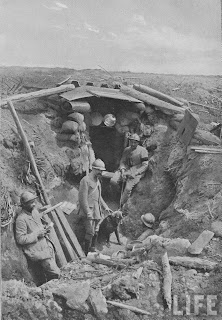
For me, World War One is a period when large parts of the world underwent a major change. One of the themes of that change, in my opinion, is technology and the way humans relate to it. In that war, technology was used for violence: massive artillery, airplanes, tanks, poison gas. Humans used technology to kill each other in mass numbers.

I chose werewolves as my paranormal element because werewolves are often used, thematically, to symbolize or represent nature and the vital life force of wild creatures. Wolves are hunters, killing to eat; humans at war are killing for reasons distant from immediate survival. For that reason, I felt werewolves were a good contrast to the technology theme.
In particular, my werewolves are rare and growing more so. What happens when nature suffers at the hands of technology? What happens when a scientist tries to bend nature to his will, in order to gain power over other people? How do the goals of the humans and the werewolves come into conflict? I enjoyed these questions so much that I would like to write another novel with the same themes one day.

Also? Werewolves are sexy. There’s something about all that animal energy that makes them appealing – think Wolverine in the X-Men comics – he’s not a werewolf, but he has a similar appeal. I wanted my characters to have some of that energy, and at the same time to be more like people to whom I’d be drawn in real life.

One of the things I love most about real-world wolves is that they are playful. They play with each other, and they will even play with other species, such as crows. I included that element by having my male werewolf be a bit of a joker. The female werewolf is much more serious because of her past experiences, but that aspect of play is one of the things that most attracts her to her future partner. I incorporated verbal banter into most of their dialogue and of course into their sex scene, which takes place in human form. For them, being able to talk to each other is an added level of intimacy. When one of them is in human form and the other in wolf form, play is still an element of their relationship; one teases the other.

As a way of making the werewolf characters less like ordinary humans, I used their senses of smell. Scent affects their perceptions and feelings, including their relationship with each other. When they meet, they can immediately tell that they are both werewolves, and that affects the ways in which they interact. They’re human, but they’re also something more.

Finally, werewolves are an important element of the genre-mixing I mentioned back at the beginning of this post. They’re the unexpected element. A novel about World War One has lots of available conflict for the characters. Any reader can predict what might happen to a group of characters who go off to war. So why not add werewolves, and see what happens?

Posted in historical fiction, moonlight mistress, werewolves, writing, writing craft | Comments Off on Werewolves in WWI? Why Not?

Tell Not Show

One of the main pieces of writing advice I’ve received over the years is “show not tell.”

It’s good advice. It can remind you that it’s easier for a reader to form mental pictures of characters whom they’ve seen in action. Action scenes are usually more compelling to read than long explanations. If a reader’s interpreting actions, they’re usually more involved in the story than when they’re simply being told what’s what. Unless the writer’s voice (or the narrator’s) is really compelling, showing is almost always better than telling.

But sometimes, you just have to tell.

This issue came up for me in the manuscript of The Duke and the Pirate Queen. There’s a whole suspense subplot featuring two secondary characters, but its purpose isn’t really to be gripping suspense. The subplot’s purpose is to solve a mystery while the hero and heroine go off together and cement their relationship. (It’s an erotic novel, so their relationship is the primary focus of the story.) I decided that the suspense subplot did not have to be entirely shown. I could tell.

I didn’t entirely tell that subplot. I decided to show a certain amount: the investigator Sylvie’s arrival at the king’s court, some of her discussions with a confederate, her questioning of a stranger who had useful information (and, conveniently, provided a partner for an additional erotic scene). But the novel is not about Sylvie, and her activities for the most part don’t directly affect the novel’s protagonists. To show every step of her investigation might be fun and interesting, but isn’t strictly necessary.

When I create an original plot outline or synopsis, I don’t always know what needs to be shown and what told. I have a general idea, but some of those decisions depend on how the plot falls out while I’m writing. Therefore, I can’t always decide until near the end of the draft. In this case, I decided that the outcome of Sylvie’s plot was more important than the progress of it. So I took some shortcuts. I told some of what had happened offscreen (information received in a letter, for example) and then showed the results with a little action and a lot of dialogue.

There’s no one right answer for when to show and when to tell. There’s only the best answer you can come up with at the time, for the particular novel.

Every reader will have a different opinion on whether you were right or wrong.

Related Post:
How to Write a Novel (in 72 easy steps)!.

Posted in erotica, the duke, writing craft | 2 Comments