5 Useful Lessons from Indie-Publishing

My adventure with indie-publishing Finding Refuge with the Kalikoi collective got me writing again, and has been fun. Plus I have actually learned some things about preparing, publishing, and *cue music*…myself.

1. Writing is a thousand times less stressful when I am writing primarily to please myself. You’d think I would’ve learned this lesson long ago, and I sort of did, but print publishing messed with my head.

2. I cannot comprehend the complexities of Photoshop or even its simpler relatives. In fact, even a basic tutorial makes me want to weep. It was definitely worth it to me to pay for a nice cover, made easier by me having a day job. Augusta Scarlett did mine. If you have the talent to do your own, she has a post linking 35 Great Sites With Awesome Stock Photos for Your Book Cover.

3. Aside from reviews of the actual novella, getting feedback related to the writing-adjacent process can be very useful along the way. It was an immense help to have other writers help me with my blurb, in particular, but also to help me choose a cover model and to discuss wordcount concerns.

4. “Writing-adjacent” is a term I made up for myself. It covers everything that is not writing or editing the story. Emailing a cover artist, reading new-to-me blogs to see if I want to submit them a review copy, struggling with a blurb, asking if someone can proofread a manuscript for me are all writing-adjacent tasks. They are work, and I started keeping track of the days I performed writing-adjacent work, because it helped show me I was making progress.

5. Organization is key. Each platform that will sell your book (Kindle, Google Play, etc.) wants different variations on the same information (summary, blurb, categories, keywords). I am now keeping a document for each novella and projected novella that includes all of this information in the same place. It’s the gift that keeps on giving!

Posted in business of writing | Tagged , | 2 Comments

#TBRChallenge – Competition: The Galaxy Game by Karen Lord

The Galaxy Game by Karen Lord is a complex, far-future space opera that includes the sport of Wallrunning. The skills and implications of Wallrunning, it turns out, influence events on an interstellar scale.

I was very pleased to re-encounter characters from Lord’s earlier novel The Best of All Possible Worlds (described at the end of this post), though The Galaxy Game focuses on other protagonists. A prologue helped orient me to the spacefaring civilization featured in these novels, and a little of how things had changed on these worlds in the interim. There’s a lot going on: pilots who bond with living spaceships, people with psychic powers, dealing with the fallout from the fairly recent destruction of the planet Sadira and its refugees.

Wallrunning is a strategy game involving, as you might guess, a wall with different zones, each with different microgravities. The wall can tilt and shear as well; complex team strategy involving such roles as ladders, hookers, slingers, snakes, an anchor, and a nexus, can help or hinder other players, cause wall tilting, or send players flying off the wall into a bodycatcher at the bottom. The game conveys status on star players and influences a major portion of several economies, whether directly or indirectly.

Though there are several point of view characters, the major focus is on Rafidelarua, a teenager who is oblivious to the larger implications of almost every situation he encounters. This means that reading the story includes piecing together disparate clues from an array of angles. Rafi moves among several different cultures and economies, and I learned about them along with him. Things Rafi encounters in passing, like the mindship he travels in, and the reason behind his quarantine prior to interstellar travel, gradually loom larger in the narrative and suddenly merge into the overarching plot. Rafi’s training as a wallrunner, then a nexus, seems almost like an aside for a while, until its significance bursts out in an extremely satisfying way.

I loved Lord’s approach to thoughtful, intersectional speculative fiction. I wrote about The Best of All Possible Worlds for Heroes and Heartbreakers back in February 2013; I described it as having the feel of one of Ursula K. LeGuin’s Hainish novels. It’s about a society of humans spread across a number of different planets, each with their own unique cultures and levels of paranormal ability. The core of the story is the relationship between Grace Delarua, a government liaison to refugees from the destroyed planet Sadira, and Dllenahkh, the chief representative for that group. Dllenahkh has very strong psychic abilities, and Grace is beginning to discover her own talents in this area.

For the entire story, Grace and Dllenahkh have an unusually harmonious working relationship and consider each other friends, but at the same time, both are restraining much more romantic and physical desires. Their interaction is complicated by the fact that most of the surviving Sadiri are male, and thus are seeking wives on Grace’s planet. Naturally, the romance eventually emerges, amid complications arising from their differing cultures. If you like sweet friends-to-lovers romances, or slow burn, this is a wonderful and rewarding example.

However, the thing I most appreciated about The Best of All Possible Worlds was the outside relationships both characters formed and maintained throughout the story. Neither character is an island. During the course of the novel, they build and maintain strong connections that are richly realistic. In particular, I loved that Grace had so many female friends, for instance her BFF Gilda, a famous scientist she meets in the course of her work, and her superior officer, Dr. Daniyel, who offers the perspective of an older generation to Grace.

You don’t need to read these two books in order, as they’re not immediate sequels, but doing so offers some additional depth to the stories.

Posted in reading, sf/f, space opera | Tagged | 1 Comment

My October Reading Log

Fiction:
Scandal in Babylon by Barbara Hambly is a reworking of her fantasy novel Bride of the Rat God as a straightforward historical mystery set in 1920s Hollywood. I was always sorry there weren’t sequels to Bride of the Rat God, so this made me very happy, and I hope it turns into another series. British scholar Emma Blackstone was widowed by World War One and lost her parents and brother to the 1918 influenza pandemic; she now works as a secretary for her sister-in-law, lovable and extravagant silent film star Kitty Flint/Camille de la Rose, as well as caring for Kitty’s three Pekinese. Emma has a budding romance with calm and competent cameraman Zal Rokatansky, who’s clearly head over heels for her but patient with a slow paced relationship. The mystery revolves around a murder that seems a clear attempt at framing Kitty; so clear, in fact, that it’s suspicious. I enjoyed the mystery but was really in it for the delicious specific details of making silent films, from “motion picture yellow” foundation makeup to editing of title cards to vivid cameo appearances by Gloria Swanson. Like in Hambly’s Benjamin January series, the ensemble cast is catnip to me as well.

I read a galley of The Misfit Soldier by Michael Mammay because I really enjoyed Planetside, his debut military sf/mystery. The new book, out in February 2022, is essentially a military sf heist novel, except the heist is organized to rescue an abandoned soldier from the war zone, and also to accomplish [a spoiler]. The first-person narrator, an unenthusiastic soldier who joined the military to hide from gangsters, has a knack for choosing the right people for the right job and is always a few steps ahead of the plot.

Doll Bones by Holly Black was this month’s TBR Challenge book for the theme “Gothic.”

Fanfiction:
nor need we power or splendor by shellybelle is a long novel about the three-way romantic relationship between Clint Barton (Hawkeye), Natasha Romanoff (Black Widow), and Laura Barton, using some elements of MCU canon and others from the comics, so I couldn’t always predict what was going to happen with some major events. The story jumps back and forth in time, sometimes easy to follow and sometimes a little less so. The writer took a realistic approach to the characters, their evolving polyamorous relationship, and their raising of the Bartons’ three children.

The Arithmancer by White_Squirrel is an AU of the Harry Potter series with Hermione Granger, a mathematics prodigy, as the lead character. Given that this first story alone is over 500,000 words, I am not sure if I will read the whole series, which is more than a million words long. It’s clear that it was its own phenomenon in the fandom. The author looks deeply into how magic might work if approached with science and mathematics; also how events might have turned out if there was more consent and more safeguarding of children than in the canonical series. For instance, why in the world would Hermione’s parents let her keep going back to Hogwarts, if they knew what happened to her there? Sometimes this works, sometimes it works less well, but it’s interesting to be along for the ride, especially from a meta-commentary point of view. What fascinates me most about this series is the application of math and science to magic in ways that are clever, fit with how the magic was shown canonically, and which actually make sense to me. I am not terribly invested in Hermione’s rise to prominence as a youthful arithmancy genius, but it’s really cool to watch the author delve into how spells might actually work in the real world.

Nonfiction:
This blog post by my friend Lorrie Kim, about the new J.K. Rowling book, engages with reading it while knowing “Rowling is very much on the wrong side of the vicious and bewildering campaign of bigotry against trans people.” She wrote about the issue in more detail here: The Changing Politics of Reading Harry Potter in the Post-Trump U.S..

Posted in fanfiction, historical fiction, mystery, silent film, writing | Tagged | 1 Comment

Dutch translation!

My World War One romance “Under Her Uniform” has been translated into Dutch! The ebook has been collected in the anthology 5 Tinten verder historisch 6 – een trio, 6 February 2018.

Original English version, Under Her Uniform:
Isobel Hailey disguised herself as a man to fight in the British Army in WWI. Only a few people know the truth, including her pair of officer lovers–so why can’t she stop thinking about handsome Corporal Andrew Southey instead? Isobel has to keep her wits about her and her fantasies hidden so she doesn’t blow her cover. But when she and Andrew find themselves working closely on a mission, their attraction–and the truth–is impossible to deny.

Posted in foreign editions, promo, wwi | 1 Comment

#TBRChallenge – Gothic: Doll Bones by Holly Black

Doll Bones by Holly Black is Middle Grade, but more than spooky enough for my tender sensibilities.

What I love most about this book is that it’s really about making stories, and the power of making stories.

Narrator Zach and his friends Poppy and Alice play complex imaginative games together with coherent fantasy worldbuilding, self-made props, and an array of dolls (Zach’s are “action figures”), including a terrifying, valuable antique Poppy’s mother keeps locked in a cabinet. Zach is twelve and has recently shot up in height and begun playing basketball; though he loves playing the game, he’s beginning to feel a little embarrassed that his best friends are girls, a feeling exacerbated by his father’s discomfort with his son’s interest in things other than sports. Poppy, the child of neglectful parents, wants to lead and control their games, and gets uncomfortable when the others put their own spin on her ideas. Alice, who is sometimes cruelly teased, struggles against her immigrant grandmother’s strict rules about her behavior. All three children are keeping important secrets from each other, while being more honest than they know while playing the game.

For such a short book, I found it emotionally intense and, as an adult reader, immensely poignant. I loved the creepy doll plot with its realistic historical elements. Excellent reading for October!

Posted in reading, sf/f, ya | Tagged | 1 Comment

Smashwords Interview

I recently interviewed myself via Smashwords, which was sort of fun!

Posted in writing | Tagged | Comments Off on Smashwords Interview

My September Reading Log

Fiction:
The Factory Witches of Lowell by C.S. Malerich is historical fantasy set in nineteenth century Lowell, Massachusetts, which at the time was a factory town full of textile mills. Many of the workers in those mills were young, single women. Mill workers Judith and Hannah are using magic to help them lead a strike for better conditions, using methods that absolutely strengthen the novella’s representations of solidarity, female relationships, and the evils of capitalism. I give bonus points to the author for making sure to show how the textile barons in the north were irredeemably intertwined with enslaving cotton-growers in the south. Here is a post on the author’s blog with a list of some research reading, including the classic The Half Has Never Been Told: Slavery and the Making of American Capitalism by Edward E. Baptist.

The Devil in the Details by James D. Macdonald and Debra Doyle, a story linked to The Apocalypse Door, a wryly noir spy universe featuring a modern Knight Templar, Peter Crossman, and Sister Mary Magdalene of the Special Action Executive of the Poor Clares. The voice is pitch-perfect for vintage noir, which to me makes it hilarious.

Red, White & Royal Blue by Casey McQuiston, while cutting a little close to the bone with its political plot, was a lovely romance between the son of America’s first female president (elected in 2016) and the grandson of the queen of England. Alex believes he can’t stand Prince Henry, who was rude to him at their first meeting, but that changes, and by the time their texting turns to heartfelt emails, I was fully invested in them finding a way to be together. I liked that the challenges they face are more than simply a prince coming out as gay and a president’s son as bisexual. Henry’s loss of his father to pancreatic cancer is still affecting him and his relationships within his family years later, while Alex’s Mexican-American father, a senator, and Alex’s hero, gay Mexican-American senator Rafael Luna, offer different perspectives on the life in politics Alex wants, particularly for those who are not white. Plus, Henry’s friend Pez, sister Bea, Alex’s sister June, and June and Alex’s friend Nora, granddaughter of the vice president, are all terrific characters; June and Nora in particular are a huge part of the story, given that Alex is the point of view character. It was fun!

Fanfiction:
No Misunderstandings by eretria for murron and auburnnothenna is an intense look at the relationships between Peggy Carter, Bucky Barnes, and Steve Rogers. There’s romance and sex, but there’s also some backstory for Peggy, and more focus on painting her relationship with Bucky than I usually see; meanwhile, Steve gets nuanced characterization as well. It’s set during WWII, and knowing what canonically lies ahead for the three of them lends a melancholy beauty to their closeness and intimacy.

Never Leave A Trace by copperbadge is a fantasy AU of White Collar with some very cool worldbuilding. The story was rewritten as an original novel, Trace by Sam Starbuck, which I’d like to check out.

Bodyguard by Sholio for scioscribe is a Netflix Iron Fist AU in which The Hand assigns Colleen Wing to be Ward Meachum’s bodyguard, to protect him from the Iron Fist. Nothing really goes as planned. I love Ward’s point of view; in that show, he is living in a completely different reality from everyone else, and this story reveals that. Ward and Colleen were my favorite characters in that miniseries, so I would have happily read a whole alternate series branching off from this story.

Posted in fanfiction, historical fiction, romance novels, sf/f | Tagged | 1 Comment

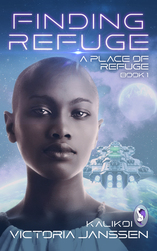
Finding Refuge available this week!

My new novella, Finding Refuge, is now available! It’s science fiction with lesbian romance, telepathy, found family, and trauma recovery.

They lost the revolution. But then, they found sanctuary—and hope.

After the fascistic Federated Colonies crushes their interstellar revolt, freedom fighters Talia and Miki have only each other.

Telepathic warrior Talia Avi lost her home planet, her people, and their psychic communion when the FC invaded, but thanks to Miki Boudreaux, she can glimpse a life beyond defeat. Genius engineer Miki lost Talia once to FC captivity and never plans to lose her again.

Miki will risk her life and her freedom to reunite Talia with the escaped remnants of her people, on a mysterious planet far outside of FC control. But the difficult part will be what comes after…when you’ve always been a guerilla at the sharp end of death, how do you learn to make a life?

Can two freedom fighters find refuge at last?

Excerpt:

When Talia opened her eyes on her last morning in her cell, the needled bulb which continually fed suppressant drugs into her veins was gone. She lurched to her feet, grabbing at the slick wall when her weakened legs failed to support her. The door slammed open and two Federated Colonies guards stepped smartly inside, their face masks distorting Talia’s reflection. A third and fourth, also armored, seized her arms and hustled her into the corridor, their gloved fingers painfully squeezing her flesh against her bones.

I’m to be executed at last, she thought vaguely. The miasma of drugs clouded her every thought, as well as the remnants of her Damarae telepathy. She’d been in this prison for a long time. She was sure any information she might once have had about Jon Churchill and his dissenter rebellion was long out of date. She hoped her death would be quick.

At the end of a forced walk long enough to make her pant for breath, a door loomed. Head drooping, she didn’t see it until she was hurled at it. It slid open and she fell through, collapsing onto the cold metal floor of another cell, easily identified by its inexorable white lights and tang of bleach and old blood. She tried to lift herself, but her wrists and elbows collapsed beneath her. Someone grasped her shoulder and helped to turn her over.

She defiantly lifted her gaze, staring with utter disbelief into the pale round face of Miki Boudreaux.

You can also find it on Goodreads, StoryGraph, and LibraryThing.

Posted in business of writing, promo, refuge series, romance novels, sf/f | Tagged , | Comments Off on Finding Refuge available this week!

#TBRChallenge – Unusual Profession: Set This House in Order by Matt Ruff

Set This House in Order: A Romance of Souls by Matt Ruff won the 2003 James Tiptree, Jr. Award, now renamed the Otherwise Award, which “celebrates science fiction, fantasy, and other forms of speculative narrative that expand and explore our understanding of gender.” I would also consider this novel to be a mystery or puzzle novel, on top of all the rest. I was glad to have the opportunity of the TBR Challenge, and a long weekend, to finally read it, the first work I’ve read by this author.

Andy Gage definitely has an unusual profession. He’s a soul, who along with many others, lives inside the head of a human being also named Andy Gage. Andy’s job is to keep all of the other souls in line, as they are a sort of squabbling family living in the same mental house. Original Andy’s self, but not his body, was murdered by an abusive stepfather; the Andy we meet was created through dissociative identity disorder, specifically because “somebody had to run the body.”

The other souls in his family have different roles in the imaginary landscape: Andy’s “father” built the eponymous House in which all the souls can interact inside the body’s mind, and created Andy to run it. Elderly Aunt Sam speaks French and makes art; teenaged Jake offers accurate judgements of people and personal interactions, while also craving beer and pornography. Meanwhile, oppositional Uncle Gideon is trapped in darkest Coventry in the middle of a mental lake, often obscured by metaphorical mist…and becomes important later in the story.

The plot may sound confusing, but it’s laid out very clearly from the beginning, and it’s easy to see how efficiently Andy manages shifting between his different souls while still coping with being, himself, both twenty-eight and two years old. “I was called to finish the job that my father had begun; a job that he had chosen, but that I was made for.” Andy then is introduced to Penny Driver, who has suppressed knowledge of her additional selves. Penny needs Andy to provide needed perspective, so she can recognize what’s behind her frequent blackouts, and find professional help. Later, Andy needs Penny’s help as well.

As an aficionado of interesting Point of View techniques, this book is a master class. Andy is the reader’s guide, but he doesn’t know the whole story of Andy’s life and mental death, and he lacks a great deal of lived experience, which his father makes clear to him. Penny, meanwhile, has a number of different souls, but most of them are secondary to her central personality, called Mouse. She lacks total control of them, but they leave her notes and letters and lists to direct her actions, which she has to trust, even though she’s not always happy with what those other souls have done. The angry souls Maledicta and Malefica, for example, constantly get Penny/Mouse into trouble while trying to protect her, while organized Thread keeps her life from flying entirely off the rails.

Content warning for memories of domestic abuse suffered by the two point of view characters as children, resulting in dissociative identity disorder that is the main subject of the novel; there is also discussion of physical murders that happened before the story begins, and are tied into its plot.

Posted in reading, sf/f, writing | Tagged | Comments Off on #TBRChallenge – Unusual Profession: Set This House in Order by Matt Ruff

My August Reading Log

Fiction:
The Enigma Game by Elizabeth Wein, set mostly in Scotland during World War II, is a prequel to Code Name Verity. The main characters are Louisa Adair, a half-English/half-Jamaican teenaged girl; an elderly German immigrant woman who adopts the name Jane Warner; Ellen McEwen, a young woman who works as a volunteer driver for the airfield and hides that her family are Travelers; and a young pilot named Jamie Beaufort-Stuart, brother to one of the Code Name Verity narrators, who also makes an appearance in this book. As you might guess from the title, an Enigma machine is a large part of the page-turning thriller plot; I also got a lot of excellent specific detail on what it was like to serve on a particular kind of bomber plane, on particular sorts of missions. The whole story has an air of melancholy, as you might expect from a book about young men doing such dangerous work; there’s also a thematic tie, through the coins they left behind at the local pub, to all the young men who never came back from World War One. Plus there’s Louisa’s grief at losing both parents before the story begins, and the sadness of knowing Jane’s exceptional life is nearing its end.

A Deadly Education: A Novel (The Scholomance Book 1) by Naomi Novik is a commentary on the Magical School genre, aimed at a YA audience. First person narrator Galadriel, or El, is trying to survive her third of four years at the Scholomance, a dangerous and often deadly school for wizard children, who are trapped inside for four years with only other students and magical creatures intent on devouring their magic. The magical culture is hierarchical, with the powerful living in enclaves where they have more protection from dangerous mals, and everyone else either at high risk or subjugating themselves to the enclaves (for instance, as janitors) in the hope of gaining the same protection for themselves or their children. El’s affinity, or particular magical skill, is for languages and spells, but leans heavily towards destructive magic, which she must constantly fight against in order to keep from, essentially, turning into Darth Vader. She’s outcast from wizards who can detect this tendency. As you might guess, it’s a noirish story, not usually my preference. Eventually, El does make a few friends, and the ending is somewhat upbeat, with a sudden twist that presumably sets up the next book. Prior to reading, I had heard that a racially offensive paragraph about dreadlocks was removed from the book by the white author, who apologized for what she had written. For that reason, I was more conscious of how people of various races and national origins were presented in the story. The secondary characters originate from all over the world, many from rich and powerful enclaves, but the presentation of these characters did not include much cultural or linguistic detail. The first-person narrator El has no interest in the cultural concerns of her fellow students, which makes some sense for the character, but I wished for more depth here, perhaps a sense of things going on that the narrator was missing. “Enclaver” supersedes other affinities in this magical world, which led to classism being the primary issue addressed thematically.

Chaos on CatNet by Naomi Kritzer is a sequel to Catfishing on CatNet. I highly recommend this YA series. Set in near-future Minneapolis-St. Paul, there’s a lot of lovely local detail and hopeful possibilities for the future, such as a police force with a much higher percentage of social services, a rebuilt bookstore that was recently destroyed (in real life) by fire, and a plaza in memory of George Floyd. Queer and polyamorous characters are presented positively, as complex individuals. New point of view character Nell has been raised in a Christian apocalyptic cult, but after her mother’s disappearance is adjusting to living with her father, her stepmother, and their respective girlfriends, while worrying about the girlfriend she left behind. She is new to the same high school where Steph, protagonist of the previous book and friend of the AI Cheshire Cat, has also just begun; the juxtaposition of their lives is integral to uncovering the existence of a second AI, its creator, and their plans for chaos.

The Henchmen of Zenda by K.J. Charles revisits Anthony Hope’s The Prisoner of Zenda through the sardonic eyes of mercenary Jasper Detchard, who narrates the True Events and ends up romantically involved with Rupert of Hentzau, though I’m not sure he ever admits to the romantic angle. Lots of swordfighting, good roles for two female characters, and a happy ending.

Faithless in Death by J.D. Robb is fifty-second in the Eve Dallas near future science fiction/mystery series, and I think this installment has come the closest of any of them to addressing current events. Content warnings for racism, misogyny, domestic violence, sex trafficking, and anti-gay therapy in the context of a religious cult run like a mega-dollar business by a charismatic self-involved man and his children. Justice is achieved in the end, but there’s a lot of nastiness that’s uncovered first.

Return of the Thief by Megan Whalen Turner had the feel of an grand finale to the entire series, complete with epic, overwhelming battles, tragedy and betrayal and redemption, and the feeling that All is Lost until All Isn’t Lost. I read it on a day off, and was thus able to immerse in the familiar world made unfamiliar with a new first-person narrator, Pheris Erondites.

It Takes Two to Tumble: Seducing the Sedgwicks by Cat Sebastian is a goodhearted, sweet romance between Philip Dacre, a widowed British naval captain, and the vicar of the small English village, Benedict Sedgwick. I think the time setting is the Regency, but am not sure. The plot owes a bit to The Sound of Music in that Captain Dacre’s three children have run wild since his wife’s death, while he was away at sea. The vicar ends up semi-looking after them; having grown up with a negligent poet for a father, he prizes order but also understands the children. Initial dislike leads to, surprise!, desire and love. At some point previously, I read the second book in this series, A Gentleman Never Keeps Score, and belatedly recognized some of the characters.

Nonfiction:
My Broken Language: A Memoir by Quiara Alegría Hudes feels like music while still being prose. Her themes are contrapuntal, even before she reaches the point in her narrative about her musical training. Hudes is a Pulitzer-winning playwright, and the co-author of the musical “In the Heights.” She grew up in Philadelphia in the 1980s and 1990s, when I first encountered the city, so much was familiar to me. Just as much was unfamiliar, as she is “Philly Rican” and experienced North Philly and West Philly while I was still beginning to learn Center City. The memoir brings together subjects from her experiences being mixed race and mixed culture to the meaning of family. She draws exquisite portraits of her family members. She explores cultural touchstones from Lucumí to salsa, and juxtaposes her upbringing with the mostly-white world of her undergraduate studies at Yale and her graduate studies at Brown. Highly recommended.

Art from the First World War by Richard Slocombe mainly made me want to see the actual paintings reproduced within, as I am sure I was missing many details. I had seen an exhibit of World War One art at the Smithsonian in 2018, but this book had some artists I had not seen before. It was a pleasant afternoon’s reading and viewing.

Fanfiction:
Life Happens by Cdelphiki is a very long Batfamily story, positing that Tim Drake (Red Robin) and Damian Wayne are thrown into a universe where all superheroes are comic book characters. Teenaged Tim uses his hacking skills to establish himself as ten year old Damian’s guardian, making a life for them while hoping for rescue. Time is flowing differently in the two universes, and the story got pretty intense at times. I found it gripping.

Escargots by Nary is a very satisfying little mystery solved by Rose Vitrac January, a character from the Benjamin January mystery series by Barbara Hambly. The story was written for Yuletide 2014.

stay inside til somebody finds us by napricot, a Steve Rogers/Sam Wilson romance, deserves special mention because it’s set during a pandemic lockdown, in an alternate version of the MCU and of our world. Sam is Steve’s upstairs neighbor in D.C., and while Bucky and Natasha are away, Steve falls into conversation with him as they both spend time on their balconies. Meanwhile, Bucky and Natasha are trying out a range of pandemic hobbies while trapped in a safehouse, somewhere in Europe.

Silver and Red by BurningTea is a sweet Leverage story set during the Christmas season. Eliot is protecting Peggy Milbank from a potential threat, while Hardison and Parker wonder how they can show Eliot how much he means to them. Peggy’s outside pov is fun.

Four Cups of Wine by borealowl is a Good Omens story in which Aziraphale makes friends with a Jewish book collector, which leads to Aziraphale and Crowley joining her family for various Jewish holidays and becoming part of her family and arguing about theology in satisfying ways.

Posted in fanfiction, historical fiction, mystery, nonfiction, reading, romance novels, sf/f | Tagged | 1 Comment