If Batman Was Two People

“You are being watched. The government has a secret system: a machine that spies on you every hour of every day. I know, because I built it. I designed the machine to detect acts of terror, but it sees everything. Violent crimes involving ordinary people; people like you. Crimes the government considered ‘irrelevant’. They wouldn’t act, so I decided I would. But I needed a partner, someone with the skills to intervene. Hunted by the authorities, we work in secret. You’ll never find us, but victim or perpetrator, if your number’s up… we’ll find you”.

I am not sure who originated the idea that the tv show Person of Interest features Batman, if Batman and Bruce Wayne were two separate people, but it’s brilliantly accurate. The “muscle” character, John Reese, even wears a costume, in this case a business suit, but the authorities repeatedly refer to him as “The Man in the Suit.” “Suit” has often been used in comics to refer to a costume, as well. Meanwhile, Finch apparently has limitless monetary resources and access to vast stores of information through his skill with computers. Both men are possessed of the requisite angstful past and doomed romantic relationships.

There’s a female villain, the hacker Root (Amy Acker), who is clearly a superhero-type antagonist with vast power and ruthlessness. Zoe Morgan (Paige Turco), a “fixer” who appears several times, is also a superhero, in her ability to resolve tricky situations or provide vital information. There’s one episode with a young boy who draws Reese as a superhero. Late in the second season, Shaw (Sarah Shahi) is a character with an almost-superhuman ability to escape deadly situations, even going so far as to dig a bullet out of her own abdomen with a razor blade.

Reese (Jim Caviezel) doesn’t have a cape or a mask, but the actor’s performance bears resemblances to Christian Bale’s recent take on the Batman, with an even greater lack of affect, presumably resulting from Reese’s tortured past as a CIA operative and assassin. Caviezel is good at portraying a sort of squinty, generalized suffering when appropriate, but he rarely shows emotion, instead fighting his way through most situations. Also, he is good at seeming threatening in a scary way (because of the lack of affect). He always seems to be talking quietly, reminding me quite a lot of Bale’s hoarse Batman whisper.

While Finch (Michael Emerson) also frequently demonstrates lack of affect, he is much more likely to let emotion slip, and seems to find it much easier to fit in with the rest of the world. He usually seems polite and inoffensive, and though he dislikes violence, he feels free to invade privacy and use his money to accomplish his goals.

There are two secondary characters in the first season, both police. Joss Carter (Taraji P. Henson) is my favorite character. She’s a “lawful good” character (I never played D&D, but I learned the basics), but that doesn’t make her boring. I love how smart she is, and how ruthless in her pursuit of law, and how she has to negotiate her own morals with the ambiguity of what Finch and Reese are doing and whether or not she should help them, as the series progresses. I also love that she was military, and a skilled interrogator, and a lawyer, and is just overall awesome.

Lionel Fusco (Kevin Chapman) is a “bent” cop who’s subverted by Reese for his own purposes. In contrast to Carter, I would call him “chaotic good” based on his current actions; he’s trying to be a better person, but also must act in his own interest to protect himself and, by extension, the people he is trying to protect. It interests me that we don’t know why he first became a “bad cop.”

Government surveillance always underlies the plot. Finch’s invention of “The Machine” after 9/11/2001 motivates all of his actions thereafter, and he and Reese rely on surveillance, cloning of cell phones, and the like, to help people. Despite lip service being paid to how invasive all this is, the action all shows the results as being helpful to individuals. The superhero treatment, in this environment, feels like a sleight-of-hand distraction from how we are really being watched, in real life.

Posted in comics, television | Tagged , | Comments Off on If Batman Was Two People

Linkgasm is Really Random

I’ve already posted most of these to Twitter, but I collected some of my recent favorites here, for future reference.

Gossamer Obsessions has a terrific post on To Have and To Hold by Patricia Gaffney.

This is a really great analysis at Salon – is this novel about war, or abuse? The twisted mind of Ender’s Game.

Abigail Nussbaum on 3 productions of “Much Ado About Nothing” – Branagh, Whedon, and Rourke.

The 1984 PBS version of “12 Years a Slave,” starring Avery Brooks. Also, a post on the new movie: Why ’12 Years A Slave’ Is Different From ‘The Help’ And ‘Django Unchained’–-And Why It Matters by Alyssa Rosenberg.

Review of The Golem and The Jinni BY Helene Wecker – sounds like a really intriguing historical fantasy – “Jewish and Syrian immigrant communities in turn-of-the-century New York.”

A Vampire is a Flexible Metaphor: An Interview with Kelly Link by Meghan McCarron.

Finally, I am really excited to see this movie:

Captain America: The Winter Soldier trailer UK

Posted in gaffney, links, romance novels | Comments Off on Linkgasm is Really Random

CapClave 2013

I will be at CapClave this weekend. You can find me at the following program items:

Saturday, 11 am, Rockville/Potomac
“1001 uses for an unpublished story”

Laura Anne Gilman, Larry Hodges, Victoria Janssen (moderator), Craig Alan Loewen, Alan Smale
Sometimes they sell, sometimes they don’t; what do you do with your unsold stories? Do you ever write anything you know can’t be sold? Do you mine the novel in your trunk?

Saturday, 4 pm, Salon B
“Doctor Who”

Kate Baker, Victoria Janssen (moderator), Kathyrn Morrow, Hildy Silverman, Jon Skovron
Doctors have become more emotional. Peter Capaldi is the 12th doctor; what adventures will he have? Will the BBC accept a different kind of Doctor? One of color, female, or transgender?

Sunday, 9 am, Salons CDE
“City Faerie Folk – Urban Fantasy in the Mainstream”

Victoria Janssen (moderator), Patrick Scaffido, Michelle D. Sonnier
Once a fringe segment of genre writing, Urban Fantasy is growing in popularity. Who are the authors that are leading the charge? What is it about the writing that is drawing in legions of fans? Does putting magic in the present day make it more mundane or all the greater for the contrast?

Sunday, 2 pm, Salons CDE
“Robot Love and Alien Dating”

Victoria Janssen (moderator), Marianne Mancusi, Kathyrn Morrow
Romance is hot. It sells. How does romance fit into Science Fiction? Or does it? Can the elements of a classic romance work in SF/fantasy? How do writers balance the two elements? Is Science Fiction Romance an oxymoron?

Posted in conferences | Comments Off on CapClave 2013

I Posted Over There

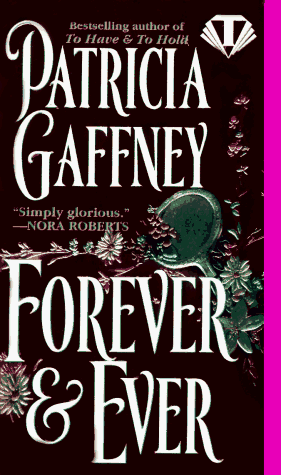
For Heroes and Hearbreakers, I posted on Delicious Despair in Patricia Gaffney’s Forever and Ever.

Fresh Meat: Dancer, Daughter, Traitor, Spy by Elizabeth Kiem at The Criminal Element.

A Fatal Likeness by Lynn Shepherd, a historical mystery that takes some liberties with historical figures.

A Question of Honor by Charles Todd, latest in a series of WWI historical mysteries with a nurse serving as detective.

The Red Queen Dies by Frankie Y. Bailey is a near-future police procedural.

At Heroes and Heartbreakers, a preview of the male/male romance Glitterland by Alexis Hall and a preview of Jeannie Lin’s historical novel set in Tang Dynasty China, The Lotus Palace.

Posted in links | Comments Off on I Posted Over There

“The Kaiser and Belgium,” Stephen Phillips

The Kaiser and Belgium

He said: “Thou petty people, let me pass.
What canst thou do but bow to me and kneel?”
But sudden a dry land caught fire like grass,
And answer hurtled but from shell and steel.

He looked for silence, but a thunder came
Upon him, from Liège a leaden hail.
All Belgium flew up at his throat in flame
Till at her gates amazed his legions quail.

Take heed, for now on haunted ground they tread;
There bowed a mightier war lord to his fall:
Fear! lest that very green grass again grow red
With blood of German now as then with Gaul.

If him whom God destroys He maddens first,
Then thy destruction slake thy madman’s thirst.

–Stephen Phillips

Posted in wwi poetry | Tagged | Comments Off on “The Kaiser and Belgium,” Stephen Phillips

Girl Wrestler! Vintage Erotica Cover

This one deserves its own post.

Image from Book Scans.

Posted in erotica, images | Tagged | Comments Off on Girl Wrestler! Vintage Erotica Cover

In Search of Balance: Forever and Ever by Patricia Gaffney

The main discussion posts on the Wyckerley Trilogy may be found at Something More.
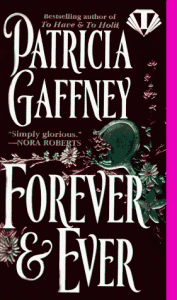
My main takeaway from Forever and Ever by Patricia Gaffney is that it’s a story of a relationship between equals. This might seem an odd thing to say, when the heroine owns a copper mine and comes from wealth, and the hero from a family of poor miners who expended great effort to educate him. Their class differences are a major part of the plot, and give rise to a lot of conflict between them. But in the end, what felt important to me was that in those conflicts, both characters had their say. Neither of them is always right, and each conflict leads to each character reconsidering their position and to compromising. Their relationship is constantly in search of balance, but if not for the conflicts, I think their interest in each other would soon fade.

Throughout, they are on a voyage of discovery, constantly fearing the unknown, even as they desire it, and are willing to adapt to it. She didn’t move; the invisible thread that held their gazes had hypnotized her, too. Finally she whispered, “I’m afraid of you.” It floored him. It evened the score, because he was afraid of her, too. But she was braver: she could admit it, and he couldn’t. Sophie begins the story in a much safer position than Connor does. She is secure in her material wealth and social position, while he has always had to fight for what he wants. They must constantly try to negotiate a middle ground.

For instance, near the beginning of the novel, they argue about literature.

She gritted her teeth. Emma Woodhouse was her favorite heroine in all of fiction; she would not stand by while this—this—miner defamed her. “The point is,” she said again, louder, “she learns from her mistakes. It’s true that she’s not a perfect heroine, but that only makes her more interesting and human. Her flaws are forgivable because she has a good heart. She can be foolish and misguided, yes, but when she interferes in other people’s lives it’s because she really believes she’s helping them. And in the end everyone—Emma, Harriet, Jane Fairfax, even Mrs. Elton—each marries exactly the right person, not only according to their hearts and their temperaments, but their stations, too. All the couples—-”

“Their stations? So Harriet could only marry a farmer because that’s what she was born for?” No boyishness now; his pale gray eyes speared her, intense and unwavering.

Sophie considered the question and answered it honestly. “Yes.” But she wasn’t prepared for the loaded silence that followed, or the uneasy feeling that accompanied her reply—although she believed it was correct. For the first time she saw uncertainty, perhaps even mistrust in the faces of her friends and neighbors. The look on Mr. Pendarvis’s face was subtler and better hidden, but she interpreted it easily. It was contempt.

“…ladies who look down on other people because of their ‘stations’ aren’t heroic. They’re stupid and arrogant.”

“You don’t understand.”

“I think I do.”

“No, no, and—-I could never make you understand.”

“Because I’m a poor, uneducated copper miner?”

She ignored that. “You’re making a comparison that isn’t fair, a false analogy. An analogy is a—-”

“I know what an analogy is,” he snapped.

She flushed—-but she wanted to ask how he knew, and if he knew, then how could he be a poor, uneducated copper miner? She shook her head quickly, frustratedly; this was hopeless. She was in an argument she couldn’t win, even though she was still sure she was right, and it was beginning to seem as if every encounter she had with Mr. Pendarvis put her in this disagreeable position.

Later, after Sophie has learned Connor betrayed her by reporting on work conditions in the mine, she is angry, but then she begins to reconsider. I think this is more easily possible for her because she has the power in their relationship at this point, as she’s higher on the social scale. Connor of course has the advantage of being male; later, he’s offered opportunities that would be denied to any woman, even one high on the social scale; but at this point, Sophie is more free to make choices. Connor is trapped by lack of money and position.

Once before when happiness had been wrenched away and her life was in turmoil, the mine had saved her. This time it did not. Days passed before she could bring herself to acknowledge why, and the reason made her more despondent. Since childhood, she had seen Guelder through her father’s eyes, but now she was seeing it through the eyes of Connor Pendarvis. It changed everything.

Connor, meanwhile, is still trapped in his lower social position, and has also lost Sophie through his own inaction. The strange thing was that he was still angry with her. All the blame was his, and yet every time he thought of the things she’d said at their last harrowing meeting, his skin felt hot. Fury and mortification came boiling up in him, as if the encounter had happened yesterday or an hour ago. You taught me how low I could sink. I’ll spend the rest of my life repenting what I did with you. Maybe he deserved that–yes, all right, he deserved it–but her absolute disgust still infuriated him. Sophie was a snob, and he believed in his heart that not a single moment had passed during their summer-long acquaintance, not even the night they had made love in her narrow bed, when she didn’t consider him her social inferior. He himself had much to answer for, but he couldn’t forgive her for that.

Throughout, their relationship is active; over and over again, they must make the choice to be together. When Connor first sees Sophie, he knows she’s of a higher social class (though not higher than the class to which he aspires). Despite being uncomfortable with their differences, he chooses to pursue her, and after some misgivings, Sophie chooses to be with him, risking her own social position in many ways. They repeatedly choose to continue their relationship. “I don’t know what will happen, Sophie, but I think we have to begin sometime.” With his fingertips light on her cheek, he passed his thumb over her closed lips, watching them quiver. “We have to come toward each other.”

Later in the novel, they acknowledge that despite their differences, their personalities are very alike (another source of conflict for them). “We’re too much alike,” Sophie sighed, snuggling against him. “That’s our problem, Con. We’re too much alike.”

“A blessing and a curse…We have the same temper. The same pride. Exactly the same things make us angry.”

I really love this exchange. He said, “I think you love me, Sophie.” Before she could agree or disagree, he added, “But I don’t think you always approve of me. And I want that. Need that.”

“Con…”

“Don’t say anything, sweetheart. I just wanted to tell you.”

“I feel the same,” she whispered, shy, stroking his temple over and over. “I know I’m not the sort of woman you’d have married if you’d had a choice. No, I’m not,” she insisted when he tried to interrupt. “You’d have chosen someone smarter—”

“Impossible.”

“—and more liberal. A socialist, probably.”

“Hm, I’ve never met a lady socialist. It wouldn’t have been easy.”

“I’m serious, Connor.”

“Maybe Karl Marx has a sister.”

And…that’s pretty much it from me. I thought I would be saying more about the class conflict in this novel, but I can sum it up as “I liked the way Gaffney showed her characters dealing with their class differences, the end.”

I also wrote a post for Heroes and Heartbreakers on despair in Forever and Ever. Here are my posts on on To Love and To Cherish and To Have and To Hold.


Posted in historical fiction, reading, romance novels | Tagged | Comments Off on In Search of Balance: Forever and Ever by Patricia Gaffney

More Preview Posts!

I speculated here on what might happen in book 3 of S.U. Pacat’s Captive Prince series.

I’ve also had more book previews go live.

A Woman Entangled by Cecilia Grant – a really excellent historical romance.

The Doll by Taylor Stevens – a thriller with a heroine who reminded me a bit of James Bond.

Twilight is Not Good For Maidens by Lou Allin – contemporary mystery set on Vancouver Island, with a female RCMP officer.

The Summer of Dead Toys by Antonio Hill – a hardbitten police procedural set in Barcelona.

Caged Warrior by Lindsey Piper, AKA Carrie Lofty – a brutal new paranormal romance series featuring gladiatorial combat for both hero and heroine.

True Love by Jude Devereaux – now I would like to visit Nantucket.

Anything But Sweet by Candis Terry – there is a startlingly large number of romance novels set in Texas. But it is hot there so I was not inspired to desire a visit.

Dare to be Tempted by Eden Davis – erotica featuring an older couple.

The Last Whisper in the Dark by Tom Piccirilli, a noir novel about a family of criminals.

Dirty Little Secret by Jennifer Echols, a YA romance set amid the contemporary Nashville music scene.

The Deepest Night by Shana Abe, second in a YA paranormal series set during World War One.

Posted in writing | Comments Off on More Preview Posts!

Readercon 2013 Report

Belatedly, here’s my rambling report on the 2013 Readercon! I did three panels this year, leading one of them, and a kaffeeklatsch. All of my programming happened on Saturday, so unusually for me, I had Friday completely free. Most of the time when I am attending a con, I don’t have enough mental energy to attend panels I’m not on, but this time I went through the Friday schedule and made a list of everything that seemed interesting. Which of course meant that for some time slots there were two or even three items I wished I could attend simultaneously.

I arrived Thursday night with friends E! and Amy Goldschlager, after an epic journey that began in Philadelphia and wound through Manhattan and the wilds of Connecticut, including a ride across a river on a ferry, an adorable tot, and delicious, delicious ice cream in a freshly-made waffle cone. Thursday night was all socializing and attempting to find my roommates, one of whom I’d never met before. (My usual roommate was unable to attend.) I figured it would be best to introduce myself before we shared a bed. After some wackiness with shutting elevator doors, eventually the introduction was accomplished, and I don’t think either of us kicked or snored. I did fall out of the bed Sunday morning…but I digress.

I started off Friday with a quiet breakfast alone and one more perusal of the schedule, then found friends and chatted until Yoon Ha Lee’s reading at 11:00 am. That lasted half an hour, so I attempted to choose a panel for the last half of the hour…and ended up splitting it between two different ones, unable to make a choice. That set the standard for the rest of the day. I was too full of adrenaline, and too distracted by saying hello to friends, to really concentrate on any one panel. So I bounced among a number of different ones, had lunch with Twitter pal Ruth Sternglantz (and met a new person in the process, Val), and otherwise all-around schmoozed, all day. I got to meet Brian Attebery! We’ve been on a mailing list together for years, but had never met.

More name-dropping, which will be incomplete, so I apologize if I missed you: over the course of the con, I got to chat with Gwynne Garfinkle, Connie Hirsch, Rosemary Kirstein, Sarah Smith, Brett Cox, Alaya Dawn Johnson, Jim Kelly, Rose Fox, Tempest Bradford, Debra Doyle and Jim Macdonald, Ian Strock, Peter Dube, Julia Starkey, Sheila Williams, Greer Gilman, Faye Ringel, Kat Creighton, Glenn Grant, Lila Garrott, and of course Philly-area locals Tom Purdom, Michael Swanwick, Shveta Thakrar, Fran Wilde, E.C. Myers, Brad Hafford, Diane and Lee Weinstein, and roomies Vashti Bandy, Susannah Mandel, and Danielle Friedman. I also met Lisa Bradley through Gwynne and, briefly, Genevieve Valentine through Tempest – she provided me with much-appreciated spoilers for “Pacific Rim,” so I could see it with an easy mind! Most of these conversations took place in hallways…that happens a lot to me at Readercon. I was briefly introduced to Wesley Chu and Emily Wagner and Tilly whose last name I do not remember and…maybe a couple of other people?

Once the dealers’ room opened, I had my usual initial wander-through, during which I am not allowed to buy anything I hadn’t already planned to buy. On that and subsequent wanders, I stopped to chat with Steve Berman and Gavin Grant at their respective tables, and had two separate conversations about classic Dr. Who with JoSelle Vanderhooft and Rob Shearman. For a literary convention, I talked about Dr. Who quite a lot.

In the evening, I attended (in full!) a panel on fairy tales that included my dear friend Ann Tonsor Zeddies. Friday night was “Meet the Prose,” a shoutfest as usual because it is so very crowded. But I at least saw quite a few people, and handed out most of my stickers to people I didn’t know. The sentence on my stickers was from “8:00 P.M.: Appointment TeeVee.”

Saturday, I had planned on another quiet breakfast before my 9:00 am panel on the work of Patricia McKillip, but saw Kate Nepveu and her family and was invited to join them. I was glad I did, as I barely saw them for the rest of the con. My McKillip panel went well, then I had to rush to the romance panel, which I was leading.
I did not take notes on the writing romance in specfic panel, because there is no way I can both participate and make notes; I hope someone did! From my own notes, I can say that I listed Pamela Regis’ elements of a romance to start off, and had the panel talk about specfic that they felt had done romance well. We also discussed ways we think romance plots in specfic could be done better, and made a few recommendations. Even though I was keeping track of the time, I was astonished throughout by how fast it was going. If I ever lead a similar panel, I have a couple of spots I think I could tighten up my questions so we get through the basics more efficiently.

I had a short break before my last panel, “The Unexamined Privilege of Safety.” By this point, I was beginning to feel talked out, but the rest of the panelists were awesome and had great things to say. I then had a short break for lunch and book-buying before my kaffeeklatsch. I love having a kaffeeklatsch because that is a place where friends (and fans, if I happen to have any) will be able to easily find me; also, free coffee! I was scheduled with Cecilia Tan, so if no one showed up, we would at least be able to chat with each other. However, we each got a group of our own; I had lured a few extra friends with the promise of chairs, since there was such a lack of them in the renovating hotel’s non-lobby. Stephen R. Wilk attended, so we got to reconnect – we had shared a reading at Arisia several years ago, and eventually figured out which story he had read (he mostly writes nonfiction). The group also discussed the Muppets at great length.

I finished off Saturday eating Korean barbecue with friends from my former writing workshop, Ann Tonsor Zeddies, Steve Berman, and John Schoffstall; we also had friends JoSelle Vanderhooft and Alex Jablokov. Alas, we were too full to eat ice cream afterwards. I then attended a panel about reader shame, led by my friend Natalie Luhrs and also including Ann. After that panel, to my good fortune, I met Tat Wood! He’s one of the authors of a nonfiction series about Dr. Who, About Time, which I love beyond the telling.

I made the Long Walk back to the elevators with many stops for hugs and goodbyes, always the most painful part of any convention. Back in my room, I packed and attempted to get some sleep before my early morning breakfast with Graham Sleight (we didn’t talk about Dr. Who quite as much as normal) and departure.

I’ve already submitted some panel ideas for next year!

Posted in conferences | Tagged | Comments Off on Readercon 2013 Report

To Love and To Cherish, Patricia Gaffney

Liz at Something More mentioned that she was planning to read Patricia Gaffney’s Wyckerley trilogy and post about it; I’d only read the middle book, To Have and to Hold, so I decided it would be fun to join in, and also post about my experience, in a rambling way. Spoilers ahead! Many of them!

To Love and to Cherish is first in the Wyckerley trilogy.

Here’s the summary: He is a local vicar, whose handsome, noble features resemble those of an angel. And with his golden-haired good looks and palpable strength, Christian “Christy” Morrell has unexpectedly become the single source of light in Anne Verlaine’s dark life. Almost from the moment they met, she realized she couldn’t help loving him.

But Anne is imprisoned by an unhappy marriage to the man who was once Christy’s closest friend. Yet when her husband leaves Anne behind in Wyckerley, she finds herself unable to deny the breathtaking passion Christy has awakened in her. She knows she has no right to ask Christy to love her, and no choice but to need him—-even though she risks both their ruin.

Like all Gaffney’s work that I’ve read so far, To Love and to Cherish features complex characters with significant barriers to their romantic relationship. The conflict for a good portion of this story is a simple one: Christy is the local vicar, and when he falls in love with her, Anne is married to his childhood friend, Geoffrey; he won’t commit adultery, and when he realizes he’s in love with her, he decides he can’t see her any more, end of story. Anne, meanwhile, is also in love with Christy, but feels emotionally trapped as well as being trapped within her marriage vows.

However, after both Christy and Anne believe Geoffrey has died in the Crimean War, the conflict shifts to a more subtle one, the fact that Anne is recently widowed, and Christy must at all times be more moral than his flock. He loves her and desperately wants sex with her, but marrying her too soon would bring the appearance of impropriety. This would likely damage Anne’s reputation and Christy’s credibility, and thus the work he does as vicar, which is an important part of his self-worth. Anne, whose marriage was mostly loveless and has been without sex for years, wants a sexual relationship as well, and is frustrated with Christy’s recalcitrance. Adding to all those conflicts is a more philosophical one: Christy is religious and Anne is an atheist. Overcoming these barriers – which they do – necessitates considerable negotiation between the two of them. Those negotiations are, I think, possibly the most important facet of their relationship. The other facet is curiosity. The two are endlessly curious about each other’s opinions. That, in turn, made them endlessly intriguing to me as a reader, and indicated they would never be bored with each other.

…Christy wanted to stare at her until she made sense to him, fit into some category of womanhood he could check off and set aside, a mystery solved. She was lovely–but that was obvious; a quality much more arresting than beauty simmered under her apparently unlimited composure. It drew him in spite of the faint mockery in her eyes–he was sure now that it was mockery–whenever she intercepted his curious glance.

And from Anne’s point of view:
I can come closer to being myself with Reverend Morrell than with anyone else–a huge, seductive, powerful relief, and the last thing in the world I’d have expected. We talk about everything. So far he hasn’t tried to convert me, but he wants to know how I “got this way.”

…Proprietary? I suppose. I flatter myself that we have a special relationship, and I find the thought of another woman–another person–hearing the things he says to me, private, confidential, fascinating things about his hopes for his life, his fears of failure–the thought of him sharing them with another person makes me feel . . . diminished. Cheated? I might almost say betrayed, but that’s too much–and–it exposes the vanity in all of this.

A major theme in this novel is love and sacrifice, including what a person needs to do for themselves in order to be able to do for others. Self-care is part of their caring for each other. With Christy, it’s obvious that he commits a great deal of himself to the villagers; he constantly worries that he is not giving enough, that he is not good enough, and that he is failing the people he wants to help. Meanwhile, Anne feels lingering guilt that her marriage to Geoffrey was a failure, even though she knows, objectively, that both of them failed each other. She feels she is not worthy of love or even friendship; she feels set apart from humanity. …I don’t think she will be my friend. She and the others will maintain the social gap they think is between us, in spite of anything I could do to bridge it. The irony is that it’s a false gap, this peeress-commoner nonsense. The real gap is even wider; it’s the one that separates goodness and simplicity (theirs) from emptiness and ennui (mine). Christy helps her to realize that people care for her as a person, as well. She helps Christy to realize that love of her begets more love for the villagers and for God, not less.

During the early portions of the novel, as Anne gets to know Christy, he is her only friend. … he fixed her with a burning blue stare and said soberly, “If you ever need help. If you ever need anything. You know that you can come to me, don’t you? I can help. I can do something. Anne, I will help you.”

She nodded matter-of-factly, but inside she felt breathless. The possibility…the possibility…. Against everything, all her experience, she found herself almost believing him. To have a friend, someone she could trust, someone who might really help her. …It was a heady sensation, like contemplating a dive from a great height. “Thank you,” she whispered, ambivalent. Oh, but the possibility…. She clings desperately to the hope of seeing him again, however briefly.

However, once she is widowed (or thinks she is), she also feels more free to reach out to the villagers, partly because she feels it is her duty, partly because she is desperately lonely. She slowly makes friends among them, though Christy helps her to realize that she has, in fact, made true friends. …and yet, the Weedies’ kindness to me was real, and for a few minutes I did not feel as if I were in disguise…. Her slow bonding with the village reflects her bonding with Christy, while also showing that she is no longer dependent on him for all caring and affection. Christy told her the latest village gossip, and Anne realized with a slight start that, far from being boring, it all fascinated her. By reaching out, she is made stronger in herself as well as in her relationship – self-care, again. Again and again, she and Christy lean on each other for emotional support, long before they become lovers.

“You were the one who needed a friendly ear tonight, and for some reason I decided to burden you even more with my problems.”

“You haven’t burdened me, you know that.”

“Ah, but that’s your attitude to everyone, all of us sheep in your flock, Reverend Morrell. You ought to guard yourself better. We’re heavy, and we’ll take advantage of you. If you’re not careful, we’ll bear you down to the ground.” She said it as a joke, but she could see the simple truth in it as soon as it was out. Christy would bear anything that was asked of him, and he would always think of himself last.

Christy’s Christian behavior (it’s no accident that his name is Christian!) throughout the novel brings to light facets of Anne’s personality that she’s had to hide for years. Her simple, straightforward kindness was so clear to him, and it drew him as irresistibly as her beauty. They have kindness in common, and it brings them together. It’s because of Christy’s active example that Anne is driven to reconsider her atheism as well as her future path in life as a vicar’s wife. I’m starting to think that believers are better off than nonbelievers if only because they have something to live by besides self-interest. Then why not simply join them? If I can’t accept all of it yet, maybe I will in time, little by little.

It’s fascinating to me that Anne’s spiritual conversion occurs almost as a result of her sexual relationship with Christy; I think, before that relationship, she would have been incapable of reaching out to the numinous for help. Her belief in Christy and in the love they share enables her to reach for concepts she would not allow herself to contemplate while trapped in marriage to Geoffrey.

I think I’ve gone on quite long enough for now!

Side note: I love this small mention of the Crimean War, since I read a couple of fascinating books about it, for a short story. I read the newspapers to keep up. Quiet old England turns out to be a shade bloodthirsty: everyone is dying for a good old-fashioned war again, which they haven’t had since Waterloo. The enemy seems to have been picked almost at random, as far as I can tell. The residents of Wyckerley are puzzled but proud of their new viscount for going off to keep Turkey safe from Russian encroachment (a murky and remote motive to me, but perhaps I don’t understand politics) and never fail to ask me what news I’ve had from my husband. I say the mails are unreliable, which is certainly true, and change the subject.

Book discussion post is here!

I wrote about Eroticism in To Have and To Hold here.

Posted in historical fiction, reading, romance novels | Tagged | Comments Off on To Love and To Cherish, Patricia Gaffney