“San Martino del Carso,” Giuseppe Ungaretti

San Martino del Carso
Valloncello dell’Albero Isolato il 27 agosto 1916

Di queste case
non è rimasto
che qualche
brandello di muro

Di tanti
che mi corrispondevano
non è rimasto
neppure tanto

Ma nel cuore
nessuna croce manca

E’ il mio cuore
il paese più straziato

–Giuseppe Ungaretti

Posted in wwi poetry | Tagged , | Comments Off on “San Martino del Carso,” Giuseppe Ungaretti

Blog Vacation!

I’m having a blog vacation this week. See you on April 9th!

A few recent links to keep you company:
Preview of Lady Drusilla’s Road to Ruin by Christine Merrill.

Preview of A Tryst With Trouble by Alyssa Everett.

Preview of Inheritance of Shadows by Janis Susan May.

Posted in holiday | Comments Off on Blog Vacation!

“The Debt,” Edward Verrall Lucas

The Debt

No more old England will they see–
Those men who’ve died for you and me.

So lone and cold they lie; but we,
We still have life; we still may greet
Our pleasant friends in home and street;
We still have life, are able still
To climb the turf of Bignor Hill,
To see the placid sheep go by,
To hear the sheep-dog’s eager cry,
To feel the sun, to taste the rain,
To smell the Autumn’s scents again
Beneath the brown and gold and red
Which old October’s brush has spread,
To hear the robin in the lane,
To look upon the English sky.

So young they were, so strong and well,
Until the bitter summons fell–
Too young to die.
Yet there on foreign soil they lie,
So pitiful, with glassy eye
And limbs all tumbled anyhow:
Quite finished, now.

On every heart–lest we forget–
Secure at home–engrave this debt!

Too delicate is flesh to be
The shield that nations interpose
’Twixt red Ambition and his foes–
The bastion of Liberty.
So beautiful their bodies were,
Built with so exquisite a care:
So young and fit and lithe and fair.
The very flower of us were they,
The very flower, but yesterday!
Yet now so pitiful they lie,
Where love of country bade them hie
To fight this fierce Caprice–and die.
All mangled now, where shells have burst,
And lead and steel have done their worst;
The tender tissues ploughed away,
The years’ slow processes effaced:
The Mother of us all–disgraced.

And some leave wives behind, young wives;
Already some have launched new lives:
A little daughter, little son–
For thus this blundering world goes on.
But never more will any see
The old secure felicity,
The kindnesses that made us glad
Before the world went mad.
They’ll never hear another bird,
Another gay or loving word–
Those men who lie so cold and lone,
Far in a country not their own;
Those men who died for you and me,
That England still might sheltered be
And all our lives go on the same
(Although to live is almost shame).

–Edward Verrall Lucas

Posted in wwi poetry | Tagged | Comments Off on “The Debt,” Edward Verrall Lucas

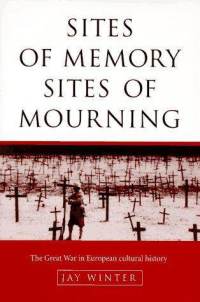
Sites of Memory, Sites of Mourning – WWI Challenge


My next book for The WWI Challenge is Sites of Memory, Sites of Mourning: The Great War in European Cultural History by Jay Winter. I actually started reading this book at the very end of last year, but I wasn’t very far into it, so decided to count it for the challenge.

As you can guess from the title, this is a nonfiction book in an academic writing style. It had been on my To Be Read pile for quite some time, because I’d come across many mentions of it in the bibliographies of other World War One-related books I’d read. I’d already read a book by one of the author’s students, as well, which included some related thoughts. Winter concentrated on Britain, France, Australia, and Germany (memorial art and apocalyptic art/literature, in particular).

The book illuminated a number of different, interesting byways that I plan to explore further. Winter shows a whole range of ways that people and communities mourned their war dead, both during and after the war’s end. Dozens of stories about parents trying to locate and retrieve the bodies of their sons were a sad indicator of many, many more stories that will never be told. It was interesting to read of the industry that arose in response, to help parents travel and to help locate the burials.

I was intrigued by how the spiritualism movement of the early twentieth century played into the experience of mourning, as I’d been reading a different book about the rise of spiritualism in the mid-nineteenth century. Winter also focused a couple of chapters on apocalyptic imagery in movies, literature, and art. I was interested to learn that there was an apocalyptic movement in art shortly before the war began, though it seems to have been linked more to rising class tensions than to any premonition of global conflict. Especially, I would like to learn more about the popular images d’Epinal sold all over France, and often depicting wartime images mingled with images drawn from Catholic symbolism. I was a little less interested in Winter’s exploration of war poetry, and as I was more familiar with that topic.

I’d recommend the book both to scholars of World War One and to those who love to see that history is always more complicated than you think it is.

Posted in wwi | Tagged | Comments Off on Sites of Memory, Sites of Mourning – WWI Challenge

Short Story Sale!

Sale! No matter how many stories I’ve sold so far, it’s still cheering when I sell another, particularly when it’s a new story rather than a reprint.

I’ve sold an erotic short story, “8:00 PM Appointment Tee Vee” to a Cleis anthology entitled Morning, Noon, and Night, edited by Alison Tyler. I love the idea of the anthology; it has one story for each hour of the day. I don’t know the release date yet, but will put it on my “publications” page as soon as I have it.

I’m especially pleased that my story will be right next to one by my buddy Kate Pearce, who wrote the 9:00 PM story. I wonder who wrote 7:00 PM?

Here’s a teaser, the first three lines of my story:

Tuesday nights are their television nights. When they meet, Sven hasn’t seen Martha’s favorite show, on the air for only three episodes. Martha is already in love with the tweedy mentor character, Knightley.

Doesn’t that make you want to read more?

Posted in promo | Comments Off on Short Story Sale!

Coriolanus (2011)

I saw the Ralph Fiennes-directed movie of “Coriolanus” several weeks ago, in one of our local art-movie theaters. I had never seen the play performed, and had never read it, though I did read a detailed summary ahead of time.

As you can tell from the still, Fiennes chose to use a contemporary setting, and that, I feel, made the movie. The film was shot in eastern Europe, in Belgrade, and all of the soldiers, and the warfare that’s shown, could easily have come from a news report. They wear modern uniforms, carry modern rifles, and are festooned with modern gear as they duck in an out of a grubby, destroyed urban landscape littered with dead or terrified civilians.

Fiennes heightens the modern feel by smoothly working in the use of modern technology. When his character, Caius Martius, is receiving a briefing from a herald in the the original version, the movie translates the herald into a soldier reporting in via Skype. Other narrative summaries happen on television screens, the actors flawlessly reading their Shakespearean lines in the cadence of BBC reporters.

After all the heavy weaponry, it’s shockingly brutal and realistic when Caius Martius and his enemy, Tullus Aufidius, fight each other with knives, struggling and wrestling in the dust. There’s plenty of blood to brighten the olive greens and grays of the main color palette.

All that said, you should see this movie if for no other reason than to witness Vanessa Redgrave as Volumnia, the mother of Caius Martius. She’s incredible, completely ruling the screen every instant she’s on it.

Posted in movies | Tagged | Comments Off on Coriolanus (2011)

“Wache,” August Stramm

Wache

Das Turmkreuz schrickt ein Stern
Der Gaul schnappt Rauch
Eisen klirrt verschlafen
Nebel streichen
Schauer
Starren Frösteln
Frösteln
Streicheln
Raunen
Du!

–August Stramm

Posted in wwi poetry | Tagged , | Comments Off on “Wache,” August Stramm

Yes, I saw “John Carter”

…and it wasn’t bad at all.

A friend of mine really wanted to see “John Carter” (which really ought to have been titled “A Princess of Mars”), and she talked me and another friend into going with her. I was the only one of us who’d read any of the Barsoom series, though C. had read all of the Tarzan books. My memory of the five or six Barsoom books I read back in high school was vague as to plot, though I did remember loving Tars Tarkas, Jeddak of the Tharks. I remember he seemed to save the day a lot. Also, I’ve always had a thing for sidekicks.

I have been noticing a lot of critical press about the movie, but after viewing the end product, I’m not sure what the actual movie has to do with all that press. It was perfectly fine – not the best movie I’ve ever seen, but very far from the worst. The design was lovely; I thought it felt very true to pulp-era science fiction, in particular the flying ships but also the helmets the Red Martians wore. I’d always imagined the Tharks as being a lot brawnier than most of them were depicted in the movie, though later on some more muscular ones appeared. I also liked how their four arms were animated in ways that made sense to me. The filmakers made an effort to include such rarities as characterization along with the hand-to-hand combat and explosions.

Several excellent actors had secondary parts. Ciarán Hinds, whom I’d recently seen in both “Tinker, Tailor, Soldier, Spy” and “Ghost Rider,” played Tardos Mors, father of Dejah Thoris. Mark Strong, who was also in “Tinker, Tailor, Soldier, Spy” played the evil Matai Shang – he gave the part more gravity than I had expected. James Purfoy played Kantos Kan with a a great sense of humor. I think the best performance in the whole thing was Willem Defoe as Tars Tarkas, with both serious and humorous scenes. I think I got my money’s worth just from those few actors. Plus Woola, the doggie. I mean calot. He was adorable, despite his rather mucus-y tongue.

Some of the 3-D was excellent, and it never felt pasted on. The only time I felt the story moved too slowly was at the beginning, when there was a prologue (I am usually bored by prologues). I realized, however, that I didn’t have much sympathy for John Carter…I found him kind of boring, even with the snatches of his sad past; I think it was mostly because he was at the mercy of Barsoom, and did well just because he happened to be extra-strong there (different gravity, don’cha know). His sole motivation is, first, survival, and second, to go home. Then he gets home just as he decides he wants to stay. Spoiler: in the next book, he gets back. *yawn*

I wanted more Tharks. I strongly suspect this is how I felt about the books as well, back when I read them. The Tharks were the main thing that made the series other than a Western that happened to be taking place on another planet, with some handwavium skiffy technology tossed in (the 9th Ray, etc.).

So, my vote is, “Needed More Tharks.”

Posted in movies, sf/f | Tagged | 1 Comment

Analyzing Antryg

I recently re-read one of my favorite trilogies by Barbara Hambly, the Windrose Chronicles. Partly I did so for enjoyment, partly because I intended to blog about the experience (My Heroes & Heartbreakers post). This read, I also wanted to take particular note of one aspect of the books: the characterization of Antryg Windrose.

I first read these books when I was in college, and I absolutely loved Antryg. He’s not your typical fantasy hero because he’s, well, insane. Though some of his insanity makes sense, because it’s a result of magic that really really doesn’t play well with the real world…does that still count? Anyway, he calls himself insane, and so do other characters. Though a very powerful wizard, he spends almost all of the time in the three novels unable to use his powers, which of course results in a lot of plot complication. There’s no point in having a powerful wizard who can actually solve all the problems of the plot with his mighty powers; it also has the advantage of making the character vulnerable, physically and emotionally, and thus more intriguing to read about. And because he’s insane, he can act unpredictably, further complicating the plot.

Hambly does this in a different way in each book. In The Silent Tower, Antryg must refrain from using magic because they are on the run, and his distinct magical signature would be detected. It is thus shockingly dramatic when, cornered, he unleashes what’s only been hinted at. In The Silicon Mage, there’s the same issue, added to his own physical weakness from being tortured not only physically but through his magic. In Dog Wizard, other wizards bind his power because they don’t trust him. It’s a balancing act for the author; how can you show the hero’s power when it’s bound? How does that affect the rest of his character, and what the author can show? Are hints better than actual showing, because the reader can imagine more vividly than the author can write?

When I looked back through the descriptions of Antryg that Hambly provides, I noticed she focused on a few traits: his eyes, his voice, and distinctive items he wears, including spectacles, piles of glittery beads, and clothing that is often ragged or layered. Here’s the first thorough description that’s given: Tall, thin, no longer young, Antryg Windrose had a beaky face in which all the individual features seemed slightly too large for the delicate bone structure, surrounded by a loose mane of graying brown hair and a straggly beard like frost-shot weeds that had been trailed in ink. Crystal earrings glinted in it like the snagged fragments of broken stars; half a dozen necklaces of cheap glass beads flashed tawdrily over the open collars of an assortment of ragged, scarecrow robes and a faded shirt. Behind the thick spectacle lenses, his wide gray eyes were bright, singularly gentle, and not sane.

Hambly also repeats the same or similar phrases relating to his appearance throughout the novels. I gave up trying to note them all (it would make a fascinating study!), but as a conclusion, it seems clear to me that her consistency in description, and the connotations her descriptions raise in the reader’s mind, are a major part of how I formed my opinion of him.

For example, here’s a description that both shows his eccentricity and the the sound of his voice. …the tall, thin young man…gravely constructing a pinwheel by the light of the kitchen fire, or telling horrific ghost stories in a deep, extraordinary voice that was beautiful and flamboyant as embroidered brocade. Later descriptions of his voice reiterate that it is deep, rich, and flexible.

On the re-read, because I was paying attention, I was startled by how often his description was repeated. It’s something to remember for my own writing. Repetition isn’t necessarily a bad thing, if it reinforces the impression of a character that you’re trying to make. The repetition is similar to the use of epithets in Homer (“wine-dark sea,” etc.). If it worked for Homer, there’s no reason it can’t work for more modern writers! (Such as Nora Roberts/J.D. Robb.)

The trilogy is now available in e-book format.

Nook: The Silent Tower; The Silicon Mage; and Dog Wizard.

Kindle: The Silent Tower; The Silicon Mage; and Dog Wizard.

Posted in reading, sf/f, writing craft | Tagged | Comments Off on Analyzing Antryg

The Gorgeousness of Cat (in The Windflower)

I recently wrote about classic romance novel The Windflower by Laura London for Heroes & Heartbreakers. In that post, I didn’t have a chance to talk about one of the most notable secondary characters, Cat, whose surname we eventually learn is (probably) Cathcart – it isn’t clear whether he uses it or not.

After I’d finished reading the book, at least five people told me Cat was their favorite character in the book, and they’d wished there had been a sequel featuring him. My thought on the matter is that there might have been plenty of sequels written in spiral notebooks or perhaps even mimeographed and passed from hand to hand…alas, I have no evidence of this.

Here’s a description, from heroine Merry’s second encounter with him: Cat. The boy scanned her without pity or recognition or even much interest while the fog played mother-of-pearl patterns on the stark bend of his tall cheekbones. On one side of his face sparkled the engraved hoop of a silver earring as big as a bangle, and his pale hair ribboned neatly from chin to hip in a thick braid knotted with leather. His buttonless black shirt fell open to the low-slung waist of his trousers, exposing the bands of tanned maturing muscle that corded his chest and below. The collar of his buff greatcoat moved idly in the wind from the sea.

Yeah. I can see why readers find him memorable, even years later. I had an instant impression of someone who looked a bit like the man illustrating this post, Norwegian actor Thor Knai. Cat is always, almost ruthlessly, competent at everything except emotional relationships, from which he tries to keep his distance.

At first, Merry sees Cat as emotionless and terrifying; this impression is reinforced when he pretends to drown her (to save her from bad guys). But later in the novel, he becomes her chief confidant, and we learn that he was raised in a brothel, and is still learning to overcome some of the things that happened to him there.

Cat provides Merry with vital information about sex that enables her to regain some agency in her turbulent romance with Devon, and though we the readers aren’t given details of the conversation, Cat’s tone sets the stage. There are probably not many people who are introduced to the facts of life by a lecture beginning: “Now, look—and pay attention, will you—I don’t want to go over this a dozen times. Furthermore, if you don’t like what I tell you, don’t squeak and fuss at me. I didn’t design the world.”

Cat and another fun character, Raven, serve as Merry’s best friends, more so even than Devon, who eventually marries her. I have the sneaking suspicion that the author might have liked them better, too.

Cat’s wealthy father is revealed late in the novel, and his relationship with his father is shown to improve. In a romance novel of today, he would have Sequel Bait tattooed across his muscular chest. I wonder if he was intended to later have his own book? Or if his reconnection with his father was meant to be the end of his character arc?

Finally, Cat’s relationship with amoral pirate Reed is very complex and interesting. Reed bought Cat out of servitude, then freed him. It’s clear they sometimes pretend Cat is Reed’s catamite for nefarious purposes, and that in many ways they are confidants, though in other ways Reed treats Cat as a child, in a way suggesting he’s trying, as Cat is, not to become emotionally involved. I can’t help thinking that the fanfiction I imagined people writing about this book would have been mostly about Cat and Reed. There’s so much conflict and potential conflict in their brief appearances together.

It seems a waste that such a great character only appeared in the one book.

Posted in romance novels | Tagged | 7 Comments