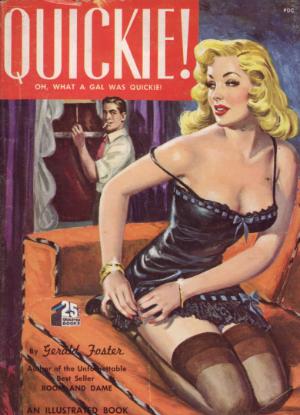
Quickie! Vintage Erotica Cover

I felt this one was awesome enough for its own post.

Also, a collation of my recent book previews:

Available Dark by Elizabeth Hand. Noir thriller with Norwegian Black Metal. This book rocks.
Charlie Cochrane’s Dreams of a Hero. A fairly short story about a gay couple living in their happily-ever-after.
Cath Crowley’s Graffiti Moon, a YA about art and love and our real selves.
Firelight by Kristen Callihan, an angsty Paranormal Romance that takes its worldbuilding in some interesting directions.
Heroic Don’ts.

Posted in erotica, images | Tagged | Comments Off on Quickie! Vintage Erotica Cover

Russian Translation of The Duchess, Her Maid, The Groom and Their Lover


I somehow missed this when it first came out, but there is a Russian translation of The Duchess, Her Maid, The Groom and Their Lover. Here’s the page at Harlequin Russia.

– Где ты черпаешь вдохновение?

Иногда вдохновение на написание романов является реакцией на уже прочитанное. Или когда я начинаю думать о той или иной теме, проблеме, жизненной ситуации, я представляю, как бы можно было облечь ее в литературную форму. В том, что я пишу мало из моей личной жизни. Мои истории – это выдумка для развлечения и удовольствия.

-Есть ли какие-нибудь приемы, которые возбуждают твое воображение?

Когда мне тяжело пишется, я играю в компьютерные игры. Это отвлекает, снимает напряжение и позволяет мне вновь вернуться к работе через какое-то время. Каждый день, когда я вновь сажусь за рукопись, я перечитываю предыдущие главы, погружаясь в атмосферу, место и время.

Posted in promo, the duchess | Tagged | Comments Off on Russian Translation of The Duchess, Her Maid, The Groom and Their Lover

Romantic Fantasy, The Element of Fire by Martha Wells

I had a new post up on Heroes and Heartbreakers over the weekend, all about the romance in The Element of Fire by Martha Wells, one of my favorite fantasy novels.

Posted in writing | Comments Off on Romantic Fantasy, The Element of Fire by Martha Wells

Betty Neels’ Books Rock – Guest Post by Magdalen Braden

Please welcome my guest, Magdalen Braden of Promantica

A while back, I posted some thoughts on romance author Betty Neels.  Strangely, that post keeps getting hits…more than I would expect.  Alas, though I think her work is a fascinating part of the romance genre, I haven’t yet read enough of Neels’ enormous backlist to talk about her in a truly knowledgeable way, so I asked for a post from an expert. 

#

Betty Neels’ Books Rock by Magdalen Braden

A friend sent me a Mills & Boon published in 1974. With a few changes, the plot could have been by Betty Neels. Here’s the back cover copy, edited just a bit:

After a childhood spent in an orphanage, Lucy Brown was delighted when Miss Ramsay organized a new life for her working in a hospital. But when Lucy got there, she discovered that the doctor in charge, Tavis Walsh, didn’t want her there, and Sister Ursula made it clear that Lucy had better stay out of her way. It was obvious that Ursula had a very close relationship with Doctor Walsh. Surely she didn’t regard Lucy as competition?

Let’s see how many Betty Neels-esque elements this story’s got:

  • Poor childhood
  • Plain-jane name
  • Glamorous doctor hero
  • Nasty, spiteful cow for a rival for the doctor’s affections

Only, it’s not by Betty Neels (I’ll protect the author’s identity; trust me you don’t want to read this one) and it’s not good. Very much not good.

Whereas, Betty Neels’s books—even the not-quite-so-good ones—are wonderful.

Here’s why, at least here’s why I think they’re wonderful:

  1. She’s a literate author. I imagine she grew up reading Charlotte M. Yonge and Charles Dickens, Elizabeth Gaskell and Stella Gibbons. People who could write a sensible sentence in English. It’s very rare that I come across an infelicitous sentence in a Betty Neels romance. We take writing of that quality for granted…until we’re reading a book written by a less skilled writer. (Here’s a sentence from the Lucy Brown book above: Once again, instead of the eager and interested aide she had been for the last hour, she felt herself the deprivation.) Betty Neels never wrote a sentence that bad in her professional life.
  2. Her characters, particularly her heroes, may be cut from the same bolt of cloth, but it’s damned fine cloth. Yes, almost all of them are rich Dutch doctors, with the rest being rich English doctors. (In 134 romances, there are precisely 6 non-medical heroes, and of those, only one is the least bit un-rich-Dutch doctor-y. See this fascinating account of the heroines’ occupations; halfway through is an aside on the heroes.) And yes, they’re all the type of man who’s likely to order for you at a five-star restaurant and get it right. But while we might not want to marry such a man ourselves (although I can see the appeal), these men are perfect for their heroines, who are hard-working, sensible, loyal and easy to love.
  3. Each book is partly a travelogue, period fashion show, foodie’s blog, British car rally, and antique furnishings auction catalogue. You could easily plan a trip to The Netherlands (specifically Holland and Friesland) from Neels’ oeuvre, right down to which stately homes to gaze at. You’d even know where to shop, which museums to skip, and what to order in a casual restaurant.
  4. Pets. Dogs, cats, donkeys, even an occasional pet rat (but a nice one, promise) are often important secondary characters in Betty Neels’ books.
  5. Sex. Admittedly there’s no explicit sex in her books, but implicit is that every single one of her heroes—even the bitter divorcés and widowers—know precisely what to do with the heroine after the book ends. (See ordering for you at a five-star restaurant, above. Now consider that a euphemism for something sexy and you’ve got the right idea.)
  6. Happy endings. Some romances leave me with the feeling that when the whirlwind quiets down, and the passion morphs into the mundane, the couple may not have what it takes to go the distance. Never, ever, with a Betty Neels romance do you have that feeling. Sure, YOU might not want to marry that sort of man, but he’s clearly perfect for her. And she might seem a bit bland for any man you know, but by the end of the book she’s the center of her hero’s world.

Last thought: Betty Neels romances are the mac-and-cheese of the genre. But really, really good mac-and-cheese, the kind you can’t wait to eat again and again. Comfort food never goes out of style, and a Neels romance—even one written over 40 years ago—doesn’t either.

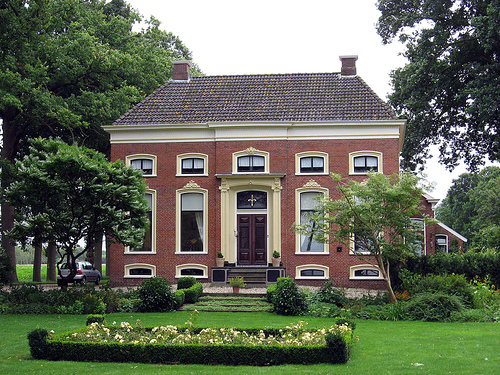
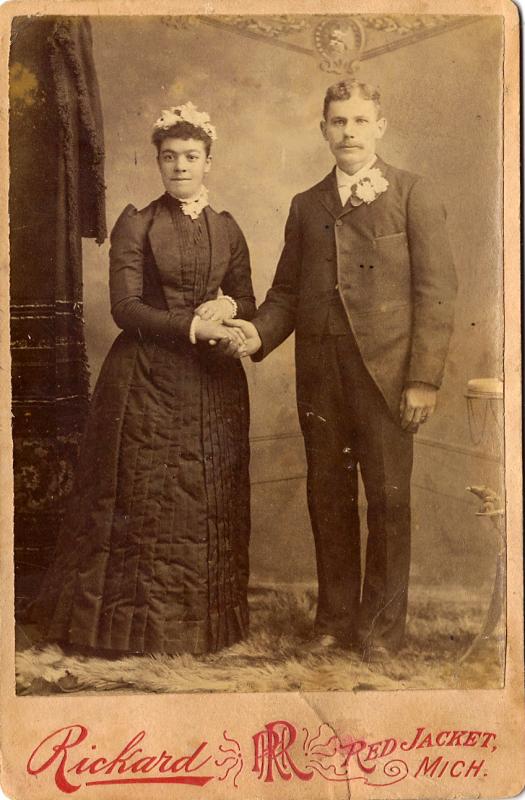
Photo sources are here and here and here.
#

Thanks, Magdalen!

If you want to read more about Neels, or share your love of her books, make sure to check out The Uncrushable Jersey Dress, a blog for all things Neels.

Posted in romance novels | Tagged | 2 Comments

“My Son,” Ada Tyrrell

My Son

Here is his little cambric frock
That I laid by in lavender so sweet,
And here his tiny shoe and sock
I made with loving care for his dear feet.

I fold the frock across my breast,
And in imagination, ah, my sweet,
Once more I hush my babe to rest,
And once again I warm those little feet.

Where do those strong young feet now stand?
In flooded trench, half numb to cold or pain,
Or marching through the desert sand
To some dread place that they may never gain.

God guide him and his men to-day!
Though death may lurk in any tree or hill,
His brave young spirit is their stay,
Trusting in that they’ll follow where he will.

They love him for his tender heart
When poverty or sorrow asks his aid,
But he must see each do his part–
Of cowardice alone he is afraid.

I ask no honours on the field,
That other men have won as brave as he–
I only pray that God may shield
My son, and bring him safely back to me!

–Ada Tyrrell

Posted in wwi poetry | Tagged | Comments Off on “My Son,” Ada Tyrrell

On Getting Away with Cliché

After a small hiatus from the genre, I started reading romance novels again in December, and I have some new thoughts.

The reason for my burnout: the constraints of the genre had palled. Instead of soothing through familiarity, they scraped across my nerves because of their sameness. I found myself skimming over scenes of first meetings, scenes of realization, scenes of sexual intimacy–skimming in novels by authors whose work I love, whose prose is skilled and creative. Everything began to seem clichéd.

I was overcome by ennui. I went through my To Be Read boxes and culled a couple of dozen romance novels I’d acquired but not yet read. Then I drew out some recent novels by favorite authors and moved them to the top of the pile, in the hope of reigniting my interest; I also pulled out some classics I hadn’t yet read. (One exception was the new Marjorie Liu novel, which I read almost immediately after purchase. I think, in my mind, her romances skew more towards science fiction/fantasy; for me they weren’t subject to my burnout.)

From the Oxford English Dictionary definition of cliché:
a. fig. A stereotyped expression, a commonplace phrase; also, a stereotyped character, style, etc.
b. Used as adj. Stereotyped, hackneyed.

I revived my interest in Romance with older novels by Patricia Gaffney (Crooked Hearts) and Anne Stuart (Devil’s Waltz). What I found engaging about the two novels is how strongly the authors’ voices were present in both the way the stories were written and in the progress of the stories themselves. While remaining firmly within genre boundaries, both authors used humor and specificity of detail, in their own particular ways, to enliven their stories. Both novels were rich in unforced banter arising from characterization that did not feel pasted on. Both novels took unexpected turns, which is tricky when you have to follow an overall romantic arc.

Also, both novels had a sort of meta-commentary on Romance as a concept, whether directly or indirectly. Whether in internal monologue or dialogue, the protagonists of the Gaffney and Stuart novels reacted against societal expectations of what romance ought to be. For example, in Crooked Hearts: “Unhand me, I said.” Hazily, she wondered why she was talking like a heroine out of Sir Walter Scott. In addition, both hero and heroine are atypical; they are criminals. In Devil’s Waltz, the hero is an atypical representative of the Rake stereotype because he maintains his self-centered behavior throughout almost the entire novel, instead of instantly shedding his Rake behavior as soon as he meets the heroine. Stuart invites the reader to be in on her joke.

I think that’s a way to make it work, the way to explore overwhelmingly common ideas without losing the reader’s interest: imbue the hackneyed with unique individual detail that comes from your own personality, not mechanically, but organically. It works for description, it works for characterization, and it works on a larger scale.

Another thought I had is that these were both older books, so their genre constraints were a little different from books that are coming out now. Totally aside from these being books written by skilled authors, these books felt different because they were different. I had enough distance from their conventions that they felt new to me.

For that reason, I’m finally reading Laura London’s The Windflower for the first time, widely acknowledged to be a classic. More on that later.

Posted in romance novels, writing craft | Tagged , | 7 Comments

Thoughts on Julie Taymor’s The Tempest

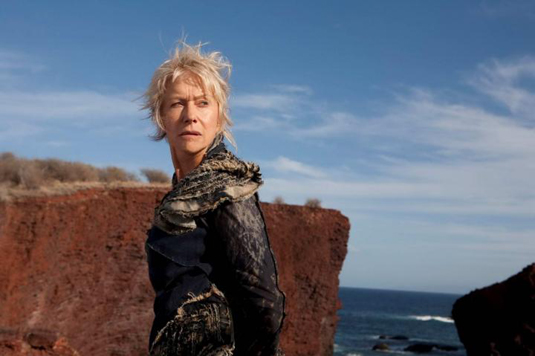
When I first heard that there was to be a movie of Shakespeare’s play “The Tempest” with Helen Mirren playing the lead role (Prospera rather than Prospero), I nearly screamed with excitement. That was before it actually came out in theaters, and it turned out I wasn’t able to go and see it. As soon as the DVD was available for pre-order, I pre-ordered. And waited. And waited, as the release was delayed time and again. Finally it arrived, and finally I had a free evening to sit down and absorb it.

I loved so many things about this movie, Helen Mirren in the lead role first among them. She was so strong and powerful, so very believable as a middle-aged woman who wielded mighty forces of magic, who loved and wanted the best for her daughter, who was both arrogant and wise, who made mistakes. She gave me chills. I couldn’t look away. Also, her outfits were awesome.

The main difference the cross-gender casting made in the play was in Prospera’s background; Taymor added in a bit about how her husband was Duke, then she was made Duke in his place, so her later betrayal by the other heir had added resonance: she was a woman who earned power, which was then taken away by accusations of, basically, using her femininity/magic to gain power unnaturally. I think the cross-gender casting also made a difference in her relationship with Miranda. A same-sex parent/child relationship has a different feel to it; I got the feeling Prospera was trying to save Miranda from suffering at the hands of patriarchy in the same way she suffered (true, by marrying her off to some random wet guy…).

I thought all of the performers were amazing, with the exception of Reeve Carney. He played Ferdinand, who seemed impossibly low-key and bland in comparison to the other actors; in the accompanying documentary, I found out he was a singer rather than an actor, which makes sense. He was simply overpowered. In all of his scenes with Felicity Jones, who played Miranda, I was fixated on her and could barely remember to look at him. He did a lovely job with his singing, though!

My favorite performers, after Mirren, were Ben Whishaw as Ariel and Djimon Hounsou as Caliban. Both men wonderfully embodied the otherworldly aspects of their characters. It’s true there were a lot of special effects surrounding Ariel, but the actor’s face and voice and especially how he used his body were a big part of how I experienced the character. He was especially deft in showing hints of emotion between Ariel and Prospera. Hounsou as Caliban had a lot of wacky body and face makeup, but I think he would have been fine without it, because he did so much with his body and voice to show Caliban’s complex, twisted mess of loneliness and ambition and pain. Also, I really like Hounsou’s speaking voice.

The movie was filmed on a small island in Hawaii, very cool since the play itself takes place on an island. The landscape, especially the vistas of cracked lava rock, had an eerie, bleak feel that I loved each time that the cameras returned to it. It became part, in my mind, of Prospera’s bleak, revenge-driven emotional landscape, tempered only by her love for her daughter.

Some viewers might find some of the special effects silly at times (they were low-budget). I didn’t mind them. To me, they were fine if not state-of-the-art (the Ariel water effects were more than fine!). It was the actors’ performances that were important to me, and I found they were utterly worth the wait.

Posted in movies, recommendations | Tagged | Comments Off on Thoughts on Julie Taymor’s The Tempest

Cover Reveal – “Under Her Uniform”

Under Her Uniform by Victoria Janssen

Isobel Hailey has disguised herself as a man so she can fight in the British Army in World War I. Only a few people know the truth, including her two officer lovers–so why can’t she stop thinking about handsome Corporal Andrew Southey instead? Isobel has to keep her wits about her and her erotic fantasies hidden so she doesn’t blow her cover. But when she and Andrew find themselves working closely on a mission, their attraction–and the truth–is impossible to deny….

A sequel to Victoria Janssen’s The Moonlight Mistress, available May 2012 in ebook from Spice Books.

Posted in promo | Tagged | 7 Comments

“The Tombstone-Maker,” Siegfried Sassoon

The Tombstone-Maker

He primmed his loose red mouth and leaned his head
Against a sorrowing angel’s breast, and said:
‘You’d think so much bereavement would have made
‘Unusual big demands upon my trade.
‘The War comes cruel hard on some poor folk;
‘Unless the fighting stops I’ll soon be broke.’

He eyed the Cemetery across the road.
‘There’s scores of bodies out abroad, this while,
‘That should be here by rights. They little know’d
‘How they’d get buried in such wretched style.’

I told him with a sympathetic grin,
That Germans boil dead soldiers down for fat;
And he was horrified. ‘What shameful sin!
‘O sir, that Christian souls should come to that!’

–Siegfried Sassoon

Historical note: The British claimed that the German army used the fat from human corpses to make various products during World War I in The Times (April 1917) and later in other newspapers. British Foreign Secretary Sir Austen Chamberlain officially admitted that the story was untrue, but not until 1925. Sources: Phillip Knightley, The First Casualty; Arthur Ponsonby, Falsehood in Wartime; Walter Laqueur, The Terrible Secret.

Posted in sassoon, wwi poetry | Tagged | Comments Off on “The Tombstone-Maker,” Siegfried Sassoon

Dracula, by one person, in one hour

I did something cool Monday night. Friends of mine invited me to their house to see a one-man show of Dracula, performed in one hour. There was no way I could resist.
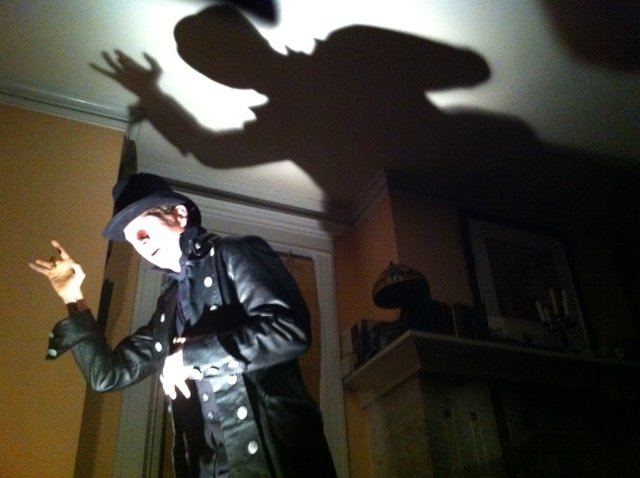
The picture illustrating this post was taken by one of the hosts, Kyle Cassidy, with his iPhone while the performance was going on. What you can’t see is the windowseat behind the actor, which held a small, stuffed Winnie the Pooh. I kept wondering if Winnie was to be one of the victims.

Joshua Hitchens, the actor, wrote the one-hour adaptation of the novel himself. After the performance, he said he’d first read Dracula at age eight, and though it terrified him, he also became fascinated with it. He’s previously performed the show only a few times: at the Philadelphia Fringe Festival, and at Philadelphia’s Rosenbach Museum and Library, which houses Stoker’s original notes and sponsors a Dracula festival each year. Hitchens had the chance to actually see and touch the notes when he performed there.

I think the audience was about a dozen people, some of whom I knew, such as local writer Michael Swanwick and his family, and some whom I’ll be happy to see again in the future. We gathered in the living room for snacks and–of course–red wine. Then we settled in the front room and waited. Some of the cats wandered in and out, and we heard mysterious creaks from above (the house is a Victorian, like most in West Philadelphia).

Hitchens wore a simple black costume. His only props were a copy of the novel, a chair, and a spotlight, borrowed from Curio Theatre Company. The spotlight was on the floor, aimed at the ceiling; Hitchens used it throughout in various ways by changing his relative position to cast shadows and, once, by turning it off completely. The coolest part, for me, was how he changed posture and speaking style for each character. I know that’s what actors do, but it’s still nifty to see, particularly when the changes happen in a split second. I was enthralled the entire way through; I enjoyed seeing how Hitchens interpreted each character. For example, Dr. Van Helsing was both avuncular and a little jovial, Dr. Seward was a bit depressed.

I have never read Dracula (I know, I know, shame!), but once I had to critique a spinoff story, so I have read a very detailed summary. Even if I hadn’t read the summary, the play would have been really easy to follow, thanks to the excellent adaptation. Most of what was trimmed, I think, was secondary plot. Quincey’s character was also cut save for one mention (Dr. Seward got his bowie knife at the end).

Aside from the play itself, though, what I loved the most was the intimacy of it. We were right there, only feet from the stage, in a small room that seemed to hold more energy, or different energy, than a giant theater. And, periodically, Milla the cat wandered in, curious about the goings on. She lent another level to the intimacy as she checked out audience legs, considered checking out Hitchens’ legs but thought better of it, jumped onto the prop chair, jumped off again just in time…I was paying attention, truly, but the cat was part of the experience for me.

You can read the hosts’ accounts of the event at Kyle’s LiveJournal and Trillian’s LiveJournal. There are some additional pictures at those posts that Kyle took afterwards. And here’s Michael Swanwick’s post.

Posted in vampires, writing | Tagged | 2 Comments