Just a Gigolo…Hero?

Today at Heroes and Heartbreakers, Just a Gigolo…Hero?, in which I discuss some of the ways in which romance heroes have been, umm, on the game.


Kate’s Father: I’m sad because, my darling, our poverty has reached such extremes that I can no longer afford to keep us and must look to my own dear tiny darling to sustain me in my frail dotage.
Kate: But father surely…
Kate’s Father: Yes, Kate. I want you to become a prostitute.
Kate: Never! Father.
Kate’s Father: Do you defy me?
Kate: Indeed I do for tis better to die poor than to live in shame and ignominy.
Kate’s Father: No it isn’t.
Kate: I’m young and strong, clever, my nose is pretty. I shall find another way to earn a living.
Kate’s Father: Oh please go on the game. It’s a steady job and you’d be working from home.

Blackadder series II, “Bells”

Posted in guest, links | Comments Off on Just a Gigolo…Hero?

The Regency TBR – Help me!

I have a pile of Regency romances (of the Signet Regency variety) in my TBR. I need help in prioritizing.

Many of these were recommended by Twitter friends and bloggers whom I read. Which five would you recommend I move to the top of the pile?

Joan Aiken, The Five-Minute Marriage
Jo Beverley (have been sort of saving this, as she’s a favorite author), The Fortune Hunter
Bethany Brooks, Her Perfect Earl
Nancy Butler:
The Kindness of a Rogue
Lord Monteith’s Gift
The Prodigal Hero
The Bartered Heart
Castaway Hearts
The Prodigal Hero
The Rake’s Retreat
The Ramshackle Suitor

Marion Chesney, Miss Romney Flies Too High
Elisabeth Fairchild:
Valentine’s Change of Heart
Marriage a la Mode
The Silent Suitor
Captain Cupid Calls The Shots

April Kihlstrom, The Nabob’s Widow
Allison Lane, The Notorious Widow
Emma Lange, A Certain Reputation
Elizabeth Mansfield, Her Man of Affairs
Evelyn Richardson, The Scandalous Widow
Sheila Simonson, Love and Folly
Phylis Warady, Breach of Honor
Joan Wolf, His Lordship’s Mistress

Posted in reading, recommendations, romance novels | Tagged | 10 Comments

Jane Eyre (2011)


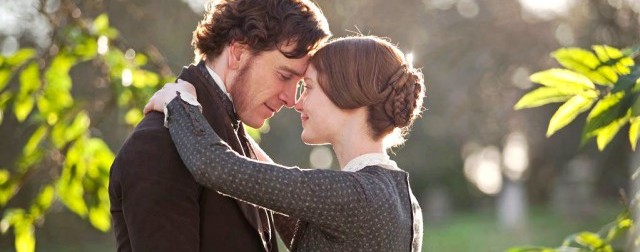
I’ve finally seen the 2011 adaptation of Jane Eyre, starring Mia Wasikowska in the title role and Michael Fassbender as Rochester. Wasikowska is probably best known for her role as Alice in the 2010 Tim Burton movie Alice in Wonderland; Fassbender played Burke in the movie version of Jonah Hex, which I didn’t see, and I believe is going to be Magneto in the upcoming X-Men: First Class…I might have to see that, just to see how it turns out.

I’ll get my “it’s not the book!” whining over with first, then talk about what I liked.

I reread the book last May and posted on it extensively, thus I could tell the movie did excerpt some dialogue verbatim, or almost verbatim. However, overall the movie was very impressionistic, zigzagging back and forth through the book’s sequence, and focusing on certain key scenes. I suppose this was necessary, given that a feature film is really only about the length of a short story, not a large novel. I was still a little disappointed about that. Not sure what I was expecting!

The movie begins with Jane fleeing Thornfield, cuts to her alone on the moor, cuts to her discovering the Rivers household. There are flashes of Lowood and her childhood at Gateshead interspersed, a way of showing the depths of her despair, and some of where she has come from. I was easily able to follow, but am not sure how easy it would be if you had not read the book or been familiar with the progress of the story.

Though much condensed, the Jane/Edward scenes at Thornfield are shown in sequence, with only brief interruptions that flash forward to her time with the Rivers family. That sequence focuses on her relationship to St. John, and barely shows Mary and Diana Rivers. I know the likely reason was time, but the privileging of Jane’s relationships with men over those with women annoyed me somewhat. I’ve always thought Mary and Diana to be an extremely important part of the book, Charlotte’s thoughts on her own sisters and on family. From this movie, there’s no real hint of their character (not much of St. John, either, though he gets more screen time–his character only really comes to life in his final scene).

Back to Jane and Edward. Those were, I felt, the best parts of the movie, though I’m not sure how I would have liked this “greatest hits” version of their relationship if I hadn’t read and loved the novel. Judi Dench played Mrs. Fairfax, and of course was awesome, but I wondered, a little, if she had a little too much camera time just because she was so excellent and not because the film needed it. Or perhaps her excellence made it seem that way!

The costuming was terrific. My eye is only slightly educated about period dress, but it all looked appropriate to me. I loved, loved, loved that we got to see the underpinnings of dresses at least twice and Rochester in only his shirt at one point. (Check out this recent blog post by Susan Holloway Scott on an 18th century man’s shirt.) I was amused to note that the one time we see the rear of Rochester’s breeches, he’s leaning out a window, so they’re pulled snug. In an earlier scene with Jane’s male cousin, you can easily see how baggy the seat of the breeches is. (If I could remember where I learned about baggy breeches bottoms, I would link.) Finally, when Jane returns to Thornfield at the end, she had the best bonnet ever.

The overall impression I had of the film was that it was about enclosures, in direct contrast to the gorgeous outdoor shots of endless rolling moor and constant wind. Even aside from so many scenes taking place inside of houses (the plot can be divided into those different houses: Gateshead, Lowood, Thornfield, Jane’s cottage, etc.), the visual enclosures were so frequent they had to be intentional; they occur in both large and small scale.

When Jane first arrives at Lowood, she steps out of her nice gown; she’s enclosed beneath her wedding veil; later, after the abortive wedding to Edward, she unlaces herself with trembling hands and steps out of the gown, standing exposed in her underthings as she is emotionally exposed. When outdoors, she is repeatedly shown within walled gardens, even when she and Edward are first in love.

It isn’t until the end, at Ferndean, that they meet outdoors, with no walls in sight. To be nitpicky, that’s in contrast to the description in the novel: “…grass-grown track descending the forest aisle, between hoar and knotty shafts and under branches arches…all was interwoven stem, columnar tunk, dense, summer foliage–no opening anywhere.” But Jane emerges from that into the freedom of an honest relationship with her Edward.

I think this adaptation is totally worth seeing, if you can handle that it isn’t the book, and couldn’t be the book. It’s its own thing.

Posted in brontë, movies, reading | 4 Comments

Linkgasm: A Friday Erotic Miscellany

I’m a guest at the Novelists, Inc. blog today, chatting about resting.

At Heroes and Heartbreakers, you can read my analysis of Balogh’s Tangled as an erotic romance. and my top 5 virgin (romance) heroes.

On to the links I didn’t write.

New-to-me blog The Pursuit of Harpyness posted “Eclectic Thoughts on Finding [Woman-Empowering] Erotica. It’s a great blog, I recommend browsing further that that one post.

Blogger Amazon on Sex, Sexwork, and Pornography, “a jumping-off point to talk about social perceptions of sexwork and sexworkers.”

Alison Tyler notes there’s a new review of her anthology Frenzy: 60 Stories of Sudden Sex, in which I have a bit of flash fiction, only 100 words long.

There’s a conference today at the University of Cinncinnati that I wish I could attend! It’s on social justice and the media, with a number of talks relating to gender and sexuality issues. Here are a few of the more interesting-sounding papers: Disco Stick: Lady Gaga and the Phallus, Anna Huelefeld; The Gaga Manifesto: Gender, Sexuality and Cyborg Mythmaking, Christina Black; Women Creating Desire for Themselves: Slash Fanfiction, Boys’ Love Manga, and Expanding the Possibilities of Pornography, Caroline Hyatt; and several others. Hopefully, some of the papers will be available online.

Posted in anthropology, erotica, links, m/m | Comments Off on Linkgasm: A Friday Erotic Miscellany

Mary Balogh’s TANGLED

At Heroes and Heartbreakers, I analyzed Mary Balogh’s Tangled as an erotic romance.

I focused on the first two sections of the novel, and how the marriage of the two main characters develops and changes through their sexual relationship.

Posted in erotica, genre, guest, romance novels | Tagged | Comments Off on Mary Balogh’s TANGLED

Building Setting: Inherent Conflict

When creating a setting for a novel, it needs to provide opportunities for conflict.

For example, in a Regency Romance, the conflict is generally between the characters and the social mores of that time and place. For one reason or another, the characters must rebel against what’s expected.

Another example is setting a story in the middle of a war. The characters’ conflicts can be set against the larger conflict and either mirror or oppose it. The characters might be on opposing sides of the war, or caught up in it against their will, or have their lives destroyed by it.

I’m considering exactly what conflicts I’d like to have in my new project. Since I’m building the world, I can build in the conflicts that best serve the story I want to tell; the setting and the story can evolve together, symbiotic.

I’ve already written stories set during war (The Moonlight Mistress) and I really liked the range of conflicts I could work with in that sort of setting. The plot I’m currently thinking about would happen before World War One–or rather, its analogue in this fantasy world–begins. In fact, the start of the war would be integral to the plot conflict. Will the characters have a chance to prevent it, or is the war inevitable, and their issues dealing with a range of impossible choices? I’m the creator of that world, so those decisions are mine to make. They’ll affect the whole story.

Also, there’s theme to consider. Major conflicts should be related to the story’s theme. How can I integrate theme into setting? Should I even do this ahead of time, even in a general way? I think I should. But that doesn’t mean coming up with pre-emptive theme will always work, or always be the best thing.

I don’t have any definite answers in this post; I don’t think there really are any definite answers. But I was wondering how others deal with this issue. How do you choose the conflicts that will exist in your setting? Do you work from world to characters, or characters to world, or in some other way entirely? What’s your process?

Posted in writing craft | Comments Off on Building Setting: Inherent Conflict

Active Settings

I had a note to myself that I should blog about “active settings.” I didn’t remember exactly why I’d written that phrase down, but ideas began to spill into my mind, as if the phrase was a cue.

Thinking of setting as active could be a useful concept for both historical and speculative fiction. After all, setting in where and when characters move, where they act. Setting can say things about character, and character can say things about setting. Our perception of a setting can change completely based on the point of view. In that case, character and setting can illuminate each other; it’s an active interaction.

Consider this brief extract from Arkfall by Carolyn Ives Gilman: “[The landscape] would have looked hellish enough to other eyes. A chain of seafloor vents snaked along the valley floor, glowing in places with reddish rock-heat…Everywhere the seafloor was covered with thick, mucky vegetation feeding on the dissolved nutrients: fields of tubeworms, blind white crabs, brine shrimp, clams, eels, seagrass, tiny translucent fish. The carefully nurtured ecosystem had been transported from faraway Earth to this watery planet of Ben. To Osaji, the slimy brown jungle looked like the richest crop, the most fertile field, a welcoming abundance of life.”

Setting can create tension. In Kage Baker’s The Women of Nell Gwynne’s, the actions of the characters conflict with the mores of their society/setting – even though it’s a steampunk universe, it’s overall Victorian England: “Secrets were, in fact, the principal item retailed at Nell Gwynne’s, with entertainments of the flesh coming in a distant second. Secrets were teased out of sodden members of Parliament, coaxed from lustful cabinet ministers, extracted from talkative industrialists, and finessed from members of the Royal Society as well as the British Association for the Advancement of Science.” The tensions of the historical setting make the plot possible; I think that could be considered an active setting. Another variation along these lines might be the setting is part of what the characters have to overcome.

Other thoughts I had, which I won’t expand on too much yet, include when the setting changes and the characters have to change with it. For example, when a stable situation is torn apart by apocalypse, and the characters have to go through the apocalypse and survive the post-apocalyptic world. A more sedate example might be when seasons change: viewing characters’ lives against a background of changing seasons that might have thematic meaning. In historicals, a background of dramatic historical events could be active, especially depending on what the author does with them.

I’ll have to consider what role setting will play in my new project. I’d like there to be more conflict between my characters’ goals and the setting than there is right now. I also have some vague thoughts of dealing with active conflicts within the setting, between the real world historical elements and my fantasy alterations. It will be fun to see if I can build some of those ideas into my concept.

#

Last week, I got a mention on SF Signal for my article If You Build It, They Will Come, written for Heroes and Heartbreakers and cross-posted to Tor.com.

Posted in historical fiction, sf/f, steampunk, writing craft | Comments Off on Active Settings

Digital Publishing Linkgasm

There have been some substantial articles recently that go deeper into issues of digital publishing and how it’s affecting and possibly might affect the print publishing market.

Romance author Stephanie Laurens wrote a 7-part, very thoughtful commentary on recent changes in publishing, from the point of view of a bestselling author of print genre fiction.

Authors Barry Eisler and Joe Konrath, both of whom do extremely well publishing digitally, discuss “the history and mechanics of the publishing industry as it exists today, analyze the way the digital revolution reflects recent events in Egypt and the Maghreb, and consider a completely inappropriate YouTube video featuring a randy monkey and an unlucky frog.” It also explains why it was economically sound for Eisler to reject $500,000 for a print publishing deal.

Kristine Kathryn Rusch continues to stay on top of hot topics over at The Business Rusch. Last Friday’s post is particularly insightful about Amanda Hocking’s choice to publish four of her novels through a print publisher, about Connie Brockway’s decision to independently e-publish, and the announcement there will be exclusively electronic sales of 100 of Dame Catherine Cookson’s backlist novels.

Rusch also commented: “…once upon a time, meaning ten years ago, publishers used to buy stand-alone sequels to books still being published by other publishers. In fact, the new publisher loved to snatch away a book with a built-in audience…the real explanation is that the beancounters changed. They went from people who understood publishing to people who understand how to make a corporation look profitable in the short term. If you use that short-term thinking, then you don’t understand how to build audience, which is what publishing is all about. This short-term thinking is what has gotten publishing into the dilemmas it is in right now, from losing its monopoly on the book delivery system to not controlling e-books and e-rights until this year to watching its print sales decrease day by day.

Books sell by word of mouth. If you don’t keep the product on the shelf long enough to build word of mouth, you sell fewer books. Duh. But the corporate beancounters, who only care about this quarter’s bottom line and not the bottom line say, five years from now, don’t understand that.”

At Digital Book World, Gather a group of digital publishing pros and usability experts in the same (virtual) room, and the discussion gets deep, detailed, and far-seeing.

And at Hot Hardware, Beware the New eBook Scam.

Posted in business of writing, digital, links | Comments Off on Digital Publishing Linkgasm

If You Build It, They Will Come: Worldbuilding in Urban Fantasy

If you missed it on Wednesday, I have a new post on Heroes and Heartbreakers: “If You Build It, They Will Come: Worldbuilding in Urban Fantasy.”

My other posts at Heroes and Heartbreakers.

Posted in genre, guest, paranormal, sf/f | Comments Off on If You Build It, They Will Come: Worldbuilding in Urban Fantasy

Paranormal Allegories

I have a post on Heroes and Heartbreakers today: “If You Build It, They Will Come: Worldbuilding in Urban Fantasy.”

Now, on to today’s post!

What do the paranormal creatures in Paranormal Romance represent? Are they allegories?

You could say, sometimes a gorgon is just a gorgon. I think, though, it’s valuable to think about paranormal creatures in fiction as allegories, symbolic representations of things from our own society that we want to examine or critique. I think that writers can’t afford not to think how their paranormal characters might be representing roles in society, from sexual to racial to any of a dozen other categories.

I’m not considering writing a paranormal…not exactly. But I’m thinking about this issue now because it’s something I want to use in my new project. If I think about it enough, maybe I can encourage my brain to use the concept on an unconscious level.

What does the writer want to convey with a story about a paranormal being? How is the text she produces working to convey what she intends? How is her text working against her, and what can she do about it? What different interpretations and judgments might readers have of the text?

Here’s a very generalized and exaggerated example of what I mean. The werewolf might represent an overwhelming sexual hunger. What does that interpretation say to the reader? I estimate that, in ninety percent of Paranormal Romance novels featuring werewolf characters, the werewolves are male. Is the implication that women can’t experience overwhelming sexual hunger, because if we don’t see it on the page, it doesn’t happen? Is the implication that periods of uncontrolled sexual hunger are natural and desirable for men, or alternatively, deviant? What message does the preponderance of male werewolves give? It’s all very well to mention that “oh, yes, female werewolves in this world also are lauded for losing themselves and devouring enemies,” but if that is not shown in a scene, it leaves much less of an impression on the reader than the seven scenes in which a male werewolf changes form and devours his enemies before having wild sex with the heroine. But it’s very easy to fall into that trap, without even noticing one is falling.

A writer can’t control every interpretation her audience places upon her work. Reading is in many ways a joint effort between writers and readers. But I think the writer can be mindful of the possible range of interpretations of her stories. Vigilant, even.

I don’t think writers should shy away from this. I think it can add a lot to a story’s depth if we keep in mind the richness that’s possible through allegory.

Here’s another very generalized example. Vampires have often been used as allegories for outsider populations, including people who suffer from a disease. If the writer chooses the latter option, the disease chosen will affect the story. For example, I read various 1980s and 1990s stories in which vampires were an allergory for humans with HIV. To criticize how our real-life society demonized those who contracted HIV, vampirism was shown to spread more easily than in some other vamprie stories, and the vampires were shown as unjustly persecuted by society. Alternatively, vampirism as an allegory for tuberculosis might show the vampires as Keats-like artists. Vampirism as an allegory for flesh-eating bacteria…would work better as a zombie story, I think.

I’m going to keep thinking about this. Do you have any thoughts? Examples? Do I need to just shut up and write?

Posted in paranormal, sf/f, vampires, werewolves, writing | 4 Comments