IASPR Call for Proposals

Just in case anyone out there is interested!

A Call For Proposals for The Third Annual International Conference on Popular Romance:

Can’t Buy Me Love?
Sex, Money, Power, and Romance
New York City
June 26-28, 2011

The International Association for the Study of Popular Romance (IASPR) is seeking proposals for innovative panels, papers, roundtables, discussion groups, and multi-media presentations that contribute to a sustained conversation about romantic love and its representations in global popular media. We welcome analyses of individual books, films, television series, websites, songs, etc., as well as broader inquiries into the reception of popular romance and into the creative industries that produce and market it worldwide.

This conference has four main goals:

1. To explore the relationships between the conference’s key thematic terms (sex, money, power, and romantic love) in the texts and contexts of popular romance, in all forms and media, from a variety of disciplinary and theoretical perspectives
2. To foster comparative and intercultural analyses of these recurring themes, by documenting and/or theorizing the ways that different nations, cultures, and communities think about love and sex, love and money, love and power, and so on, in the various media of popular romance
3. To explore how ideas and images of romantic love—especially love as shaped by issues of sex, money, or power—circulate between elite and popular culture, between different media (e.g., from novel to film), and between cultural representations and the lived experience of readers, viewers, listeners, and lovers
4. To explore the popular romance industry–publishing, marketing, film, television, music, gaming, etc.—and the roles played by sex, money, power, and love in the discourse of (and about) the business side of romance.

After the conference, proceedings will be subjected to peer-review and published.

Please submit proposals by January 1, 2011 and direct questions to conferences [at] iaspr [dot] org.
Posted in reading, romance novels | Comments Off on IASPR Call for Proposals

I’m a Naughty Guest Today


I’m a guest today at The Naughty Girls Next Door, with my thoughts on “Selling the Unusual Setting.”

Drop by and say hello! I’d love to hear your thoughts on this topic.

Posted in guest | Comments Off on I’m a Naughty Guest Today

Websites Are Interview Suits

If you’re reading this blog, you may or may not have visited my website. I’ve been thinking about it a lot in the last year or so. I’ve read articles and blog posts about what makes a good website. I’ve made lists of other people’s websites that I like. I’ve investigated designers.

You will notice, though, I haven’t done much with the actual website. The reason? It takes commitment on my part. I have to make a whole host of decisions, and I’m not sure I’d be making the right ones. I’m in the midst of looking at even more websites, and also at designers.

Currently, my website is fairly simple. I hand-coded it myself (partly why it’s so simple!). Though I know how to do tables, I haven’t yet included any on my website because I worry that they won’t come across properly on all platforms; I feel that’s a valid concern, when so many people access websites through their phones or other handheld devices. I don’t want to make those people wait around for complex pages to load.

On the other hand, a plain website doesn’t look Glossy and Fashionable. I have to decide how important that is to me, to look…I suppose the word to use is successful. As in, “fake it until you make it.” As in, wear a suit to a job interview even if the current employees go to work in jeans.

I seem to have a knee-jerk bias against looking Glossy. I’m not sure why. I don’t think my bias is necessarily a good thing, in this case. Because there are interview suits. (I even have one! Though I haven’t worn it in a while.) And even though this blog gets many more hits than my website, seemingly making it more important, that won’t necessarily always be the case, particularly if I manage to integrate blog with website someday soon (one of the things I’m discussing with a web designer).

I don’t want to turn off a potential reader simply because they don’t like my face.

Posted in business of writing, promo | 8 Comments

Edmund Blunden, "Vlamertinghe: Passing the Chateau"


Vlamertinghe: Passing the Chateau

And all her silken flanks with garlands drest–
But we are coming to the sacrifice.
Must those flowers who are not yet gone West?
May those flowers who live with death and lice?
This must be the flowerist place
That earth allows; the queenly face
Of the proud mansion borrows grace for grace
Spite of those brute guns lowing at the skies.
Bold great daisies’ golden lights,
Bubbling roses’ pinks and whites–
Such a gay carpet! poppies by the million;
Such damask! such vermilion!
But if you ask me, mate, the choice of colour
Is scarcely right; this red should have been duller.

–Edmund Blunden

Posted in blunden, wwi poetry | Tagged | Comments Off on Edmund Blunden, "Vlamertinghe: Passing the Chateau"

Wilfrid Wilson Gibson, ‘The Going"

The Going

He’s gone.
I do not understand.
I only know
That as he turned to go
And waved his hand,
In his young eyes a sudden glory shone:
And I was dazzled by a sunset glow,
And he was gone.

–Wilfrid Wilson Gibson

Posted in gibson, wwi poetry | Tagged | Comments Off on Wilfrid Wilson Gibson, ‘The Going"

Descriptive Worldbuilding

When I was writing The Duchess, Her Maid, The Groom & Their Lover, I was doing a lot of my worldbuilding on the spot, whenever I felt something was needed.
I do think about aspects of the world before I begin writing, but probably just as much comes along in the middle, or during revisions, when I suddenly realize, “I never described this room, and that would set the scene better.”

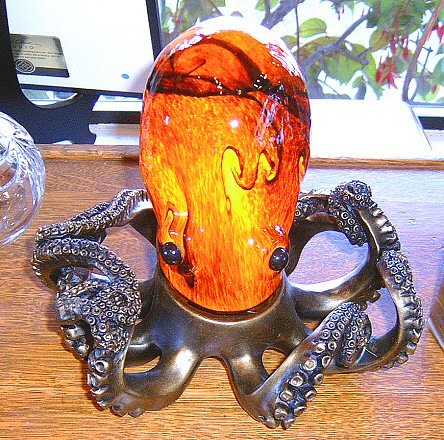
If I’m in a hurry, or just can’t decide how to “dress” a room, I sometimes use the internet to find items I think would be appropriate for my setting and story. I use the pictures I find to inspire me and decide how to describe the often-vague images in my mind. The octopus lamp that illustrates this post is one such. I’d already decided I wanted octopuses to be a theme of Maxime’s duchy, and had planned to give the decor a mingled Mediterranean/Asian feel. This lamp gave me the idea to have oil lamps as described below. Sea creatures of other kinds would also be popular there, as the duchy’s economics depend on its port. In addition, I wanted to give the duchy’s aesthetics an Art Nouveau feel, for two reasons. I like that aesthetic; and decor can subtly show how this duchy is different from the oppressive duchy shown earlier.

Camille’s palace furnishings are shown as heavier and more medieval in style, mixed with eighteenth-century French decor, that I intended to hark back to Louis XIV and the French revolution. Sometimes I was even more explicit: …the corridor of red marble was lit by yellow beeswax candles, sweet-smelling and thick as his forearm, in gold sconces shaped as unearthly smooth disembodied feminine hands, braceleted in cruel red stones. I actually saw a picture of a lamp in the shape of a woman’s hand, though it wasn’t as disturbing as the sconces I wrote about! I looked at a whole variety of pictures of medieval and Renaissance beds.

All of my ideas about the various duchies, plus looking at images online, yielded these descriptive passages for the scenes set in Maxime’s duchy:

[Henri] entered the room, which flickered with oil lamps behind colored glass, red and gold and sunset orange. On a second look, he saw the glass had been blown into the shapes of bulbous octopuses with bronze tentacles and bright bubbles encircled by bronze dolphins.

He’d left his red and black lacquered portable writing desk on a bamboo stand nearby.

She strolled with Captain Leung…up a short staircase to a tower room filled with padded divans in shades of cream and buttery yellow, bamboo tea tables, and potted plants, some large enough to be called small trees, others draping vinelike from the walls and ceiling.

Luckily for me, I’m using some of the same settings for The Duke & the Pirate Queen; that saved me a little effort when I had scenes taking place in Maxime’s ducal palace.
Posted in the duchess, writing craft | 5 Comments

Under Flowerpots, Mostly

This post was originally written for Savvy Authors.

It makes me chortle when people ask writers “Where do you get your ideas?” Because where does anyone get ideas? And what kind of ideas do they mean when they ask?

I probably shouldn’t laugh, because most of the time, that question generates really interesting answers.

What’s my answer? I find my ideas under flowerpots, mostly. And by that I mean I have to reach down into places where I don’t normally look, where composting is going on. To me, ideas are combinations of seeds or, wrenching away from my very stretched flowerpot analogy, sparks.

A spark will make something in my brain go “That’s interesting!” or “yes!” but it isn’t a story. It doesn’t generally have inherent conflict, so it can’t be a story. It’s when that spark meets another, and maybe several others (it’s like fire!), that ideas begin to form.

(If I’m confusing you, well, that’s not unusual for me! Sometimes, when I’m trying to explain something I’m writing, I’m reduced to waving my hands around and making noises like “shunk” and “zhirrr.”)

How I get ideas is not a wholly, or even mostly, conscious process for me. But I’ll try to explain.

Here’s an example, using a story that is only partially written. I decide to write a story about a young woman and a much older man. That’s the spark, which might have come from a call for submissions, or just brainstorming a list of setups for stories; I can’t remember any more. Later, it occurs to me that the thing they have in common is a love of baseball, which is another spark. Still later, those sparks begin to overlap and make more sparks, such as maybe the man was a minor league baseball player and the woman’s mother was obsessed with him at the time, and this leads to emotional complications separate from their original relationship that create conflict and also works thematically with the May-December romance in some way. Eventually, all those sparks reach a state of density that means I have enough Idea to make a story. Anybody could use those same sparks, but they would always come up with a different idea from them, and subsequently a completely different story.

The story I wrote for Alison’s Wonderland, “The Princess,” is very, very short: it’s only one hundred words long. But it still had more than one spark. The sparks for that story include: gender role reversal; the story of Andromeda; stereotypical princesses; and surprise ending. The combination of sparks is what makes the story unique, and mine.

I have learned something from writing this post. What I have learned is that I’m not very good at dissecting where I get my ideas!

Actually, that’s a good insight. It means that I really do find my ideas under flowerpots. For me, that works. And since one of the major rules of writing is do what works, I’ll take it.

What works for you when you’re looking for ideas?

Posted in writing, writing process | 2 Comments

Contemporary Historical Resources Linkgasm

Here are a few links I’ve found useful in my historical research. These are all collections/archives of contemporary materials. Contemporary to historical periods, I mean.

Old Magazine Articles, edited by Matt Jacobsen. “OldMagazineArticles.com is a Los Angeles-based website; privately owned and operated, it is the effort of one old magazine enthusiast in particular who believes deeply that today’s readers of history can learn a good deal from the old periodicals. It is a primary source website and is designed to serve as a reference for students, educators, authors, researchers, dabblers, dilettantes, hacks and the merely curious.”

The Home Economics Archive at Cornell University contains full-text articles and books from 1800-1999.

The Life Magazine photo archive, covering from the 1860s through the 1970s.

The Early 1900s in Color. This was a blog post at Citynoise.org that features a collection of color photographs from around the world.

Posted in historical fiction, images, links, research | 2 Comments

The Journal of Popular Romance Studies, First issue!

The Journal of Popular Romance Studies has published its first issue! If only this journal had been around when I was in graduate school…but no, then I never would have gotten around to writing novels.

So far, I’ve read A Little Extra Bite: Dis/Ability and Romance in Tanya Huff and Charlaine Harris’s Vampire Fiction, by Kathleen Miller. Abstract: “This essay examines Tanya Huff’s Blood Price and Charlaine Harris’s Dead Until Dark through the lenses of Disability and Feminist Studies to suggest that in these works disability functions as a reclamation of the female body–which has often been viewed as ‘always and already’ deformed–even as it contributes to the reinvention of the vampire romance genre.”

I found the essay fascinating because I didn’t know much about Disability Studies as a discipline, and now I’m excited to know more. I was intrigued by the ways the two books worked with and against the idea that these heroines are imperfect simply because they’re female, as well as because of their damaged sight or telepathy; their otherness is then heightened and explored when contrasted with their powerful, immortal partners. Read the article to learn more.

There Are Six Bodies in This Relationship: An Anthropological Approach to the Romance Genre, by Laura Vivanco and Kyra Kramer, has some really cool ideas in it as well. I never enjoyed the fact that I’d read the French theorist Foucault, until now, when it proved useful!

I was also very happy to see Pamela Regis’ review of Historical Romance Fiction: Heterosexuality and Performativity, by Lisa Fletcher, as I’ve been thinking of reading that book.

I can’t wait to read through the rest of the issue!

Posted in genre, reading, romance novels | 2 Comments

Trusting Authorial Voices

I’ve recently been thinking about novel beginnings, and how it’s common (and good) advice to start with big obvious conflict. However, I don’t think that it’s always necessary to do that. More importantly, I’ve been thinking about why that is true for me as a reader, and by extension, as a writer.

When I begin reading a new book, I want to trust the author, and the author’s voice. I want that as much as or more than any other element of the story. If the author’s voice is strong/interesting, she doesn’t have to be describing Things Blowing Up Real Good. Her prose can ease me into the story. This is more likely to happen if I am familiar with the author, and that trust is already established; otherwise, she has to show me she has Style. Not too much Style–not so much that I’m annoyed–but a level that makes me feel I’m in good hands.

As you might guess, the author’s voice is something on which everyone’s mileage will vary. Widely.

More prosaically, I can get involved with a story quickly if it immediately poses questions, either through presenting a mystery or presenting a contradiction or something otherwise unexpected. Even an unexpected description (which goes back to voice, a bit) will do for making me want to read on. (Ditto chapters, scenes, paragraphs, sentences…it’s turtles, all the way down.)

Immediate suffering/problems on the part of the narrator does work for me, as well, quite reliably. I think that’s the quickest and easiest way to engage the reader. What does the protagonist want, and why can’t she have it?

However, I prefer the feeling of being safe in the author’s hands.

As an example, as a child I loved the Chronicles of Narnia. I looked forward to seeing the movie version of The Lion, The Witch, and the Wardrobe after hearing how faithful the details were to the book. However, I didn’t love the movie. After some thought, I realized that what made the experience incomplete for me was that in the movie, the author’s voice was gone. And that voice was what I loved, without even knowing it. I don’t remember flashy opening sentences. I remember the voice.

Related Post: Novel Beginnings – On Opening Sentences.

Posted in reading, writing craft | 2 Comments