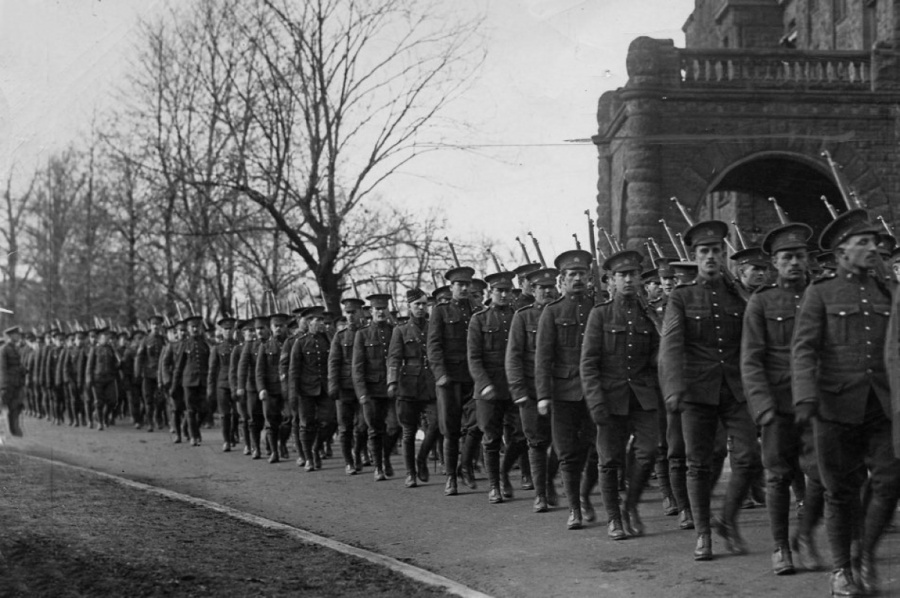
“Antwerp,” Ford Madox Hueffer

Antwerp

I
Gloom!
An October like November;
August a hundred thousand hours,
And all September,
A hundred thousand, dragging sunlit days,
And half October like a thousand years …
And doom!
That then was Antwerp …
In the name of God,
How could they do it?
Those souls that usually dived
Into the dirty caverns of mines;
Who usually hived
In whitened hovels; under ragged poplars;
Who dragged muddy shovels, over the grassy mud,
Lumbering to work over the greasy sods …
Those men there, with the appearance of clods
Were the bravest men that a usually listless priest of God
Ever shrived …
And it is not for us to make them an anthem.
If we found words there would come no wind that would fan them
To a tune that the trumpets might blow it,
Shrill through the heaven that’s ours or yet Allah’s,
Or the wide halls of any Valhallas.
We can make no such anthem. So that all that is ours
For inditing in sonnets, pantoums, elegiacs, or lays
Is this:
“In the name of God, how could they do it?”

II
For there is no new thing under the sun,
Only this uncomely man with a smoking gun
In the gloom….
What the devil will he gain by it?
Digging a hole in the mud and standing all day in the rain by it
Waiting his doom;
The sharp blow, the swift outpouring of the blood
Till the trench of gray mud
Is turned to a brown purple drain by it.
Well, there have been scars
Won in many wars,
Punic,
Lacedæmonian, wars of Napoleon, wars for faith, wars for honor, for love, for possession,
But this Belgian man in his ugly tunic,
His ugly round cap, shooting on, in a sort of obsession,
Overspreading his miserable land,
Standing with his wet gun in his hand….
Doom!
He finds that in a sudden scrimmage,
And lies, an unsightly lump on the sodden grass …
An image that shall take long to pass!

III
For the white-limbed heroes of Hellas ride by upon their horses
Forever through our brains.
The heroes of Cressy ride by upon their stallions;
And battalions and battalions and battalions–
The Old Guard, the Young Guard, the men of Minden and of Waterloo,
Pass, for ever staunch,
Stand, for ever true;
And the small man with the large paunch,
And the gray coat, and the large hat, and the hands behind the back,
Watches them pass
In our minds for ever….
But that clutter of sodden corses
On the sodden Belgian grass–
That is a strange new beauty.

IV
With no especial legends of matchings or triumphs or duty,
Assuredly that is the way of it,
The way of beauty….
And that is the highest word you can find to say of it.
For you cannot praise it with words
Compounded of lyres and swords,
But the thought of the gloom and the rain
And the ugly coated figure, standing beside a drain,
Shall eat itself into your brain:
And you will say of all heroes, “They fought like the Belgians!”
And you will say, “He wrought like a Belgian his fate out of gloom.”
And you will say, “He bought like a Belgian
His doom.”
And that shall be an honorable name;
“Belgian” shall be an honorable word;
As honorable as the fame of the sword,
As honorable as the mention of the many-chorded lyre,
And his old coat shall seem as beautiful as the fabrics woven in Tyre.

V
And what in the world did they bear it for?
I don’t know.
And what in the world did they dare it for?
Perhaps that is not for the likes of me to understand.
They could very well have watched a hundred legions go
Over their fields and between their cities
Down into more southerly regions.
They could very well have let the legions pass through their woods,
And have kept their lives and their wives and their children and cattle and goods
I don’t understand.
Was it just love of their land?
Oh, poor dears!
Can any man so love his land?
Give them a thousand thousand pities
And rivers and rivers of tears
To wash off the blood from the cities of Flanders.

VI
This is Charing Cross;
It is midnight;
There is a great crowd
And no light–
A great crowd, all black, that hardly whispers aloud.
Surely, that is a dead woman–a dead mother!
She has a dead face;
She is dressed all in black;
She wanders to the book-stall and back,
At the back of the crowd;
And back again and again back,
She sways and wanders.

This is Charing Cross
It is one o’clock.
There is still a great cloud, and very little light;
Immense shafts of shadows over the black crowd
That hardly whispers aloud….
And now!… That is another dead mother,
And there is another and another and another….
And little children, all in black,
All with dead faces, waiting in all the waiting-places,
Wandering from the doors of the waiting-room
In the dim gloom.
These are the women of Flanders:
They await the lost.
They await the lost that shall never leave the dock;
They await the lost that shall never again come by the train
To the embraces of all these women with dead faces;
They await the lost who lie dead in trench and barrier and fosse,
In the dark of the night.
This is Charing Cross; it is past one of the clock;
There is very little light.

There is so much pain.

L’Envoi:
And it was for this that they endured this gloom;
This October like November,
That August like a hundred thousand hours,
And that September,
A hundred thousand dragging sunlit days
And half October like a thousand years….
Oh, poor dears!

–Ford Madox Hueffer

Posted in wwi poetry | Tagged | Comments Off on “Antwerp,” Ford Madox Hueffer

“‘Ello, I wish to register a complaint.” – Vintage Erotica Cover

This cover proves that the Paranormal Romance subgenre started earlier than we thought it did. Behold the Parrot Shifter.

Posted in erotica, images, paranormal | Tagged | 4 Comments

Sime-Gen and Slashiness

My previous post on House of Zeor (1974) by Jacqueline Lichtenberg is about Sime-Gen and Romance Novels.

If you will recall, in my last post I noted that though the author of House of Zeor explicitly excluded sexuality from the vampiric feeding relationship between Sime and Gen, her descriptive language for the act of feeding was often reminiscient of that used in contemporaneous romance novels. In this post, I want to look at how vigorously she avoided hints of male/male sexuality in her depictions of male/male feeding while, at the same time, creating intensely emotional relationships between two male characters. In today’s parlance we might say, “bromance.” I think part of the reason for this stems from the cultural context of the time in which the book was written; homosexuality was not as openly discussed as it is now.

For those not familiar with fannish jargon, slash fiction depicts a sexual (or romantic, with sex on the horizon or implied) relationship between two characters of the same sex, those characters being borrowed from a “canonical” source such as a television show, a movie, or a book. Though there is some argument about terms, in general fanfiction is not considered slash if the homosexual relationship depicted is canonical, for instance fanfic about character relationships from the tv show “Queer As Folk.” By definition, a “canonical” work cannot be slash. Slashy is something different. “Slashy” canon is likely to engender slash fanfiction (bromantic cop shows, for example, are often considered very slashy). So, while House of Zeor is considered slashy, it is not slash. It has simply been a starting place for a number of slash stories.

I’m not going to write about Sime-Gen slash, however, since I haven’t read any (yet). What interests me is the tangled way sexuality is presented in House of Zeor. “Slashy” is the very first descriptor I heard for the Sime-Gen novels. For me, sampling the novels after I was already familiar with slash fanfiction, this was obvious. I’m going to focus on why House of Zeor struck me as slashy. (Took me long enough, didn’t it?)

Just as in romance novels, romantic tension in slash is often heightened by the forbidden nature of the attraction (they come from different social classes, for example, or one character is immortal and one is not). In House of Zeor, the avoidance of attraction often feels as if it “doth protest too much.”

“You will, no doubt, be pleased to note that the suite has two large, separate bedrooms.”

“Oh, it wasn’t that bad [when they were forced to share a bed].” Valleroy blushed pink under his tan. He had lain stiff as a corpse the whole night, afraid Klyd would make some unthinkable advance.

…Valleroy pressed his lips against the Sime’s. Those sensitive, Farris lips were smooth, dry, and hotter than any Gen’s because the Sime body temperature is much higher. But there was absolutely no similarity with the kiss of a woman.

…Valleroy wondered about that. Every time he’d touched or been touched by a Sime, there had been not the slightest tinge of any sort of sexual overtone. Here was a totally separate body function. A complete new life process to add to the traditional biologist’s list. And, like the other vital life processes, it took priority over reproduction. In the case of selyn transfer, the libido was completely short-circuited–very much as adrenaline suspends digestion.

I suspect the reason for repeated removal of sex from the equation had to do with the story’s exploration of power relations as separate from gender relations–trying to see what life might be like if being male or female was not relevant. In science fiction of this period, and indeed today, thought experiments of this type are very common, the roles of oppressors and oppressed being reversed, shifted, or removed entirely. Given that science fiction is always really about the contemporary world, though, this never works perfectly. As you can see in the quotes above, taking sex out of the equation is more difficult than it looks. 1974 clearly leaves an imprint on the text.

When sex is deleted from the equation, the unequal power relationship depicted still has, to our eyes, sexual overtones; possibly more so for women readers. Women, like any oppressed minority, are more practiced at noticing nuances of power relations in their everyday lives, which might explain why the majority of slash fans are female. They have eyes for the slashy vibe. They gain power by turning that vibe to their own desires. That is a topic that I could explore for…far too long for a blog post, and I would probably deserve a PhD at the end of it all. Back to the novel.

Other scenes, to me, have a strong feeling of romance, or at least strong sexual bonding.

…the Sime’s rain-slicked hands gripped Valleroy’s wrists. Then hot tentacles twined around his forearms, pulled him forward until his lips met the hard-set Sime mouth. Valleroy felt himself being pulled inside out. His every nerve was afire with rushing sparks of pain that left blackness in their wake…as if his soul was being sucked from his body into a vast black void!

There are hints of other forms of sexuality, as well, other possibilities.

Something told Valleroy that [Klyd] was feeling an even more intense awareness of Aisha’s [Valleroy’s girlfriend] feminity that he himself was. And from what he’d learned of the Householding custom, Valleroy knew that the channel’s gene was so valuable that he was allowed to take whatever woman he fancied…whenever he liked. Strangely enough, Valleroy wasn’t jealous even when Klyd put a hand on Aisha’s cheek. But if the Sime had any ideas regarding her, he forgot them immediately. She fainted.

One brief scene in the novel troubled me, and I have not yet parsed fully how it might fit into my theories. A male Sime character at an auction is presented as preferring to feed only on male Gens. It’s clear there is a sexual component, and other Simes join together to prevent his purchases (which are legal; the Gens are being sold to be killed by having their energy consumed).

Klyd explains, “It’s extremely rare among Simes. Narvoon is from out-Territory originally. I’m told he had a particularly hard time of it, and he was warped by the experience. Some say he hates himself for being Sime, and can’t stand the thought of having children. Others say this is his way of committing suicide, and it’s working. I don’t know, but he certainly isn’t well.”

It’s hard to reconcile this speech with the slashiness of the rest of the novel, though it does easily fit into the “evil leering gay villain” trope. It seems almost gratuitous, as that character never appears again.

I’m going to keep thinking about this book. It’s fascinating to me how a story can mirror so much of a society’s hopes, fears, and desires.

I leave you with one final example of slashiness that also works for romance:

Klyd reached out and took Valleroy’s hand. “How can you find the capacity to be angry with me… after what we’ve just done?”

Something of that deep rapport that had welded the two of them in transfer still lingered in that touch. Valleroy said, “I can’t be angry.”

Posted in fanfiction, romance novels, sf/f | Tagged | 4 Comments

Sime-Gen and Romance Novels

A shorthand description of the Sime-Gen series is “Science Fictional Vampires,” but the stories are far from being that simple. The Simes, human mutants with tentacles housed in their arms, can only live through drawing life force from the Gens, who have the appearance of normal humans but are also mutants. The series explores, very deeply, a range of issues raised by one portion of humanity requiring another portion of humanity as food, the strengths and weaknesses of both sides, and their struggles to achieve a balance. As you might imagine, the baseline issue is power: one part of society has it, another appears not to have it.

The first novel, House of Zeor by Jacqueline Lichtenberg, was published in 1974 (she had begun writing it in the late 1960s). It led to a series of novels by the same author as well as some collaborations with Jean Lorrah. In addition, there was and is extensive fanwork related to the series, including a large number of print fanzines. For quick reference: A General Overview of Sime~Gen by Linda L. Whitten. Series website. Some fanwork is also available online.

My history with the series is very brief. Long ago I was staying with friends-of-a-friend for a weekend event. They had a number of the books, perhaps all of them. I read one, or possibly two (they aren’t very long). I then forgot about them until a year or so ago, when a friend decided to reread the entire series. I became interested, and started with House of Zeor, the earliest published.

I found many, many points to ponder in House of Zeor, because in my view it mirrors and interacts with second-wave feminism, in particular with feminist thought on sexuality and power relations. At the same time, the text seems curiously blind to other ways that it represents aspects of sexuality, gender, race, and colonialism.

In later novels of the series, I’m told, there is more exploration of what power the Gens hold, but in House of Zeor, the focus is on the predatory power of the simes, seen through the eyes of a gen named Hugh Valleroy. In his world, most simes live by killing a gen every few months. While searching for his gen girlfriend, who’s been taken captive by simes, Hugh must work with Klyd Ambrov Zeor, who is working to create a society in which simes do not kill. Klyd is one of a rare minority of simes, called channels, who can take energy from gens, store it within themselves, and then feed it to other simes. Klyd’s goals are made more complex by the rarity of his mutation. Hugh, beginning from a place of fear, comes to believe in Klyd’s goals.

I find it fascinating how the author explicitly excludes sexuality from the Sime-Gen feeding relationship. Klyd laughed…. “Channels are virtually incapable of anything but a vigorous, if intermittent, heterosexuality.” At the same time, the author used language that can easily be interpreted as sexual, some of it even closely akin to language I have seen in romance novels.

I was especially reminded of 1960s and 1970s romance novels that featured socially and sexually powerful male figures—often referred to as “Alpha Males”–paired with naïve, younger, less socially powerful women. These male figures generally take the lead in the sexual aspects of the relationship, and are often forceful about it due to the heroine’s lack of experience or her “secret desire” to be dominated. Given that these novels are contemporaneous with House of Zeor, I don’t think it’s farfetched to assume a connection, whether conscious or unconscious.

Klyd held out one steady hand in a matter-of-fact gesture that lulled Valleroy’s distrust. An attacking Sime, hungry for a Gen’s selyn–the very biologic energy of life itself–didn’t ask consent before moving in for the kill. For a moment, Valleroy felt a strange confidence in the channel…”Mr. Valleroy. I feel your fear of me…and fear brings out the beast in a Sime….”

Klyd points out to Hugh, “You’d have to learn not to fear [Simes] or be constantly in danger of attack…unless you were rendered low-field by transfer.” Transfer means that the gen has given energy to a sime. I couldn’t help but equate this statement with gender relations, something like the false statements used to blame women for being attacked by men: “You can’t be scared of men or they’ll attack you…unless you keep your personality under wraps/wear concealing clothing/don’t try and take jobs that belong to men.”

Later, Hugh has his first close look at the unique feature of sime anatomy, which reminded me of a romance heroine’s first view of an erect penis, and her first (traumatic) experience of sex.

He’d never actually seen Sime tentacles so close, and the reality sent his skin crawling. Six tentacles to each forearm, two “dorsal” along the top, two “ventral” along the bottom, and smaller ones, laterals, always sheathed except in selyn transfer, along each side. Retracted, they lay along the forearms from the elbow to wrist like ropes of gnarled muscle. But when extended they were like pearly-gray snakes, supple, muscular, and hypnotically fascinating.

And later on: Valleroy could appreciate how vulnerable a Sime must feel with those nerve-rich laterals unsheathed. He could see it in the almost imperceptible trembling of the soft pink flesh. And yet, these organs were the most deadly survival equipment possessed by any species on the face of the earth.

…Valleroy sat down hard in his chair. “…The last time a Sime touched me…like that…it was horrible…I want to [donate energy], but I don’t know if I’ll be able to bring myself to do it. I get shaky just thinking about it.”

…[Klyd] took Valleroy’s hands, twining tentacles around the Gen wrist. “You see what I mean?” Valleroy flinched away from the Sime’s hot touch, his heart again racing painfully. The muscular, handling tentacles were covered with an incredibly soft, dry, smooth skin like a velvet sheath over steel. They left a lingering sensation on Valleroy’s skin that made his hair stand on end.

The text demonstrates that there can also be pleasure involved in transfer, at least for simes; the inexperienced gen is excluded. Again, the language used reminded me of romance novels.

“Klyd works dispensary every day so that each of us gets a turn with him every few months. And his touch is like…” [The sime] trailed off, enraptured by a distant vision of paradise.

Valleroy prompted, “Like what?”

“Oh,” she said shaking her head sadly, “you wouldn’t understand.”

Klyd’s physical description reinforced my impression of romantic heroes: “distinctive features—aquiline nose, sensitive lips, concerned brow, intense chin and jaw line….”

It isn’t much later in the novel that women came into the story with any significance.

Hugh has these thoughts concerning his girlfriend, Aisha: “Her conventional Gen background had given her conventional Gen ideas. She couldn’t understand Simes enough to analyze them like that. It was one reason he’d never been able to talk marriage to her…or to any girl he’d ever met.” Aisha does not actually appear in a scene until perhaps the last quarter of the novel, and though she does accomplish one important act, she feels superfluous to the story as a whole, an afterthought. Meanwhile, Klyd’s wife, Yenava, is not even mentioned until about halfway through, and she only appears briefly in a couple of scenes, one in which she, extremely pregnant, is working as a teacher of children and one in which she has an argument with Klyd.

[Yenava] threw the folder she’d been carrying to the floor at Klyd’s feet and broke loose from his grasp. “You…unfeeling…beast!” Without waiting for a reply, she tore out into the colonnade and was gone. Klyd parted the hangings she’d left swinging in her wake and called after her, “You’re tired. You’d better get some rest!”

She then dies offstage, in childbirth. The cause of her death is lack of Klyd’s presence to ease her through complications; he’s been delayed in his mission with Hugh. To me, the lack of female characters was telling. It was as if gender relationships were entirely set apart from the gen-sime thought experiment, even though the influence of sexuality on the novel’s central problems, to me, seems obvious.

…But I have gone on long enough for now. Stay tuned for the next post, going live Wednesday, about male/male relationships in House of Zeor.

Posted in fanfiction, romance novels, sf/f | Tagged | 4 Comments

“The Jewish Conscript,” Florence Kiper Frank

The Jewish Conscript

There are nearly a quarter of a million Jews in the Czar’s army alone. –Newspaper clipping.

They have dressed me up in a soldier’s dress,
With a rifle in my hand,
And have sent me bravely forth to shoot
My own in a foreign land.

Oh, many shall die for the fields of their homes,
And many in conquest wild;
But I shall die for the fatherland
That murdered my little child.

How many hundreds of years ago–
The nations wax and cease!–
Did the God of our fathers doom us to bear
The flaming message of peace!

We are the mock and the sport of time!
Yet why should I complain!–
For a Jew that they hung on the bloody cross,
He also died in vain.

–Florence Kiper Frank

Posted in wwi poetry | Tagged | Comments Off on “The Jewish Conscript,” Florence Kiper Frank

That vine is worrying….


Please feel free to supply your own captions in the comments.

…I have been wondering if that vine has a name. And if it likes walks on the beach.

If you missed it earlier this week, I have a new post over at Heroes & Heartbreakers, about Rosina Harrison’s memoir Rose: My Life in Service to Lady Astor.

Posted in erotica, images | Tagged | Comments Off on That vine is worrying….

A few mystery novel previews

I’ve had a few more previews of new mystery novels up at The Criminal Element recently.

Fresh Meat: The Traitor in the Tunnel by Y.S. Lee – a young adult spy novel featuring a female spy.

Fresh Meat: Nine for the Devil by Mary Reed and Eric Mayer – this one is set during the reign of Emperor Justinian, and features a eunuch detective.

Chomp by Carl Hiaasen – another Young Adult mystery, riotously quirky and hilariously funny.

Posted in mystery | Comments Off on A few mystery novel previews

More on Holding the Line by Harold Baldwin

This is a continuation of my comments from this post.

Because I read Holding the Line on my e-reader, I was able to easily copy quotes that I found interesting. I reproduce them here for my own reference and, hopefully, your enjoyment.

Here’s a bit about the equipment assigned to each infantryman: Hanging from the belt is the entrenching tool and handle; it is shaped like a tiny grub hoe. One would be apt to be amused at the idea of digging a hole with a toy like that, but under shell fire you could dig a hole quicker with that little tool than with a pick and shovel. Next is the haversack worn on the left side and the water bottle on the right. In the pouches attached to the belt and braces a hundred and twenty rounds of ball ammunition are carried. In addition to all this a man takes his blanket and oil sheet rolled on the top of his valise.

This lengthy anecdote, also relating to equipment, took place immediately after Baldwin’s arrival in France. At five o’clock in the morning we were issued goatskin coats, mittens and gloves, and inspected by the O. C. The order came to march, and in heavy marching order, we trudged to the depot. This marching order consists of rifle and bayonet attached to braces, which in turn are attached by self-locking buckles to the belt, the knapsack or valise which usually contains a shaving kit, towel, soap, change of underwear, socks, one pair of boots, mess tin, and any other little convenience you may wish to carry. Later on we learned by bitter experience to dispense with everything except absolute necessities. The aforesaid goatskin coats were a gift from the then Czar of Russia and were supposed to have come from China. When we had donned our gift coats there was a perceptible murmur of comment running from end to end of the ranks, caused by the odor from the presents of the Czar not unlike the presence of a skunk. Examination disclosed that the bloody (literally) coats were dotted in many places with the actual flesh of the deceased animals still sticking to them. In spite of stern orders from the O. C’s. of the various companies to maintain silence during inspection, it was plainly discernible that the smell had penetrated even the seasoned nostrils of the officers themselves, from the Colonel down….I am certain that the Germans would have been badly frightened that we had a poison gas of our own if we had had a chance to tackle them with our coats on when the stink was fresh and full in its pristine glory, as it was when we first got them.

Baldwin refers to his experience of the Zonnebeke Road at Ypres, at least I think he does, since he calls it the “Z– Road.” (Edmund Blunden’s poem The Zonnebeke Road.) At last we emerged on the road, and, to my dying day, I shall never forget the sights that met our eyes. Everywhere were shell craters, both on the road and on each side of us. In every shrine, where the Belgians placed their crucifixes, men in agony from the gas had crawled and died there; dead bodies, dead horses, wrecked ambulance cars, gun limbers, ammunition limbers, and in one place were six of the very finest horses I have ever seen, with their drivers, dead. Villages, where the people had been living when we went up, were now utterly desolate; everything a smoldering mass of ruins, such had been the fury of that shell fire. And it was still going on, shells screaming over us or bursting close by.

For those who’ve read War Horse or seen the recent movie, here’s a mention of one way the British army used horses: I must tell of the men who were supplying our guns with ammunition. Six horses on a limber, with three drivers, and two carriers on the limbers, would trot steadily to the bomb-proof shelter where the ammunition was kept, load up, and still at the steady trot return to the guns. All the time heavy shrapnel was bursting overhead, and the awful crack of this shell is enough to break the strongest nerve.

Though the memoir was intended as propaganda, I still found some of the imagery riveting.

Posted in research, wwi | Comments Off on More on Holding the Line by Harold Baldwin

Holding the Line by Harold Baldwin – WWI Challenge

My next book for The WWI Challenge is Holding the Line by Harold Baldwin. It’s a memoir that was published in February 1918, when most memoirs I have looked at seem to have been written and published in the years after the war was over, in the 1920s and even the 1930s. That’s Baldwin over to the left.

I soon discovered this memoir had been intended as a recruiting tool; Baldwin was an Englishman living in Canada, working to enlist more Canadians and to enlist Americans to fight alongside the British on the Western Front. It was interesting to read what anecdotes he chose to include in his memoir, given his purpose. More than once he defended the British regular army against various claims against them, for instance that they used colonial troops as cannon fodder to spare themselves.

Baldwin enlisted in August 1914, despite being two inches too short for regulations (he did, however, meet the requirement in body weight). This means that he was among the first 20,000 Canadians to enlist and be sent to France. He was wounded, so far as I can tell from the text, at the Second Battle of Ypres in April 1915, which means that he most likely began writing his memoir well before the Americans entered the war. I am guessing he meant to recruit Americans to go overseas with the Canadians if their own army was not yet involved. (At that point, the United States was neutral in the conflict, and public opinion did not favor entering the war at all.)

Perhaps part of it was, “if a shorty like me can be a soldier, you’re really a wimp if you think you can’t do it.” More than once, Baldwin emphasizes the physical strength needed to be a soldier and specifically states what great shape he was in after hauling equipment on long marches and, later, training to be a message runner. His rhetoric reminded me a bit of modern men’s fitness magazines. He also shares anecdotes that are humorous at his own expense, which could alleviate any idea that he is boasting; that might be a narrow line to walk, when he expected skeptics to be reading his work.

Baldwin throughout talks about the camaraderie and mentoring among the men (his mentors were usually British Regular Army), and is quite honest about fear.

During our stay in this billet I was always very conscious of a curious frightened feeling, and as I looked at the carefree faces of my comrades, I often wondered if they felt as I did. Sometimes a dull, menacing boom, making the air vibrate, would cause a silence to fall and a far-away look in the eyes told me more emphatically than any words could that the rest of the boys were “thinking it over,” probably just as hard as I was doing.

Or this: It is a peculiar sensation to find yourself under fire for the first time. A man feels utterly helpless and at first he will duck his head at every whiz he hears. Of course ducking is useless, because if you hear the whiz of the pill, or the report of the rifle, you are still untouched, but every man who has ever experienced this will tell you that he could not help ducking even knowing how useless it was.

I found this bit particularly interesting, just from my geeky standpoint of understanding the weapons they used.

It was while trying to keep warm that first night over the little charcoal fire that I first learned how to handle my bayonet, if I was ever to be lucky enough to ram it so far into a German belly that I couldn’t pull it out handily. The lesson came from a corporal of the East Lanks (Lancashires) who was explaining the advantages of the Lee-Enfield rifle and bayonet over the Ross [which the Canadians had], and his description was so realistically vivid that my teeth forgot to chatter with the chill I had. “You see,” he said, “if you push it in too far, you canna get it oot again, because this groove on the side o’ it makes the ‘ole air-tight; as soon as it is jabbed into a man the suction pulls the flesh all over it and you canna chuck it oot.”

“Well, what would you do if you couldn’t get it out and another mug was making for you?” I asked.

“Why if a twist won’t do it, stick your foot on the beggar and wrench it out; if that won’t do it, just pull the trigger a couple of times and there you are–she will blow out.”

“And why couldn’t I do the same with this one?” I asked, referring to my Ross bayonet.

“It’s too broad at the point. The man that gave ye that dam’d thing might just as well ‘ave passed sentence o’ death on yer in a ‘and to ‘and go.”

Late in the memoir, the Lank is proven correct.

The Ross rifle at this stage of the game verified the prophecy of the corporal of the East Lanks. The reader will remember the conversation in the dugout at Armentieres. To my dismay, when I began to fire with rapidity, the cursed bayonet shook itself clear of the rifle. I had fired about six rounds when the bolt refused to work. The rifle was hopelessly jammed, and I tried to hammer the bolt open by placing the butt on the floor of the trench and stamping on the knob of the bolt with my heel. It was hopeless, however, and I hurled “the thing” in the direction of the advancing Germans, with a scream of fury that pierced even that infernal din. The flimsy magazine-spring of these rifles often fails to work, and, generally, at the most critical moment. As a sniper’s rifle, the Ross is everything to be desired; but when fifteen rounds per minute have to be ripped off to make up for a lack of machine guns, the Ross is a miserable failure.

And there are funny bits:

We could not part with Billy; the boys argued that we could easily get another colonel but it was too far to the Rocky Mountains to get another goat…Billy, the goat, is still going strong and it is the boast of the Fifth that Kaiser Wilhelm has not yet “got their goat.”

I enjoyed reading this memoir, and though it was very anecdotal in places, I think I got some useful information about it. I’ll be thinking of this memoir in the context of others I read that were published much later.

Posted in research, wwi | Tagged | 2 Comments

“Song of the Red Cross,” Eden Phillpotts

Song of the Red Cross

O gracious ones, we bless your name
Upon our bended knee;
The voice of love with tongue of flame
Records your charity.
Your hearts, your lives right willingly ye gave,
That sacred ruth might shine;
Ye fell, bright spirits, brave amongst the brave,
Compassionate, divine.

Example from your lustrous deeds
The conqueror shall take,
Sowing sublime and fruitful seeds
Of aidos in this ache.
And when our griefs have passed on gloomy wing,
When friend and foe are sped,
Sons of a morning to be born shall sing
The radiant Cross of Red;
Sons of a morning to be born shall sing
The radiant Cross of Red.

–Eden Phillpotts

Posted in wwi poetry | Tagged | Comments Off on “Song of the Red Cross,” Eden Phillpotts