Janet Mullany – Guest Post

Please welcome my guest, Janet Mullany!

#

IMMORTAL JANE

He released her hands and stood. “Consider, Jane. You’ll marry some bore of a country gentleman who’ll kill you in childbed and who won’t want a bookish wife anyway. Perhaps you’ll stay a spinster and lose your bloom and die young of some disease they’ll find an easy cure for in a hundred years or so. Or you’ll see your sister die first.”

“Now you’re cruel.”

“No, it is the truth. But let us paint a happier picture for Miss Jane Austen. You write a few books that entertain your family and you win a little fame, perhaps even some money, while you live. And after, what then? Your books languish forgotten on dusty bookshelves and you are but a name on a binding that disappears with decay and time. You think your books offer you a chance at immortality?”

Jane and the Damned

*

Jane and the Damned isn’t a romance so it doesn’t have a traditional happy ending. It’s a historical urban fantasy with romance elements, part alternative historical with a bit of this, that, and the other, and some “spot the Austen novel” moments. But I think a characteristic of the HEA is that hero and heroine exist in a bubble of passion, which is why vampire romances are so hot (and, oh yeah, the physical perfection and great sex and all that stuff)—the eternal is now. Never mind that she’ll be looking at hip replacements while he is still a gorgeous 28-year-old sex god. Or, they’ll both be forever young and gorgeous vampires, the HEA distilled into eternity, the passage of time halted.

It’s a great fantasy.

But Jane Austen as a vampire? Neither of these endings would work and I had to create a scenario where her immortality would come with her books, even if at the age of 21 (the book is set in 1797) she was not at all sure she would ever be published. But I was following a trend, even though I hadn’t read a lot of vampire books, and I certainly hadn’t read any of the vampire classics, but I had watched hours of True Blood on HBO before getting tired of all those ripped perfect bodies and all that blood.

All those ripped perfect bodies and all that blood are what I define as Vampires Type A in popular culture. Vampires Type O are the evil ones. The ones mortals must fight to save the world, yadda yadda. And then there’s all this stuff about garlic and holy water and crosses (anyone remember that Roman Polanski movie with the Jewish vampire?—“Oy, lady, did you ever get the wrong vampire…”), not being able to cross running water, go out in daylight, use public transport (I’m making that up), and so on.

I had to come up with a vampire scenario that fit into my depiction of Georgian England, the age of reason and of both social and industrial revolution; the world that produced Jane Austen. I chose very selectively from vampire lore, although essentially the Damned are Type A—hot, desirable, and very fashionable. They’re the ton. Everyone wants to have sex with them or provide them with a dining experience. (These vampires do not feed—that is so vulgar. They dine.) The Prince of Wales (later the Prince Regent) loves to hang out with them and the newspapers are full of their scandalous behavior.

To tie the vampire elements to what we know of Austen’s life, I used another established literary trope, that Austen became what she was because of some lifechanging event: frequently a passionate love affair, a secret destroyed in the letters her sister Cassandra burned after her death. The family secret as I interpreted it was that Jane Austen was once a vampire and it influenced everything she wrote.

Do you agree with my vampire-HEA assessment? And what do you think of the current Austen-paranormal trend?

#

Thanks, Janet! It was great to have you visit!

Posted in guest, historical fiction, paranormal, vampires | 4 Comments

Fascinating Faces

I adore looking at old photographs, particularly photographs of people.

I found this one on the web. It’s of actress Marjorie Day. There’s not a lot of information about her out there that I was able to find on a cursory search. But for my purposes, that doesn’t really matter.

I feel like I know her from the photo, in a different way than knowing facts, in a kind of abstract way. It’s a casual photograph, not overly posed, or so it seems to me. I feel like I have a glimpse of her personality from it.

I can’t stop looking at her expression, at her stance. She’s somebody. You can see it. She will probably show up in my fiction one day.

This Bassano photo in the National Portrait Gallery seems like it’s of a different person.

Posted in images, writing process | Comments Off on Fascinating Faces

My Smashwords Experiment

Recently, I decided to experiment with Smashwords and Kindle publishing. So far, I much prefer the interface and FAQs on Smashwords, though I’ve been told most people sell more copies through Kindle.

For my experimental book, I compiled all of my lesbian erotica that was also speculative fiction (some science fiction, some fantasy). All of these stories were originally in print.

Here’s the result, Erotic Exploits. You can download a free sample that’s 25% of the total, which means at least the whole first story.

Table of Contents:

“Free Falling”
“Camera”
“Wire”
“Toy”
“The Princess on the Rock”
“Place, Park, Scene, Dark”
“Mo’o and the Woman” (also available for free online, elsewhere)

If you buy or download, please let me know how the formatting came through on your device.

Posted in business of writing, erotica | Comments Off on My Smashwords Experiment

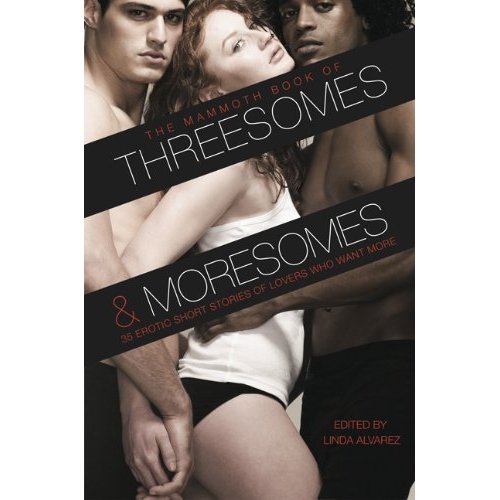
The Mammoth Book of Threesomes and Moresomes


The Mammoth Book of Threesomes and Moresomes, edited by Linda Alvarez, releases today in the U.S.!

(My contributor’s copy has a different cover than the one shown on Amazon. Not sure why.)

It includes one of my favorites of my own stories, “The Magnificent Threesome.” One day, I want to write more about those characters. There are a few classic Western plot elements I wasn’t able to include in the story’s six thousand words or so. But only a few. *ahem*

Posted in promo, short fiction | Comments Off on The Mammoth Book of Threesomes and Moresomes

Dealing with Rejection

I am sure there must be at least a few writers who’ve never been rejected, but I’m equally sure they’re the exceptions that prove the rule. It’s part of being a writer. If you don’t submit your work, it can’t be rejected; but if you don’t submit your work, it can’t be accepted, either. It’s important to remember that even when you’re feeling especially crushed.

Every submission is a risk, even if it seems that your story is absolutely perfect for the editor you’ve chosen. Even if that editor likes your story and wants to buy it, they might have to reject you anyway, because they’ve already spent all their money, or they’ve already filled the anthology, or someone higher up at the publisher hates your prose style. Even if your story or novel is accepted, all sorts of things out of your control can happen and the story will never see print.

I think the best way to deal with rejection, after the screaming and crying, is to keep those things in mind. And then to go do something else. Preferably send out your submission again; but you’re allowed to spend a week watching The Muppet Show in your pajamas, first.

And always keep new projects in the works, ready to get you excited about writing again.

Posted in business of writing | 8 Comments

Edward Thomas, "As the Team’s Head-Brass"

As the Team’s Head-Brass

As the team’s head-brass flashed out on the turn
The lovers disappeared into the wood.
I sat among the boughs of the fallen elm
That strewed the angle of the fallow, and
Watched the plough narrowing a yellow square
Of charlock. Every time the horses turned
Instead of treading me down, the ploughman leaned
Upon the handles to say or ask a word,
About the weather, next about the war.
Scraping the share he faced towards the wood,
And screwed along the furrow till the brass flashed
Once more.

The blizzard felled the elm whose crest
I sat in, by a woodpecker’s round hole,
The ploughman said. ‘When will they take it away?’
‘When the war’s over.’ So the talk began –
One minute and an interval of ten,
A minute more and the same interval.
‘Have you been out?’ ‘No.’ ‘And don’t want to, perhaps?’
‘If I could only come back again, I should.
I could spare an arm, I shouldn’t want to lose
A leg. If I should lose my head, why, so,
I should want nothing more…Have many gone
From here?’ ‘Yes.’ ‘Many lost?’ ‘Yes, a good few.
Only two teams work on the farm this year.
One of my mates is dead. The second day
In France they killed him. It was back in March,
The very night of the blizzard, too. Now if
He had stayed here we should have moved the tree.’
‘And I should not have sat here. Everything
Would have been different. For it would have been
Another world.’ ‘Ay, and a better, though
If we could see all all might seem good.’ Then
The lovers came out of the wood again:
The horses started and for the last time
I watched the clods crumble and topple over
After the ploughshare and the stumbling team.

–Edward Thomas

Posted in thomas, wwi poetry | Comments Off on Edward Thomas, "As the Team’s Head-Brass"

Gilbert Frankau, "Eyes in the Air"

Eyes in the Air

Our guns are a league behind us, our target a mile below,
And there’s never a cloud to blind us from the haunts of our lurking foe–
Sunk pit whence his shrapnel tore us, support-trench crest concealed,
As clear as the charts before us, his ramparts lie revealed.
His panicked watchers spy us, a droning threat in the void;
Their whistling shells outfly us–puff upon puff, deployed
Across the green beneath us, across the flanking grey,
In fume and fire to sheath us and baulk us of our prey.

Before, beyond, above her,
Their iron web is spun:
Flicked but unsnared we hover,
Edged planes against the sun:
Eyes in the air above his lair,
The hawks that guide the gun!

No word from earth may reach us, save, white against the ground,
The strips outspread to teach us whose ears are deaf to sound:
But down the winds that sear us, athwart our engine’s shriek,
We send – and know they hear us, the ranging guns we speak.
Our visored eyeballs show us their answering pennant, broke
Eight thousand feet below us, a whorl of flame-stabbed smoke–
The burst that hangs to guide us, while numbed gloved fingers tap
From wireless key beside us the circles of the map.
Line–target–short or over–
Come, plain as clock hands run,
Words from the birds that hover,
Unblinded, tail to sun;
Words out of air to range them fair,
From hawks that guide the gun!

Your flying shells have failed you, your landward guns are dumb:
Since earth hath naught availed you, these skies be open! Come,
Where, wild to meet and mate you, flame in their beaks for breath,
Black doves! the white hawks wait you on the wind-tossed boughs of death.
These boughs be cold without you, our hearts are hot for this,
Our wings shall beat about you, our scorching breath shall kiss;
Till, fraught with that we gave you, fulfilled of our desire,
You bank–too late to save you from biting beaks of fire–
Turn sideways from your lover,
Shudder and swerve and run,
Tilt; stagger; and plunge over
Ablaze against the sun:
Doves dead in air, who clomb to dare
The hawks that guide the gun!

–Gilbert Frankau

Posted in frankau, wwi poetry | Comments Off on Gilbert Frankau, "Eyes in the Air"

Telepathy and Romance

Telepathy and romance are two great tastes that ought to taste great together. So why is it that, so often, a telepathic heroine or hero–finds true love with the one person whose mind can’t be read?

It’s part of a romance novel’s plot, of course, for a couple to get to know each other better. There need to be obstacles in the way. If one person can read the other’s mind, a lot of the tension is gone from the story. If one of the partners is immune to the other’s ability, that creates tension and can also serve as a signal to the telepath that here is someone special.

But what if the telepathy did work? Usually, in those cases the plot tension arises from the non-telepathic character having secrets which the telepath might accidentally–or purposely–uncover. The telepath might learn things that complicate the relationship further.

But there’s another way to use telepathy in romance, I think, a way that I’ve seen more often in science fiction or fantasy novels that happen to have a romance. Telepathy can be used as a kind of leveller, a new way of looking at how two people interact. “Normal” humans are isolated from each other in many ways. Their intimacies are negotiated and can never be total as we can’t see another person from the inside. What if they weren’t isolated from each other? What happens then?

If one or both characters can read the mind of the other, most of the simple romantic conflicts can be eliminated. The writer has to delve deeper for plot conflict, perhaps specifically engaging with gender roles in a relationship, or other power differentials. The writer could explore how their characters would interact on another level entirely.

Posted in romance novels, sf/f, writing craft | 6 Comments

Heroine Doe

What do you look for in a romance heroine? Or the heroine of a space opera, or of a quest fantasy? What kind of heroine always makes you want to read further?

Does she need to be an orphan, or have a big happy family, or a mean and awful family?

Should her eyes be amethyst or only ever brown? Can she ever be conventionally beautiful?

Is she spunky? Angry? Sweet? Cynical? Kickass?

Can she physically defend herself? Does she have cool specialties?

Is she lonely? Vengeful? Weary? Angry?

What are the characteristics that, if you were given them in a blurb, would make you want that novel immediately?

What kind of heroine do you wish you were reading about right now?

Posted in genre, reading, romance novels | 8 Comments

Types of Masculinity

What does it mean, to be a man? To be masculine? What does it mean to be a man who is the hero of a romance novel?

Romance readers, including me, often talk about “alpha” or “beta” heroes as two generalized types. The alpha can be seen as a protector and/or a provider (rich in money or at least in skills) as well as a person with a need to dominate a relationship, or at least romantic situations; often the alpha is depicted as physically large and strong and far more attractive than the norm. The beta can be equated with the “nice guy” who might or might not be the most muscular or beautiful man the heroine has ever met.

What needs do those two basic types of heroes meet for readers? Are there possible alternative models of masculinity that could satisfy readers? How do market forces affect what’s available? How do reader expectations affect what sells and what writers write? How do types of romance heroes mirror what society finds normative?

Do the alpha and beta models of masculinity allow for truly equal male/female relationships? And how do those roles intersect with female alpha and beta characters in fiction?

Posted in genre, romance novels | 2 Comments