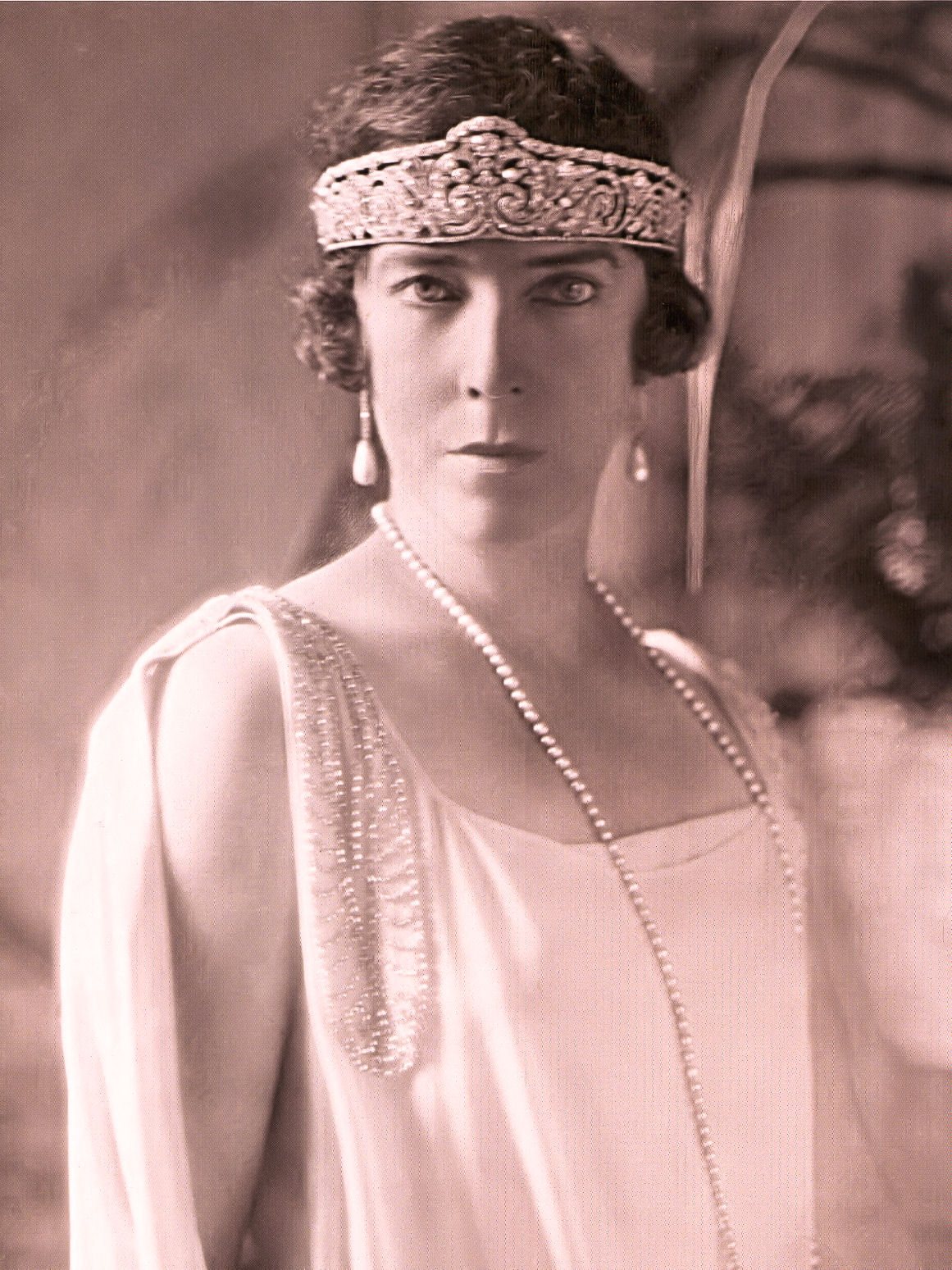
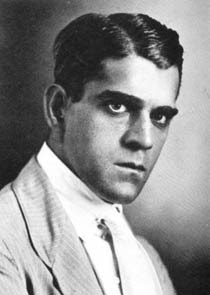
Picspam: Albert I, King of the Belgians

I have learned one very important thing during my recent World War One research. It is that Albert, King of the Belgians, was a total hottie. Particularly when he wore spectacles.

Also, he looked great in uniform, whether with helmet in this late photo

or kepi in this earlier one. Check out the differing details of the two uniforms.

His wife, Elisabeth, was pretty hot, too.

I love this picture.

Sometimes, research is more fun than you expect it to be.

Posted in images, research, wwi | 3 Comments

Erotica Under the Skin

I want to read erotica from the inside.

The surface elements are much less important to me than how the characters feel. A bland setting or one that is poorly realized is, to me, a flaw, and an intriguing one is a bonus, but I don’t absolutely require fabulous worldbuilding. For me, erotica is about the characters.

If the characters are bland, unoriginal, lacking in conflict, then what’s the point of me reading the story? If the characters are intriguing enough, they don’t need to be having sex while riding an elephant up the side of a mountain in the middle of a thunderstorm. If what they’re thinking and wanting and feeling while they have sex interests me, I only need a few key details of what they’re actually doing.

Some erotica, often touted as “literary,” might have other priorities, such as elaborate prose, political commentary, or thought-provoking plot elements. Sometimes I am in the mood for that. But overall, character is the most important element I look for.

I don’t care what gender the characters are, or if the story is about a pair or a menage or simply strangers who’ve met up for a single occasion. I care whether they’re interesting.

Posted in erotica, reading | Comments Off on Erotica Under the Skin

Isaac Rosenberg, "Dead Man’s Dump"


Dead Man’s Dump

The plunging limbers over the shattered track
Racketed with their rusty freight,
Stuck out like many crowns of thorns,
And the rusty stakes like sceptres old
To stay the flood of brutish men
Upon our brothers dear.

The wheels lurched over sprawled dead
But pained them not, though their bones crunched,
Their shut mouths made no moan,
They lie there huddled, friend and foeman,
Man born of man, and born of woman,
And shells go crying over them
From night till night and now.

Earth has waited for them
All the time of their growth
Fretting for their decay:
Now she has them at last!
In the strength of their strength
Suspended–stopped and held.

What fierce imaginings their dark souls lit
Earth! have they gone into you?
Somewhere they must have gone,
And flung on your hard back
Is their souls’ sack,
Emptied of God-ancestralled essences.
Who hurled them out? Who hurled?

None saw their spirits’ shadow shake the grass,
Or stood aside for the half used life to pass
Out of those doomed nostrils and the doomed mouth,
When the swift iron burning bee
Drained the wild honey of their youth.

What of us, who flung on the shrieking pyre,
Walk, our usual thoughts untouched,
Our lucky limbs as on ichor fed,
Immortal seeming ever?
Perhaps when the flames beat loud on us,
A fear may choke in our veins
And the startled blood may stop.

The air is loud with death,
The dark air spurts with fire
The explosions ceaseless are.
Timelessly now, some minutes past,
These dead strode time with vigorous life,
Till the shrapnel called ‘an end!’
But not to all. In bleeding pangs
Some borne on stretchers dreamed of home,
Dear things, war-blotted from their hearts.

A man’s brains splattered on
A stretcher-bearer’s face;
His shook shoulders slipped their load,
But when they bent to look again
The drowning soul was sunk too deep
For human tenderness.

They left this dead with the older dead,
Stretched at the cross roads.
Burnt black by strange decay,
Their sinister faces lie
The lid over each eye,
The grass and coloured clay
More motion have than they,
Joined to the great sunk silences.

Here is one not long dead;
His dark hearing caught our far wheels,
And the choked soul stretched weak hands
To reach the living word the far wheels said,
The blood-dazed intelligence beating for light,
Crying through the suspense of the far torturing wheels
Swift for the end to break,
Or the wheels to break,
Cried as the tide of the world broke over his sight.

Will they come? Will they ever come?
Even as the mixed hoofs of the mules,
The quivering-bellied mules,
And the rushing wheels all mixed
With his tortured upturned sight,
So we crashed round the bend,
We heard his weak scream,
We heard his very last sound,
And our wheels grazed his dead face.

–Isaac Rosenberg

Posted in rosenberg, wwi poetry | Comments Off on Isaac Rosenberg, "Dead Man’s Dump"

"Strange Meeting," Wilfred Owen


Strange Meeting

It seemed that out of battle I escaped
Down some profound dull tunnel, long since scooped
Through granites which titanic wars had groined.
Yet also there encumbered sleepers groaned,
Too fast in thought or death to be bestirred.
Then, as I probed them, one sprang up, and stared
With piteous recognition in fixed eyes,
Lifting distressful hands as if to bless.
And by his smile, I knew that sullen hall,
By his dead smile I knew we stood in Hell.
With a thousand pains that vision’s face was grained;
Yet no blood reached there from the upper ground,
And no guns thumped, or down the flues made moan.
‘Strange friend’, I said, ‘here is no cause to mourn.’
‘None,’ said the other, ‘save the undone years,
The hopelessness. Whatever hope is yours,
Was my life also; I went hunting wild
After the wildest beauty in the world,
Which lies not calm in eyes, or braided hair,
But mocks the steady running of the hour,
And if it grieves, grieves richlier than here.
For by my glee might many men have laughed,
And of my weeping something had been left,
Which must die now. I mean the truth untold,
The pity of war, the pity war distilled.
Now men will go content with what we spoiled.
Or, discontent, boil bloody, and be spilled.
They will be swift with swiftness of the tigress,
None will break ranks, though nations trek from progress.
Courage was mine, and I had mystery,
Wisdom was mine, and I had mastery;
To miss the march of this retreating world
Into vain citadels that were not walled.
Then, when much blood had clogged their chariot-wheels
I would go up and wash them from sweet wells,
Even with truths that lie too deep for taint.
I would have poured my spirit without stint
But not through wounds; not on the cess of war.
Foreheads of men have bled where no wounds were.
I am the enemy you killed, my friend.
I knew you in this dark; for so you frowned
Yesterday through me as you jabbed and killed.
I parried; but my hands were loath and cold.
Let us sleep now….’

–Wilfred Owen (1893 – 1918)

Posted in owen, wwi poetry | Comments Off on "Strange Meeting," Wilfred Owen

Adventures in Pronouns – Jessica Freely Guest Post

Please welcome my guest, Jessica Freely!

#

Hi everybody and good morning! First of all, I want to thank Victoria for generously opening her blog to me — again. I had a great time last time I was a guest here and I’m sure today will be just as much fun.
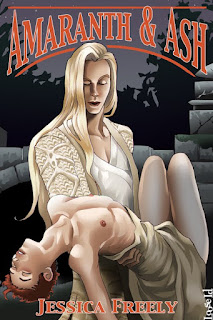
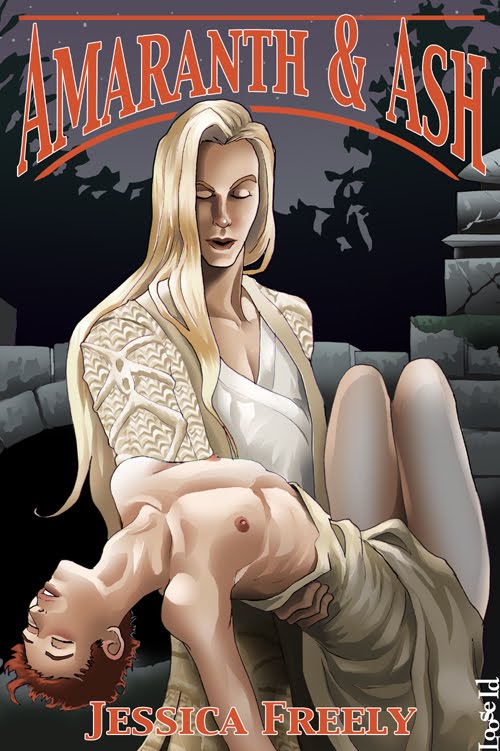
In a second I’m going to tell you a bit about my new release, Amaranth & Ash, and one particular challenge I faced in writing it. Before I do, I want to make a couple of announcements. We’re running a contest today, right here on Victoria’s blog. Leave a comment and you’ll be entered to win a free copy of Amaranth & Ash. That’s easy, isn’t it? Secondly, a free short story featuring some of the major characters from Amaranth & Ash is up in the files section of my newsletter group. It’s called Amaranth & Grail and it’s available exclusively to newsletter members, so if you’d like to join,
In my other life I’m a science fiction and fantasy author and with Amaranth & Ash I decided to create a full-blown world with all the bells and whistles. I created a society, a religion, an economy, and a geography, and I had a blast doing it. Harken’s Landing, the setting of the story, is a city founded by colonists from earth who came to their new world to escape oppression back home. As these things sometimes go, no sooner had they landed than they began oppressing one another. The society is strictly segregated by caste, and each caste has its own distinctive physical characteristics.

When it came to the vasai, who are intersex, I had some decisions to make regarding pronouns. I realized I had an opportunity here to play with gender neutral pronouns. But before I’d even finished writing the book, I had people telling me I couldn’t do that. Reasons given were that it’s distracting to the reader and that gender-neutral pronouns “just sound silly.”

I’m not real big on being told I can’t do something, especially when the evidence summoned to support the sanction is subjective. Isn’t speculative fiction supposed to be about imagining worlds and people radically different from our own? How far can we really get if we must constantly adhere to a gender binary system? I felt locked into a male-female dichotomy that I don’t happen to think represents contemporary humans very accurately, let alone the people of Harken’s Landing. Worst of all was the expectation that I was supposed to accept that as “just the way it is.”

So, predictably, I started fooling around with all kinds of pronoun systems. A great resource I found is Regender.com. With this handy web tool, you can read any internet web page a variety of ways: with gender pronouns switched, with gender neutral pronouns, or with pronouns based on race instead of gender. It’s a fascinating way to shake up your preconceptions and I recommend it.

I had a wealth of ideas to play with. My personal favorite was a caste-based pronoun system I devised. It made sense! After all, in Harken’s Landing the most important thing that everyone needs to know about you, before anything else, is your caste. So it stands to reason that their language conventions would enshrine caste divisions instead of reproductive roles. To keep it simple, I created pronouns for each caste based off of the name of the caste. It looked like this:

Male – He smiled. – I kissed him. – His hands shake. – That is his.
Female – She smiled. – I kissed her. – Her hands shake. – That is hers.
Elai – Ei smiled. – I kissed Eir. – Eir hands shake. – That is Eirs.
Vasai – Va smiled. – I kissed var. – Var hands shake. – That is vars.
Pel – Pe smiled. – I kissed per. – Per hands shake. – That is pers.
Chel – Che laughed – I kissed chem. – Ches hands shake. – That is ches.

See? Simple!

Here is a section of Amaranth & Ash and how it would have read if I had gone with this idea:

Evanscar inclined var head. Even with var soul packed up tight as a fist, Amaranth could feel the vasai’s eyes boring though var back as va made var way to the refreshments. Va handed var empty glass to Build, the pel attendant. “Thank you,” pe said.

Then, Parnal appeared. Amaranth went to Eir immediately, took Eir hands, and bowed over them. “Can you forgive me?”

Parnal was a middle-aged Elai of solid proportions, a hair shorter than Amaranth but wider and thicker. Ei was balding, and the hair that remained was dark with flecks of gray and trimmed short. Eir eyes were pale blue, Eir face rectangular and stolid. “I wondered if perhaps I had done something to put you off,” Ei said.

Hmm. Interesting? Perhaps. But readable? Well… even I had to admit that the pronoun business was distracting.
I had a decision to make. Was I going to market Amaranth and Ash as a romance, or as experimental science fiction? Call me mercenary if you like, but I had a pretty good idea of the respective markets for each. I knew I was choosing between getting Amaranth and Ash in front of a decent sized audience within the year, or in front of a tiny audience in two to three years, maybe. Since Amaranth and Ash began as a love story, I decided to do what I had to in order to keep the romance front and center for my readers. That meant scaling back on my adventures in pronouns quite a bit.

But I didn’t want to abandon the idea entirely. I decided to compromise by having individual vasai adopt a pronoun of choice that can be male, female, or gender neutral. While Amaranth identifies as male, Grail, a third major character in the book, identifies as gender neutral.

Now the question became what gender neutral pronouns to adopt. I have a wonderful editor at Loose Id, and she worked with the copyediting staff and me on this issue. We considered keeping the va, var, vars pronouns, but finally decided to go with sie and hir. Next to the colloquial use of the singular they, sie and hir are the most common gender neutral pronouns currently in use in English. They look more like what we expect to see as pronouns too, making them less distracting. Hopefully my approach serves to introduce the concept of gender neutral identity without turning the story into a vocabulary exercise.
In the end, I’m highly satisfied with the way Amaranth & Ash turned out. The story is one of love across social boundaries and the backdrop of Ash and Amaranth’s love affair is the breakdown of a rigid hierarchy based on class and race. Gender identity is actually a minor part of the story, but it’s the part I struggled the most with because our own culture and language place so much emphasis on he and she as absolute and exclusive to one another.

You can buy Amaranth and Ash here.

I wonder what other kinds of ideas the conventions of our language make it difficult for us to have? What do you think?

#

Thanks, Jessica!

Posted in erotica, guest, sf/f, writing craft | Comments Off on Adventures in Pronouns – Jessica Freely Guest Post

Marriage of Convenience or Not?

My current novel is not a Marriage of Convenience. I’d been thinking it was. In my mind, for many months, I’ve been calling it “The Werewolf Marriage of Convenience.”

Alas, I was wrong. My desperate desire to write a Marriage of Convenience obscured the reality. My characters know each other too well for their marriage to be one of convenience.

I think one of the major aspects of a Marriage of Convenience story is a focus on the hero and heroine (or whatever other gender pairing/grouping you choose) getting to know each other. They’ve been forced into intimate proximity, and have to make the best of it. If they already know each other, that can’t happen, unless there’s an additional layer: for example, they knew each other once, but have been separated for years; or for another example, they didn’t know each other as well as they thought, because one of them was actually a spy the whole time, or harbored a secret deep angst, or was actually an alien.

In my story, the characters met in The Moonlight Mistress when they were both held captive by the villain. They’re both werewolves, and both want werewolf children, so after their escape, one talks the other into marrying (very Marriage of Convenience!). They make sure they are sexually compatible before marrying (not very Marriage of Convenience) and know something already about their partner’s basic personality, clearly exposed during their captivity (ditto).

The trick to this story, then, won’t be the things they don’t know about each other. I think it will have to be what they don’t know about what they do know. (I know what I mean!)

The tensions in the story will have to revolve around what their flaws will mean for their marriage. They’ll have to learn the depth of those flaws. They’ll have to learn to accept and live with flaws they already know about.

So…maybe it is a Marriage of Convenience. It just has one extra layer. What do you think?

I’m thinking I’m going to think about it some more, while I work on a favorites list of marriage of convenience novels.

Related Post:
The Intricacies of Marriages of Convenience.

Posted in genre, romance novels, writing process | 3 Comments

Perfect Research Books Fall From the Sky

It is so satisfying with the perfect research material for a work-in-progress drops from the sky.

This blog is syndicated on Facebook, and after seeing one of my posts about World War One research, a Facebook friend recommended a couple of additional research books to me. One of them was already on my list, but the other wasn’t, which gave me great joy.

French Women and the First World War: War Stories of the Home Front by Margaret H. Darrow will be a lovely complement to my other source on occupied Northern France; it looks at the war from a different angle which I can hopefully also incorporate into my novel. It’s important to me to know something of how people of the time felt about the events they were experiencing, and since I don’t have a time machine (alas!), research is the best method to help me feel my way inside the minds of the characters.

In Flanders Flooded Fields: Before Ypres There was Yser by Paul Van Pul didn’t exactly fall from the sky – I searched it out myself. But after I’d made a note of it, I forgot I had it on my list! When I found the title again, weeks later, it certainly felt like the book had dropped out of the sky! It’s from British specialty publisher Pen and Sword, which mostly focuses on military history; this book was translated from Dutch. Most scholarship on World War One skims over the Belgian Army’s activities, so this in-depth book is a treasure for me. As a bonus, it reads very smoothly and has excellent explanatory maps.
You might wonder why I don’t research from primary materials. Sometimes I do – memoirs, newspapers, etc.. But for the most part I would prefer to have a book, especially when I’m in the midst of writing the novel I’m researching. I am such a geek that even the slightest whiff of primary research can send me into ecstasies for weeks; I will emerge with beautiful urns full of the coolest information ever, but I will not have progressed on the actual writing of my novel.

I do, however, go to primary materials when I need details – how much did this cost in that year? What kind of hat was in style? The trick is escaping from the delicious black hole of research, and staying focused like a laser on what I need to know right now.

Posted in research, wwi | Comments Off on Perfect Research Books Fall From the Sky

Pointing the View

I recently had Thoughts on point of view, based on a writer buddy’s questions about differences between using first and third person, and single versus multiple points of view.

I think a big difference between using a single point of view in first and third persons is voice. In first person, the narrator’s voice needs to be really strong, really consistent. In third, “your” (the author’s) voice can be a little more dominant, depending on how close a third you’re writing. I realize they’re both your voice, but in my opinion, your voice is more subsumed into character in first than in third.

Here’s my take on the difference through examples. In first, the reader feels what the character feels (my heart froze). In third, the reader sees what the character is doing from the outside (she crushed the flowers beneath her heel); it’s more show and less tell, even though you can tell to some degree (She felt awful.)

You can get some good fun for the reader out of the first person narrator not realizing/figuring out stuff that the reader might understand/figure out (for instance, when a child narrator is witnessing his parents fighting; we know one of them is having an affair, but the kid thinks it’s about the last slice of pie). Ditto third because the reader gets to figure out what’s going on from the clues presented, just as the character is doing. You can increase or decrease the mysteries the reader has to solve by how you present information to her.

I’m going to ponder this further. Any thoughts?

Posted in writing craft | Comments Off on Pointing the View

I Don’t Read It For the Sex.

I don’t read erotica for the sex.

Well, not entirely. I know. I write the stuff, so why I don’t I read it for its intended purpose? Possibly for the same reason that a pastry chef might not eat pastry at home. Back when I first began writing erotica, I read a lot of it, anthology upon anthology. I read with a critical eye. For the most part, these days when I look at an erotic scene I can’t help but dissect it. Only a few authors are able to engage me enough with the characters that I can be lost in the scene solely for story’s sake. Occasionally, something unexpected will serve the same purpose, some new way of writing or describing, but that happens even less.

These days, when I read erotica, I read it for the story. Go ahead and laugh – I’m not lying. What I’m looking for in erotica isn’t sex. I look for what goes along with the sex. I like characters having problems and finding solutions; I like characters who are having adventures; and, most of all, I like when the characters and their actions challenge the status quo in some way. To me, any story that gives me characters outside of the ordinary run of stories, or outside of society’s mainstream, is interesting. In other words, I want there to be more than just sex. Otherwise, there’s no meaning.

What I want is simple, but it’s surprisingly hard to find. A lot of erotica focuses so intensely on a single pair that it feels insular to me. I like having a sense of what they’re up against, “It’s us against the world.” Or against the genre. That works for me, too.

What works for you?

Posted in erotica, reading, romance novels | 4 Comments

Robert Frost, "Range-finding"

Range-finding

The battle rent a cobweb diamond-strung
And cut a flower beside a ground bird’s nest
Before it stained a single human breast.
The stricken flower bent double and so hung.
And still the bird revisited her young.
A butterfly its fall had dispossessed
A moment sought in air his flower of rest,
Then lightly stooped to it and fluttering clung.

On the bare upland pasture there had spread
O’ernight ‘twixt mullein stalks a wheel of thread
And straining cables wet with silver dew.
A sudden passing bullet shook it dry.
The indwelling spider ran to greet the fly,
But finding nothing, sullenly withdrew.

–Robert Frost

Posted in frost, wwi poetry | Comments Off on Robert Frost, "Range-finding"