Defining erotic romance, romance, erotica


I’ve now read dozens of definitions and discussions of romance and of erotica and of erotic romance, and after all my reading, I’ve come to the following conclusions, none of which have anything to do with the quality of the writing or the style of the writing or who is reading it and for what purpose.

Erotic romance, in my mind, is just romance. I don’t care how much sex is in it, or how that sex is portrayed. When I read “erotic romance” I read it as if it’s romance, with those genre expectations in mind: happy ending and focus on the growth of a couple’s romantic relationship (and sometimes a threesome’s romantic relationship).

Erotica, to me, includes plotless or “stroke” fiction which is sometimes termed pornography as well as literary erotica. Mainly, though, I think of erotica as any work in which sex is a major component. The story doesn’t have to focus on the development of a couple’s relationship; it might focus on a couple, or it might focus on several groupings of different types. The story does not have to have a happy ending. It may include couples and happy endings, but it doesn’t have to.

I think of erotic romance as a subset of erotica, not the other way around. To me, erotica is an inclusive term for the literature of sexuality.

Your mileage, of course, may vary considerably.

Related post: Erotic Journeys and Bodice Rippers.

Posted in erotica, genre, romance novels | 6 Comments

Online Promotion – Is It Worth It?


Every little bit helps – that’s what I tell myself when I think about online promotion. I also tell myself not to get too excited about it.

There are all sorts of guides to help an author through the process of promoting their book online and to tell them how to keep that effort ongoing. I find them all a bit depressing. The reason? I know how big the internet is.

“Space is big. You just won’t believe how vastly, hugely, mind-bogglingly big it is. I mean, you may think it’s a long way down the road to the chemist’s, but that’s just peanuts to space.” –Douglas Adams, The Hitchhiker’s Guide to the Galaxy

The internet may not be as big as space, but it’s much, much bigger than I can comprehend. There are blogs and websites that I will never, ever encounter, no matter how many odd searches I run. True, a lot of those sites won’t be relevant to my book, so aiming publicity in those directions wouldn’t do me any good. But it only drives home to me the sheer number of people who use the internet every day. Beyond that, there are billions of people who never use the internet at all. Anything I do online, therefore, is a drop in the bucket. Even blogs with traffic in the thousands every day are tiny, when you think of them in comparison to The Daily Dish or Mashable or BoingBoing.

And, of course, the number of bookbuyers who never even peek online is much larger than the number of bookbuyers who do. An author will never hear a single word from most of the people who read her book. The number of people who post reviews of even some of their reading is, in comparison to the total numbers of readers, vanishingly small.

There are ways to reach a bigger audience on the internet, but I’m not sure I want to do that. It takes time and money to promote via an author newsletter and contests and the like. The time, especially, I grudge. I don’t want to take time away from writing fiction to promote so extensively. I don’t think it’s necessary to familiarize the entire internet with my name and book titles, only those who might want the information (or that I assume might want it). This is especially true because I write erotica. There is a very large audience who don’t like erotica whom I feel it’s useless for me to approach. Some readers from that audience really, really don’t want me to approach, and I am fine with leaving them alone.

I promote online anyway, to some extent. I’m, hopefully, promoting to an audience already disposed to be interested in my writing, which makes the effort more valuable in comparison to the time spent. I write guest posts for other people’s (relevant to my writing) blogs, announce my publishing news on various social networking sites, and have an author website. If nothing else, those things mean that readers who might want to send me email have an address where they can send it. The excerpts and information I provide on my books might persuade a reader to buy my book. It might not make a difference to the masses of people out on the internet, but it makes a difference to those few. If I’m lucky, some of those few will like my writing enough to recommend it to others, whether online or otherwise.

However, online promotion makes a difference to me, too. Promoting is doing. It’s an aspect of writing which is under my control. When so much about publishing is not under my control, that’s perhaps the most important reason to promote online.

As for this blog, it’s not really a promotional vehicle, though I do promotional things on it. I just like to talk about writing and publishing and books…if people read it, that’s extra. If readers comment, that makes blogging more fun, but it isn’t necessary. I needn’t fear I’m forcing my opinions on anyone, as they can read or not read as they choose. Most importantly, I enjoy it.

So what do you think? Do I have it all wrong? How has the online promotion business been for you? Good, bad, indifferent?

Today’s silent film star, if you haven’t already recognized him, is Rodolpho Alfonzo Rafaelo Pierre Filibert Guglielmi di Valentina d’Antonguolla, also known as Rudolf Valentino.

Related posts:
Jessica Freely Guest Post – Wildly Successful E-book Promotion.
Tweet Tweet! (Twitter).
Professional Writing and Spending Money.

Posted in blogs, business of writing, promo | 11 Comments

Tweet tweet!

Not so long ago, I became a Twit. Or perhaps that should be Twitterer. As you know, Bob, Twitter is a form of instant messaging. You’re limited to 140 characters per tweet, or message. You can follow the tweets of others, and others can follow you. If you choose, you can limit your tweets to certain people. I chose to leave mine open.

You can find my profile here:
http://twitter.com/victoriajanssen

So far, what I’ve enjoyed most is the interaction of Twitter. I generally follow other writers, some of whom I know in person and some whom I don’t. I also follow a few personal friends, one of whom I rarely see because he travels so much for his job; he is a champion tweeter, though, and it’s great to hear what he’s up to each day. My fellow writer tweeters can share the small frustrations and also the pleasures of their writing day, and not lose too much time about it. As writing is often such a solitary activity, it’s nice to be able to stop by one’s local virtual pub/water cooler/coffeeshop for a brief chat now and again.

Also, Twitter is a place for off-the-cuff remarks; real time announcements, the sort you just want to share before writing a long blog post the next day; and quick links to interesting articles you just read. Also, more and more Twitter is being used to disperse news rapidly.

There are flaws. I usually don’t twitter on the weekends or during evenings, and the conversation moves on without me pretty quickly. There are only so many people I can follow and still keep track of them, particularly if I’ve never met them or never interacted with them elsewhere online. Some people follow but prefer not to interact, so sometimes it feels as if one has a silent audience, even though on the internet one always has an invisible, unseen audience.

However, for me the benefits outweigh the flaws. I like the quick, casual interaction. I even like the challenge of writing posts of 140 characters or less.

Did I just twog? That is, blog about Twitter?

If you comment, feel free to leave your twitter address!

Related Post: Online Promotion – Is It Worth It?.

Posted in business of writing | Comments Off on Tweet tweet!

Kate Pearce Guest Post: The Regency versus The Victorian

The Regency versus The Victorian

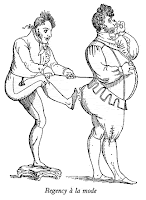
Every so often I get mail or reviews that comment on what my characters get up to in my Regency-set erotic romances. Usually the comments suggest that no one in the Regency period would know about any erotic sexual practices, that it just wasn’t done. Well, um, that just ain’t so. And I totally blame Queen Victoria.

During the Georgian and Regency period, poor, over-protected Princess Victoria grew up in a somewhat dysfunctional family. Because of the Royal Marriage Act of 1772 the descendants of King George II had to obtain the monarch’s consent to marry, or if they were above the age of 25, they had to notify the Privy Council. As you can imagine, family relationships being what they are, none of G II’s descendants were very happy about this. So most of them chose not to marry and had gazillions of mistresses, or chose to marry more than once, sometimes in secret (the Prince Regent, anyone?)


Basically Princess Victoria’s uncles were a roistering bunch of unapologetic drunkards, and womanizers, much pilloried in the press and in the print cartoons of the day, often pictured engaged in the grossest forms of entertainments. Take the monarch who proceeded Victoria, her uncle, King William IV. He had children. He actually had ten illegitimate children with the actress Dorothy Jordan, with whom he lived very happily for many years. But King William did not have a single legitimate heir. Hence Victoria’s accession to the throne.

And I can understand why she might have ‘over-reacted’ a little to the excesses of her ancestors and become a straight-laced repressive old harridan. But it doesn’t mean that my Regency characters have to act like Victorians. The British army was in India and engaged in conflict in Europe, times were uncertain, there was civil unrest at home and in Ireland. Taking risks, living life for the ‘now’, in case it all ended, was far more the mindset of the generation proceeding Victoria’s.

Every generation is determined not to be like the one before them-look at what happened in the 50’s, the 60’s, the 80’s and the 90’s. Cause and reaction, moral to immoral, neon to grunge, excess to eco-friendly. It happens. That’s why I can almost forgive Queen Victoria-almost.

Obviously I can’t give this little, um, lecture to everyone who tells me I have it all wrong and that Regency folk were quiet well-mannered and meek, (but I feel so much better for getting it off my chest here LOL). They had access to the erotic tales of India, they were experiencing a huge revival of interest in Classical Rome and Greece and none of these cultures have the same Christian mindset about sex. Why wouldn’t they be experimenting? I would’ve been.

And guys, if you can bear the thought of untraditional, and quite frankly, naughty sexual practices in your historical romance novels, check mine out. They are definitely not Victorian.

Kate Pearce
http://www.katepearce.com/

Posted in erotica, guest, historical fiction | 6 Comments

Guest post tomorrow! And Wolverine….

Stop by tomorrow for a guest post on mores in the Regency period versus the Victorian period from historical erotica author Kate Pearce.

http://www.katepearce.com/

Me, I’ll be reading Kate’s post and then running off to see the new Wolverine movie.

Posted in erotica, guest, historical fiction | Comments Off on Guest post tomorrow! And Wolverine….

Evangeline Adams Guest Post – Writing African-American Romance

Please welcome my guest, Evangeline Adams!

#

A year ago, after thinking I would write only historical romance, that I could never, ever in my life write a contemporary romance, ideas for contemporaries popped into my head like a stack of wobbling dominoes. But I was resistant and wary, stricken by the irrational fear that if I set aside my historical romances to write contemporary romances, I would: (a) have my thunder “stolen” by other historical romance writers and (b) have a difficult time moving back into historicals. But the biggest monkey on my back, one I didn’t want to acknowledge until just recently, was that I feared writing these contemporary romances because my protagonists would be black.

But when I essentially rejected those contemporary romance ideas last year, I couldn’t put a finger on that lingering sense of unease I felt by their presence. A few months down the road, around the end of last year, I got an idea for a historical romance with black protagonists. And that frightened me to death. I’ve read the African-American historical romances written by Beverly Jenkins and Altonya Washington and enjoyed them, but since the majority of my HR and HF readings involved white characters, it was pretty easy to push the concept of black characters in HR out of my mind. But this idea…it blossomed nigh fully-formed in my head, just as fully-formed as those contemporary romance plots. And as I did with the contemporaries, I set that aside, anxious to work on manuscripts with acceptably white protagonists.

This isn’t to say that I shouldn’t write white characters, nor that my ethnicity should drive what I write, but I was lacking both the balance and proper perspective of both sides of my heritage. I picked up one of the contemporary ideas a few months ago and found that it was a great idea, that the characters were great and the romance would be really angsty and sexy–just one of the ways I like my romances. So I dusted it off and began to work on an outline with the hope of actually writing it. And I was excited about it–until I began to begin the preliminary research for it (one of the reasons I hesitated to do CR’s was because it’s a hell of a lot more easier to get things wrong, to have real life people telling me I got things wrong, whereas 100-150 years ago, I don’t have to worry about someone living in 1904 New York emailing me to say a deli wasn’t on that street, or the Central Park Zoo didn’t get a particularly animal until a few months after my story was set–you get the picture).

The trouble with researching this CR was not about getting things wrong, but about getting things right. My plot is very much tied to the class, skin-tone, and racial issues with the upper-class black community, as well as the greater issues that all blacks must deal with, and suddenly, I felt overwhelmed with fear that this book would be “too black.” That same fear choked the historical idea I plotted merrily the second it came to me (deals with classism, racism and lynchings in 1900s America). At this point, I believed in this plot and believed in its success. I just couldn’t shake that incessant fear that kept me from writing it.

It suddenly hit me when I struggled with plotting a “regular” historical romance: the fear was of being considered a second-class citizen. If you’ve been a regular visitor to Dear Author or Karen Knows Best, you’re aware of the issues surrounding not solely black romance writers, but writers of color writing characters of color: it’s a jungle out there. To state it bluntly, a level playing field is available to authors of color only if they “write white.” Sure, they can branch off into exploring other cultures the way Marjorie M. Liu or Jade Lee (aka Katherine Greyle) do, but the foundation must be “white” in order to reach the same audience white romance authors are allowed to reach. I hadn’t realized how profoundly this state of the industry affected me until I could smell my terror when I even thought of writing a book with black protagonists. The saddest thing is that there is really nowhere to turn to deal with this fear (I wonder if other black authors, aspiring or published, have felt this way?), and the industry offers no real, concrete answers (I have contemplated asking an agent where I would stand if I queried them with a “black” romance, and what would happen if they did take me on, sell the MS, and then I pitched a “white” romance to them).

Many imprints state in their guidelines that they accept “multicultural” romances (like Jade Lee, I think that term should not mean “African-American”), but when they reject “multicultural” submissions, it’s difficult to know whether the MS was rejected because of its unreadiness or because of its content. I worry about this even more so when I think of the themes I like to explore, and how within a “black” romance, they are given a new dimension. Would the book be considered “too black”? Or would race/racism be “unromantic” for readers? Most romances deal with two people bridging their cultural/socio-economic differences to conquer societal mandates, but to add the extra topping of race? It’s seen as scary, taboo, aggressive, angry, it dissolves the “fantasy.” It’s even more dicey when the romance genre thrives on ethnic/cultural stereotypes such as “Noble [Native American] Savages,” “Arrogant Greeks,” “Passionate Sheiks,” or “Latin Lovers,” if not the “tragic mixed-race” plots that seem inherent to most, if not all, romances with Middle-Eastern (excuse me, half-English!!) and Native American protagonists–all stereotypes that have been handed down to us, and rarely refuted, by our Victorian forebears.

I won’t say I’ve completely vanquished this fear, but I do know that the first steps to overcoming it is the identify it, acknowledge it and then to root it out wherever it hides. That said, as I sort out this whole thing, I’m learning to accept that life is a process of “being and becoming,” and that whatever the outcome of this struggle, I’ll be stronger. To end on a more upbeat note, I will say that over the course of my research for both my AA contemporary and my AA historical, I’ve come across a few monumental books that have given me a deeper perspective on the history of African-Americans in American history, that has also deepened my appreciation for my heritage: The Senator and the Socialite: The True Story of America’s First Black Dynasty and Our Kind of People: Inside America’s Black Upper Class, both by Lawrence Otis Graham and Aristocrats of Color: The Black Elite, 1880-1920 by Willard B. Gatewood. All three are extremely fascinating reads that turns on its head the assumption that African-American history is strictly that of oppression, racism, and sorrow.

#

You can visit Evangeline Adams at her blog, Edwardian Promenade:
http://edwardianpromenade.com/

Photos of women in period dresses courtesy of http://www.flickr.com/photos/floridamemory/

Posted in genre, guest, historical fiction, romance novels | 5 Comments

Happy May Day! And Guest Post Tomorrow.

Stop by tomorrow for my guest, Evangeline Adams of Edwardian Promenade, who posts about writing African-American romance.

Happy May Day!

“Never had the Maypole been so gayly decked as at sunset on midsummer eve. This venerated emblem was a pine-tree, which had preserved the slender grace of youth, while it equalled the loftiest height of the old wood monarchs. From its top streamed a silken banner, colored like the rainbow. Down nearly to the ground the pole was dressed with birchen boughs, and others of the liveliest green, and some with silvery leaves, fastened by ribbons that fluttered in fantastic knots of twenty different colors, but no sad ones. Garden flowers, and blossoms of the wilderness, laughed gladly forth amid the verdure, so fresh and dewy that they must have grown by magic on that happy pine-tree. Where this green and flowery splendor terminated, the shaft of the Maypole was stained with the seven brilliant hues of the banner at its top. “

–Nathaniel Hawthorne, “The Maypole of Merry Mount”

but also:

“…and now, disengag’d from the shirt, I saw, with wonder and surprise, what? not the play-thing of a boy, not the weapon of a man, but a maypole of so enormous a standard, that had proportions been observ’d, it must have belong’d to a young giant. “

–from Fanny Hill by John Cleland

Posted in holiday | Comments Off on Happy May Day! And Guest Post Tomorrow.

dedication and acknowledgements

Have you ever wondered how the front material gets into a book? Some readers ignore those pages entirely, others read them with great interest. I was always one to read the dedication and acknowledgements; as I grew to knew more writers and publishing professionals, it became more and more fun to recognize names and the connections between them.

In the case of my books, the dedication and acknowledgements get forgotten about until some time after the manuscript has been submitted. Then I remember that all those people I wanted to remember to thank have not been thanked, and I need to send their names in to my editor, hopefully not too late to appear in the actual book.

There are so many people to list. I usually decide on the dedication pretty early in the process, thinking of the manuscript in progress as, for example, “Lorrie’s book.” But the acknowledgements are harder; I hate to leave anyone out. One’s editor or editors and agent are important, of course. Anyone who critiqued the manuscript will make it in. There are those who contributed titles or character names or the ideas for vital scenes. Also, I make sure to include a nod to the production people who are often ignored, but whose contribution to the final book is incalculable. But what about smaller contributions? Whom to include and whom to leave out?

Next time, I’ll send the dedication and acknowledgements in with the draft. I’ll have kept a running list of the relevant people as I write. Right? Right.

Posted in business of writing | Comments Off on dedication and acknowledgements

Crystal Jordan Guest Post: How To Make The Mating Instinct Work

Today’s post is by Crystal Jordan, author of On the Prowl and many other works. You can visit her blog here: http://www.crystaljordan.com/blog/ and her website here: http://www.crystaljordan.com/
Welcome, Crystal! It’s great to have you!

How To Make The Mating Instinct Work
So, I saw a list of plotlines an author “has to work extra hard to make me accept” on Victoria’s blog the other day, and when I read this quote:

Destined Love and/or reincarnation and/or Genetic Mating or scent-marking or whatever that makes the relationship instantly gel

I took it as a challenge. You see, I write shape-shifters. Often. Some of them have this destined mate thing, some of them don’t. I like to mix it up from one imaginary “world” to the next. Mostly so I don’t get bored–I have to admit, that one isn’t for my readers’ benefit.

I do think it’s possible to pull off the “destined love” and “genetic mating” thing. However, I completely agree with Victoria that nothing should make a relationship instantly gel. If that’s why a writer uses the mating instinct, then I think it’s a contrived plot device that’s as annoying as any other that readers encounter. I’m not saying my work is always perfect on this front, believe me, but I do think there are ways for the mating instinct to be part of the plot without seeming forced.

First, I think destined mating should cause more problems than it solves. Yes, the mating instinct should not be seen by either or both (or all, in the case of menage or more) parties as a good thing. In fact, it’s usually something they want to avoid, manipulate, control, or run away from like the hounds of hell were nipping at their heels. An example from my own work: Antonio and Solana are the main characters in one of the novellas in my newest book On the Prowl. He’s the newly minted leader of a Pride of panther-shifters. One of the biggest problems for these shifters is keeping the population up because they can only breed if they are mated, and not everyone is guranteed a mate. Antonio tracks his mate down only to find she’s a non-shifter–someone who will never be able to breed, someone who was kicked out of his Pride for just this reason before he came home to assume leadership. So the fact that the two of them are mates is something that makes neither of them very happy. They don’t want it, they fight against it, and they have to come to terms with how being together will negatively affect their lives.

And that’s where I come to the second must-do on making mating work. I think the writer needs to make it obvious that these people would choose to be together even without the mating instinct. The instinct may be what makes them completely unable to walk away from the person they see (at first) as being the least-acceptable partner for them, or the worst possible choice they could make, but it can’t be the only common ground they have to stand on by the end of the story. In other words, the romance has to be believable even if you didn’t have the mating instinct going on in your book.

However, I do think that having that mating instinct is just an extension of most people’s desire for a “soul mate.” That one person (or people) that was fashioned just for you. That perfect match. With shape-shifters and destined mates, it’s a more culturally recognized institution for that kind of species, but that doesn’t mean the people involved don’t have as much (or more) work cut out for them in making the relationship work. Plus, for me, the mating thing? Is hot. I love the instantaneous connection (and, in my books, that means sexual connection with a heat-rating that’s off the charts and orgasms that register on the Richter scale), but insta-connection should never, ever equal insta-relationship. Everyone has to grow and earn their happy ending, mates or no mates.

Related Posts:
Why I Love the Marriage of Convenience Plot.

Intricacies of the Marriage of Convenience Plot.

Where’s the Sexual Line in Paranormal Romance?

Types of Paranormal Romance.

Posted in guest, paranormal, romance novels, werewolves, writing craft | 4 Comments

Excerpt from a War Nurse’s Diary: The Operation-Theatre

Tomorrow’s post is by Crystal Jordan, who’s graciously agreed to visit. That’s her latest book’s cover illustrating this post.

Today I have more from the nurse’s diary I’ve been reading.

###

Towards the end of November we took over the operation-theatre. Things were quieter then, as the Flemish mud made an offensive impossible. There was only the usual artillery-fire and small raids to deal with. Meanwhile a very cold winter had commenced. It was pitiful to see those poor Belgian soldiers without any comfortable quarters when out of the trenches. My friend and I had hired a bed-room in the town. We were very lucky, for our landlady was goodness itself to us. Just opposite our house there was a church built on the generous lines of a cathedral, and here a large detachment of soldiers was quartered, sleeping on straw on the stone flags. We used to watch them at dawn come out in the deep snow to a horse-trough, and, breaking the ice, strip to their waists and wash. After dusk we saw them marching in from the trenches in their ragged blue overcoats, caked in mud, carrying piles of accoutrement on their backs and spades and guns over their shoulders.

No warm home-coming for them, no fire to dry their clothes by, no hot meal ready. Just the dark, cold church. These men had no bundle of letters from home to cheer them; all they had to face was a desolated country, desecrated firesides, ruined homes, starving penniless families, violated womenfolk and suspense—not just for weeks or months, but for years, without news of all that life held dear for them. Do you wonder that they hate the Germans? In return they were paid three-half-pence per day. A few weeks ago I received a letter from a Belgian Captain whom I had nursed. He writes “Dear Sister, do you realize that it is now three years since I have received any news of my wife and three little ones? Are they alive or dead? The suspense has made an old man of me; at thirty-five my hair has turned grey with anxiety.”

Most of our operations occurred at night, as the wounded travelled through the danger-zone with less risk of being fired upon after dark. During the day we performed operations on patients who had been in the wards for some time. Our doctors and nurses had no cosy sitting-room to rest in when off duty. There was only the busy kitchen stove for warmth; so we used to gather them in the theatre when there was no case to prepare for. What jolly times I remember in between the rushes of work! Our stove was always going, with a big kettle of boiling water ready for emergency cases, so about eleven A. M., after the nurses and doctors had done the morning round of dressings, we used to make a cup of tea.

One of the chauffeurs would bring in from Dunkerque a box of French pastries, or better still, some kind mother sent a lovely “tuck-box” containing an English homemade cake! Then the men would find their hair needed a barber’s attention, so out came some scissors and a sheet, and we became pro tem. a hair-dresser’s establishment! During the autumn rush of the Battle of the Yser we had so overflowed our borders that we were obliged to take in two small class-rooms, scattering straw thickly on the floor in lieu of mattrasses. It was a miserable arrangement, but better than the streets. Later on, in December, one of the class-rooms was turned into a sitting room for the staff. The couches consisted of crates, covered with red blankets; an old bedstead boarded up at one side, with a sack of shavings and blankets over it, made a fine Chesterfield couch! The students hired a gramophone and piano from Dunkerque, so we became quite civilized.

###

–from A War Nurse’s Diary: Sketches from a Belgian Field Hospital, 1918

Related Post: Synergy in Writing and Research.

More from her diary.

Posted in research, wwi | Comments Off on Excerpt from a War Nurse’s Diary: The Operation-Theatre