RWA 2011 in NYC – things to think about

If you’ve never been to New York City before, and if you’re debating whether or not to attend the 2011 RWA National Conference in New York City, here are some of my thoughts.

Because the city is a major destination, it might be easier to find cheap flights; if you live in an area where it’s possible, it’s also very easy to take the train to Penn Station, which is close to the conference hotel. The hotel, the Marriott Marquis, is expensive, but unlike in some other cities, you won’t be limited to the onsite hotel restaurants; Midtown is crowded with restaurants with a wide range of prices. (Though take note, the Marquis has a cool revolving rooftop restaurant!)

Depending on your tourism desires, sightseeing can also be very cheap in New York, if you’re willing to walk and take the subway. (Cabs are reasonable as well, but sometimes hard to come by during rush hour or in certain neighborhoods). There are myriad guides and helpful websites to tourism in the city. And the people-watching can’t be beaten.

Plus, you can also attend the International Association for the Study of Popular Romance Conference, which is piggybacked on RWA. One trip, two conferences!

Posted in conferences, rwa | 7 Comments

Alas, No Steampunk.

I’m sorry to announce that the steampunk Western novel for Spice has been cancelled.

I’m not sure if I will continue to work on that project for another possible publisher, or work on something else entirely, since I have a number of different projects clamoring for my attention.

I’ll post when I’ve decided.

Posted in business of writing | 10 Comments

Recent Steampunk

Today, some recent steampunk novels.

Caveat – I have not yet read any of these books, but I’ve been collecting them for my To Be Read pile. Suggestions welcome if you have them! Please refrain from spoilers in the comments.

The Native Star by M.K. Hobson. “The year is 1876. In the small Sierra Nevada settlement of Lost Pine, the town witch, Emily Edwards, is being run out of business by an influx of mail-order patent magics.”

The Alchemy of Stone by Ekaterina Sedia. “Mattie, an intelligent automaton skilled in the use of alchemy, finds herself caught in the middle of a conflict between gargoyles, the Mechanics, and the Alchemists. With the old order quickly giving way to the new, Mattie discovers powerful and dangerous secrets – secrets that can completely alter the balance of power in the city of Ayona. This doesn’t sit well with Loharri, the Mechanic who created Mattie and still has the key to her heart – literally.”

Boneshaker and Dreadnought by Cherie Priest feature a Civil War-era alternate Seattle.

Leviathan and Behemoth, Young Adult novels by Scott Westerfeld, are set in a universe where WWI went differently. “This global conflict is between the Clankers, who put their faith in machines, and the Darwinists, whose technology is based on the development of new species.”

Clockwork Angel by Cassandra Clare is linked to a present-day Young Adult series by this author.

Posted in reading, recommendations, sf/f, steampunk | 2 Comments

Selling the Unusual Setting

This post was originally written for The Naughty Girls Next Door. Since then, I learned from author Michelle Styles in a comment to that post that Harlequin Mills & Boon has been seeking out unusual historicals, publishing one a month – so there’s a market right there! You can check out her comment in more detail here.

Here’s the original post:

And now for something completely different.

A different time period, I mean. Since I’ve been following author blogs and forums related to the romance genre, again and again I’ve encountered the notion that unusual historical settings are a hard sell. There’s less talk about erotica; it’s a smaller part of the market and doesn’t always overlap; it’s its own niche, and I think sometimes there’s more freedom of setting in erotica than in romance.

My post today is not to be taken as the be-all and end-all on this issue. Mostly, I’m just thinking through strategies that might work. Keep in mind that my World War One novel, The Moonlight Mistress, is erotica, which as I mentioned might be an easier market for unusual settings. I have not yet sold a romance novel, so anything I say about the romance market is gleaned from observation and conversation.
Here are my thoughts on unusual settings in Romance. In romance, historical usually means Regency (often extended beyond the actual Regency period), Victorian, pre-Regency Georgian, a few French Revolution novels, and…not a lot else. There’s a sprinkling of European medievals, usually set in England, and a few Westerns (America, usually post-Civil War), and a few others. I’m sure I’m missing some, and of course the periods and locations of the few books not set in eighteenth through nineteenth century England will vary according to market pressures and other things which I am not going to go into, since that isn’t really the topic of this post.

My topic (finally she gets to it!) is how to make the most of the “unusual” period you’ve chosen. Bear in mind that none of my suggestions are guaranteed to work. If they were, I’d be selling them on television. My suggestions are just intended to help you to think about ways of selling your novel in a more holistic way than simply throwing it against the wall of Regencies over and over again.

If you’re starting from scratch, I think the first step is to write the book. No, really. You’re much better off trying to pitch something that’s a little different if you already have it in hand. The editor can then see what the whole novel is like, and you can impress them with how cool it is and how relevant to today’s world.

A simultaneous step is to know the market. Even if there’s nothing else exactly like your novel out there, still be prepared to give examples of already-published similar works, not just books but movies or television series or comics, to give an idea of your novel’s potential market viability. “Similar” might mean similar themes, a similar basic plot, or a similar sub-genre. For instance, you could compare your romantic suspense novel set during the Russian Revolution to one set during the French Revolution that features similar situations. Or compare your novel to a series of historical mysteries set during the Russian Revolution or some other revolution. Or even to a novel with similar themes set during the breakup of the Soviet Union. Knowing that there are similiarities will not only help you pitch the novel, if needed, but also will give you ideas as to how you might shape it to make it more marketable. (Yes, I said write to market! Those aren’t naughty words!)

Third, you can set up a niche market for yourself. Perhaps you could write some short stories set in the time period and location of your choice. After you’ve sold a few of those, you can use them to demonstrate the possible viability of a longer project. At the least, you’ve made a little money from the short stories!

I’d welcome further ideas on this topic, so feel free to comment or tell me that my ideas would never work.

Posted in business of writing, historical fiction, wwi | Comments Off on Selling the Unusual Setting

Pirate Promotion

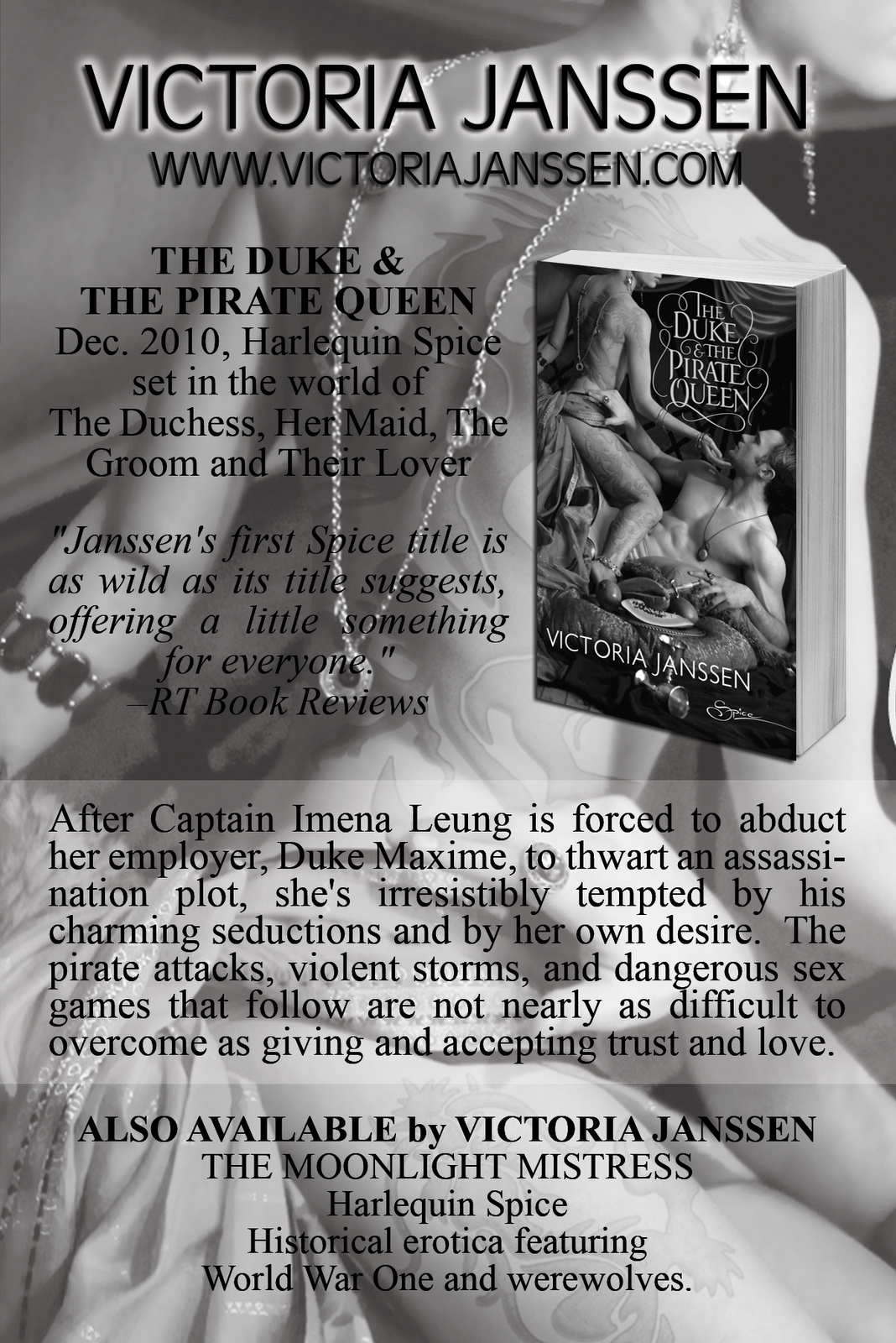
A friend of mine is providing me with quite a lot of her own time and energy to help me with promotion for The Duke & The Pirate Queen. Recently, we met for lunch a couple of times and she, who once worked as a journalist, walked me through an outline she’d created, of things she saw as easy opportunities for book promotion.

She has a lot more confidence in me than I do. Which is one of the lovely things about friends. We even discussed how certain things might not actually do any good, but I might do them anyway to make me feel like I was doing something to help the book.

Aside from organizing the book’s launch party, which she has done for both of the previous books as well, she’s writing up a press kit for me to include on my revamped website, which will hopefully go live in November; she looked at the press kits on some romance author sites, and we’re going to base it on those patterns, with the addition of a sort of FAQ interview (she’s done a lot of interviews in the past). I’m hoping that will make my biography page more interesting. She left it to me to arrange for an author photograph, which I’ve never actually had; I contacted a professional friend, and potentially I’ll be able to get that taken care of before the book comes out.

The rest of her ideas, we’re going to work on after the new year. Right now, the website is my priority, and I’ll be working with someone in October on that.

It feels good to have a priority. It all feels more manageable when I have a tidy list.

Posted in promo, the duke | Comments Off on Pirate Promotion

Promotional Bookmarks

Back when I first posted about promotional bookmarks and postcards for The Duke & The Pirate Queen, I promised to give an update on how it was going. So, here’s how it’s going…sort of.

I don’t actually know yet how it’s going. I carried quantities of the bookmarks and postcards with me to the RWA conference and to Readercon, and left them on the freebie tables. People took them. I had taken far too many to RWA, so I collected most of the leftovers before I left on Saturday, but a lot of them had still been taken. Several people told me they’d seen my materials and said how beautiful they were, so that was nice feedback.

Once home, I began preparing packages of the promotional materials to send out. First on the list was a bookstore owner who’d actually contacted me via email, and second was a librarian I’d met at RWA; she’d given me her card. I also collected a few librarian and bookstore addresses from various sources on the internet: people who’d recently won awards from RWA, and specialty bookstores who looked as if they might be interested. In the weeks since, I’ve been gradually preparing envelopes for each of those venues, including a handwritten letter in each one, to ask if they are willing to distribute the materials for me. I’m not expecting to hear back from them; I just hope they have a use for what I’ve sent. Ziplock bags inside of flat-rate priority mail envelopes have been my method so far.

The best thing, so far, about having these materials is that I, well, have them. I was able to give them to people I talked to, and in some cases the bookmark seemed more appropriate than giving them my business card. The materials also served as conversation pieces, as anything with my covers tends to do, thanks to Harlequin.

I will be bringing more bookmarks and postcards to the fall conventions I plan to attend. If you’d like me to send some to you, or to your local bookstore or library, please comment or email me.

If I get any additional feedback, I’ll report!

Posted in promo, the duke | 4 Comments

Genre is the Highest Form of Literature

I think genre fiction is the highest form of literature. I really do. If “highest” means most important to humanity. How’s that for a sweeping claim? Romance, fantasy, mystery, and science fiction. Those are the highest literature out there.

For one thing, look at history. Today, Dickens is “literature.” To contemporary readers, he was cheap “escapist” entertainment. So longevity, I feel, is an important part of what makes a particular novel “important” or “not important”, “commercial” or “literary”…and I’m already tired of all the air quotes. So I’ll stop with those.

Fiction is literature. Literature is fiction. Stories are stories are stories. Every reader reads every story in a different way, through a different lens, for a different purpose. I can get just as much out of a good mystery as I can out of a novel about some white man’s midlife crisis; more, actually, since I’ll finish the mystery. The really important stories don’t wear out. I think genre is the best vehicle for those stories. Coming of Age/Finding Yourself; Fighting Evil; Finding Family–those are all a lot more fun when they happen in the midst of aliens attacking, or hot sex, or trying to solve a murder.

Genre has longevity. People like genre, and they read a lot of it, so it tends to linger; think of all those copies of Harry Potter novels piled up like walls. Think of that pulp adventure story people like so much, The Iliad (which is also kind of epic fantasy), or that fantasy romance that people still talk about, starring Rama and Sita. Genre, it sticks around. The sub-genres shift, but the basics are still there.

Genre tends to use its tropes to address issues of current social concern, even if it does so thematically and not directly; for that reason, it will always be an important historical resource. You can learn an awful lot about, say, gender roles in the 1940s just from reading golden age private detective novels. Or how people feel about technological watersheds from reading science fiction. Fiction can be a useful comparison to nonfiction of a given time period. Add to that the entertainment aspect of genre, and you get more longevity.

Plus, genre tells the stories that are important to us, under the surface. Genre fiction is today’s mythology. Genre fiction is in us, not just from the books themselves but also from television, movies, games…certain stories are there, and we use them to make shapes out of our lives. We swim in a genre sea. Certain stories will continue to be there, forever and ever, amen.

And that’s why I think genre is the highest form of literature.

Posted in genre, reading | 4 Comments

Top Posts from 2010 (so far)

I like playing with the tracking on my blog sometimes. Here are the most popular posts on this blog, by month, for 2010 so far. It’s very interesting to see which posts seem to be of more general interest.

January: Tell Not Show, a writing craft post.

February: My Favorite Girls Dressed As Boys (Fantasy Edition), which continues to get visits along with its companion post from September 2009, The Romance Edition.

March: Why Not 20th Century Historicals? The first view of the Alison’s Wonderland cover was close behind. People like pretty pictures!

April: Slow Writers Anonymous. Author Gwynne Garfinkle’s post on Researching the 1970s was close behind.

May: Combined posts (the Brontë tag) on my reread of Jane Eyre. Various individual posts on that set were also in the top ten for the month.

June: Evie Byrne’s guest post on On the Female Vampire.

July: Eroticism in To Have & To Hold by Patricia Gaffney.

The top posts for August were news rather than topical posts: my announcement that I was writing a steampunk Western, and my reports on the 2010 RWA Conference.

If you had a different favorite, let me know in comments!

Posted in promo, writing | 2 Comments

Rear, meet seat; fingers, meet keyboard.

One of my favorite pithy sayings about writing is “ass in chair, fingers on keyboard.” It’s short and to the point. Unless you write standing up, or perhaps sitting on a rubber doughnut, it’s pretty standard for a writer to sit in a chair and write. You can’t write while roaming the streets or hurtling off a diving board or driving, or rather you shouldn’t because that could lead to injury.

Side note: If you think texting while driving is bad, I knew someone who used to write while driving. He kept a little notebook on his leg and when he was stuck in traffic, he would scribble down humorous verse.

Back on topic. It sounds so simple, doesn’t it? “Ass in chair. Fingers on keyboard.” For me, the hard thing about accomplishing that task is not sitting, but eliminating the things that prevent me from sitting. If I’m trying to sit near a basket of dirty laundry or similar, that visible sign of Things To Do That Are Not Writing can be very distracting. I have to either leave the house, perhaps for a coffee shop where cleanup is not my responsbility, or perhaps mentally schedule that load of laundry for later: after I’ve written for two hours, after I’ve written a thousand words, at 7:00 pm, tomorrow afternoon.

Then comes moving my fingers on the keyboard. I move on to another pithy quote to tell how to accomplish this:

“Throw up into your typewriter every morning. Clean up every noon.” –Raymond Chandler

Another version of this quote, which has numerous sources, is “Don’t be afraid to let yourself write shit.” Just because the story isn’t yet perfect doesn’t mean you get out of working until it’s as perfect as it can be. There aren’t any shortcuts to accomplishing this task.

Except, perhaps, ass in chair. Because the sooner you start, the sooner you’ll be done.

“I hate writing. I love having written.” –Dorothy Parker

Related posts:
Writing Elsewhere.

Finish it.

How To Write a Novel (in 72 Easy Steps!)

Posted in quotes, writing, writing process | 2 Comments

Charles Sorley, "Barbury Camp"

Barbury Camp

We burrowed night and day with tools of lead,
Heaped the bank up and cast it in a ring
And hurled the earth above. And Caesar said,
“Why, it is excellent. I like the thing.”
We, who are dead,
Made it, and wrought, and Caesar liked the thing.

And here we strove, and here we felt each vein
Ice-bound, each limb fast-frozen, all night long.
And here we held communion with the rain
That lashed us into manhood with its thong,
Cleansing through pain.
And the wind visited us and made us strong.

Up from around us, numbers without name,
Strong men and naked, vast, on either hand
Pressing us in, they came. And the wind came
And bitter rain, turning grey all the land.
That was our game,
To fight with men and storms, and it was grand.

For many days we fought them, and our sweat
Watered the grass, making it spring up green,
Blooming for us. And, if the wind was wet,
Our blood wetted the wind, making it keen
With the hatred
And wrath and courage that our blood had been.

So, fighting men and winds and tempests, hot
With joy and hate and battle-lust, we fell
Where we fought. And God said, “Killed at last then? What!
Ye that are too strong for heaven, too clean for hell,
(God said) stir not.
This be your heaven, or, if ye will, your hell.”

So again we fight and wrestle, and again
Hurl the earth up and cast it in a ring.
But when the wind comes up, driving the rain
(Each rain-drop a fiery steed), and the mists rolling
Up from the plain,
This wild procession, this impetuous thing.

Hold us amazed. We mount the wind-cars, then
Whip up the steeds and drive through all the world,
Searching to find somewhere some brethren,
Sons of the winds and waters of the world.
We, who were men,
Have sought, and found no men in all this world.

Wind, that has blown here always ceaselessly,
Bringing, if any man can understand,
Might to the mighty, freedom to the free;
Wind, that has caught us, cleansed us, made us grand,
Wind that is we
(We that were men)—make men in all this land,

That so may live and wrestle and hate that when
They fall at last exultant, as we fell,
And come to God, God may say, “Do you come then
Mildly enquiring, is it heaven or hell?
Why! Ye were men!
Back to your winds and rains. Be these your heaven and hell!”

–Charles Sorley, 24 March 1913

Posted in poetry, sorley | Comments Off on Charles Sorley, "Barbury Camp"