Love & Mysteries

“Love interest nearly always weakens a mystery because it introduces a type of suspense that is antagonistic to the detective’s struggle to solve the problem. It stacks the cards, and in nine cases out of ten, it eliminates at least two useful suspects. The only effective love interest is that which creates a personal hazard for the detective – but which, at the same time, you instinctively feel to be a mere episode. A really good detective never gets married.”

–Raymond Chandler, “Casual Notes on the Mystery Novel” (essay, 1949), first published in Raymond Chandler Speaking (1962)

Posted in chandler, mystery, quotes | 2 Comments

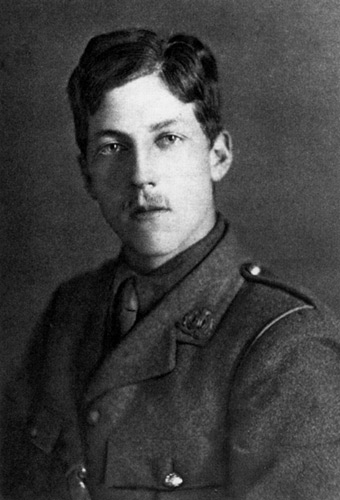
Charles Sorley, "When you see millions of the mouthless dead"


When you see millions of the mouthless dead
Across your dreams in pale battalions go,
Say not soft things as other men have said,
That you’ll remember. For you need not so.
Give them not praise. For, deaf, how should they know
It is not curses heaped on each gashed head?
Nor tears. Their blind eyes see not your tears flow.
Nor honour. It is easy to be dead.
Say only this, ‘They are dead.’ Then add thereto,
‘Yet many a better one has died before.’
Then, scanning all the o’ercrowded mass, should you
Perceive one face that you loved heretofore,
It is a spook. None wears the face you knew.
Great death has made all his for evermore.

–Charles Sorley (1895-1915)

Posted in sorley, wwi poetry | Comments Off on Charles Sorley, "When you see millions of the mouthless dead"

Bearded Heroes

I’m a guest today at the Novelists, Inc. blog on “Five Ways of Thinking About a Writer’s Conference.”

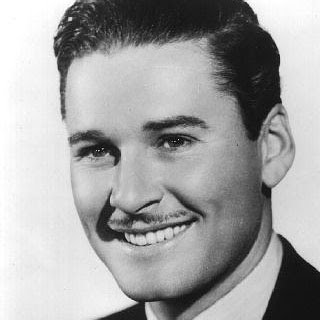
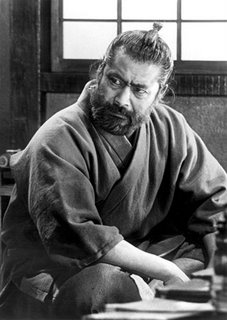
As for my own personal blog, I’ve been wondering something. Where are all the romance heroes with beards? Or even moustaches?

I’m thinking about this because Maxime, hero of The Duke & the Pirate Queen, has a beard. The man on the book’s cover does not have a beard; I’ve rarely seen moustaches, much less beards, on the covers of romance novels. Or on the characters inside romance novels. Or even in erotic novels, for that matter.

I recently read The Forbidden Rose by Joanna Bourne; it’s a historical set during the French Revolution. For most of the novel, the hero is bearded, or more accurately, stubbled. It’s part of his disguise. I believe, though, in “normal” life he is cleanshaven.

Three major characters in my World War One-set novel The Moonlight Mistress (Pascal Fournier, Noel Ashby, and Gabriel Meyer) have moustaches. In that case, I considered their facial hair to be an important part of the historical worldbuilding; it’s early in the war, and they don’t yet have the gas mask issue that led some soldiers to shave. But also, I like moustaches. Again, the man on the book’s cover does not have a moustache, though I am pretty sure he represents Pascal. Maybe there’s some kind of marketing thing going on with all these cleanshaven men. Or maybe models just don’t tend to have facial hair.

I wonder why that is? Facial hair, I suspect, is more commmon in historical romance set in certain periods when, well, facial hair would be more common. Is there more facial hair in Western Romance? I can’t bring examples to mind. Does this trend hold over time?

Do readers just not want to imagine the scratchiness? Anybody have any thoughts on this?

Posted in moonlight mistress, reading, romance novels, the duke | 4 Comments

When to Submit.

How do you know if you’re ready to submit a story or novel to an editor?

When’s the deadline?

Have you proofread? Have you put “the end” at the end? Then it’s time. Go for it.

Okay, so I’m being a little facetious. But not entirely. More than once I have used a deadline (perhaps adjusted to account for mailing time) to inspire me to finish a story. Or I’ve used a deadline as a goal. After that, I trust myself to get it done in time.

Trusting yourself isn’t something you learn automatically. Well, you might trust yourself automatically, but if you don’t have the experience to back it up, your trust in yourself might not be useful.

I’m not being very useful, am I?

I can’t help it. Writing cannot be turned into a tidy set of rules. Trying to turn the psychology of writing into tidy rules is even worse. But “know yourself” is a good one.

Know when you’ve gotten as far as you can get on a story in the time you have. And then submit it.

Posted in business of writing | Comments Off on When to Submit.

Eroticism in To Have and To Hold by Patricia Gaffney

I recently read Patricia Gaffney’s To Have and to Hold for the first time. If I’d only read the first section of the book (a bit less than half), I could easily interpret it as an erotic novel, though one without much explicit sex. To explain why I think that, first I have to talk about the book as a whole.
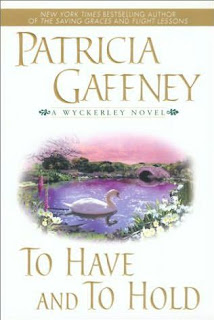
There’s a lot of discussion of this novel mostly because of its hero, aristocrat Sebastian Verlaine. Sebastian enacts a “forced seduction” of the heroine, Rachel Wade, who was imprisoned for ten years for the death of her abusive husband. Sebastian later allows his acquaintances to verbally torment Rachel; if Sebastian had not acted at the last minute, he would have tacitly allowed her to be raped by one of them. However, after and because of these actions on Sebastian’s part, a switch flips in his personality and he becomes the Rake Reformed who’s hoping to be Redeemed. From then on he is, like Mary Poppins, practically perfect in every way as a romantic hero; “He had two immediate goals: to make her laugh and to make her come.”

I am vastly simplifying. It’s difficult to do otherwise with this complex and rewarding novel, which I’m still thinking about (I’ll no doubt have more to say a few months from now). Sebastian still has flaws in the book’s second section but, well, I can sum up his character shift by saying he gives her a puppy. And a conservatory. Both of these are things Rachel desperately desires and was denied while in prison; he responds to her deep needs with deep acuity.

In return, Rachel gives him a copy of an opera libretto which he truly loves. Throughout, she can often interpret the motives behind his actions. She becomes an expert on him. I think part of her skill at interpreting him is that she suffers from PTSD, because of her experiences with her husband and in prison; she’s hyperattentive to people who might be threats. However, she is also easily devastated by kindness and tenderness; after Sebastian’s reversal, she gives him her trust, which to me is much more impressive than Sebastian’s reform. The second section is the epitome of romantic fantasy; ultimate trust and ultimate knowledge of the other.

In both sections, Sebastian is extremely attuned to Rachel: first cruelly, then kindly; first focused on his own gratification through her, secondly on her gratification. But back to the eroticism. Rachel’s sexual desires are shut away for the first part of the novel. She cannot fully access that part of her until Sebastian changes, so I feel her true journey towards wholeness happens more in the second section than the first, when her erotic feelings are tightly bound up with emotional/romantic feelings (something our society perceives as normal for women).

Therefore, I looked at Sebastian’s erotic journey. At first, he can sense the barriers between him and Rachel. The only way he can allow himself to think of removing those barriers is with sex; he’s a dissipated rake; seduction is what he does. He cannot change his character except through sex. He thus makes her into an erotic object, and seeks to break her down to his level. “Her passivity irked him.” “He felt pity for her, and curiosity, and an undeniably lurid sense of anticipation.” “She was in his power, a virtual slave. The situation was unquestionably provocative, but it ought to have been more so, more stimulating. He hadn’t really gotten to her yet. She simply didn’t care enough.” “Because of her reserve, touching her seemed a daring encroachment, almost like the breaking of a taboo. But wasn’t that what made her irresistible?” “…that master-servant simulation had piquant sexual overtones he found stimulating.”

Then Sebastian begins to lose his emotional distance and is having trouble seeing her merely as an erotic object. He has to work harder at it. “He entertained himself by imagining her in lewd sexual situations, but the man in his fantasies was always himself; when he tried to put a deviant or a pervert in them with her, someone who hurt her or degraded her–someone other than himself–the fantasies evaporated, leaving him with a bad taste in the mouth.”

His feelings of distaste lead him into a little more self-awareness, and realization that he wants more from her than her body. He’s beginning to get the idea that there will be a form of exchange between them. “…he’d seen a change coming in himself for a while now. Out of boredom and cynicism, he was starting to become nasty. He didn’t approve of it, but in some ways he saw it as inevitable…But the older he got, the less fun he was having. It took more every day to divert him, and lately he’d begun moving gradually, with misgivings, into excess. There were no vices and few depravities he hadn’t tasted, with differing degrees of satisfaction. He worried that when he ran out, he would choose a few favorites and indulge in them until they killed him…he had some idea that if he could possess her, the essence of what he lacked and she had would be his. He would appropriate it.” “…he alternated between wanting to save her and wanting to push her to her limit.”

He doesn’t go about seduction very well at all. His thoughts here are far from romantic. But his analysis of his seductive maneuvers made me think of erotica, the sort with a psychological bent. “Her silence and her manner–completely withdrawn–suggested that their first time together was not going to be particularly transcendent, and that his best course would be simply to get it over with. That was one way. Another would be to exploit her provocative unwillingness, use it to heighten his pleasure–and hers, too, if she would let it. For the hundredth time he wondered what her husband had done to her. Since he didn’t know and she wouldn’t tell him, it seemed he had no choice but to enjoy her in any way he liked…He considered stopping everything and letting her go, but only for a split second, before the thought flew off to wherever bad ideas go.”

After the forced seduction (I use that term rather than rape because this is a novel, and a fantasy scenario), Gaffney complicates the encounter further with Rachel’s thoughts. “She understood why her fear of him had diminished…It was because she’d discovered from the most intimate experience that, unlike her husband, he was not thoroughly corrupt. He spoke of the “piquancy” of her unwillingness, and she didn’t doubt that he found it so, but he had never hurt her, not really, and she knew with a bone-deep certainty that he never would. His methods of coercion were subtler, and maybe it was sophistry to say that therefore they were kinder. But she had been used by men in both ways now, brutally and gently, and she could say without equivocation that she much preferred Sebastian’s.”
After they’ve been intimate, Sebastian tries to regain the self he was before, by encouraging himself to separate from her emotionally. While his acquaintances torment Rachel with invasive questions, he picks at the piano keys. “The unimaginativeness of his friends’ preoccupations ought not to have surprised him, but it did. Had they always been this shallow and insipid? This vicious? What made him think he was any different from them?” “…this was different. This was worse. He was letting it happen, watching it grow more beastly by the minute, because he wasn’t testing her anymore. He was testing himself.” “The worst for Sebastian was recognizing his own soft, mocking tone in Sully’s despicable cadence. He felt physically sick.” “He felt the tear down the middle of himself widening, and that was wrong; it should have been narrowing. He’d just done a thing to make himself whole again.”

And then emotion breaks through, and Sebastian changes. “He heard a snap in his head, exactly like a bone breaking, and at once the eerie fugue state evaporated. His past and his future had broken cleanly in two. This, now, was the present, a violent limbo he had to smash his way out of to survive.”

The rest of the novel is all about emotional intimacy; even the sex scenes are about emotional intimacy. But in the first section, the sex and erotic thoughts are deeply tied with the hero’s journey to self-awareness, and the heroine’s journey towards feeling sexual desire through trust and intimacy.

Gossamer Obsessions has a terrific post on this novel from October 2013.

Posted in erotica, gaffney, reading, romance novels | Tagged | Comments Off on Eroticism in To Have and To Hold by Patricia Gaffney

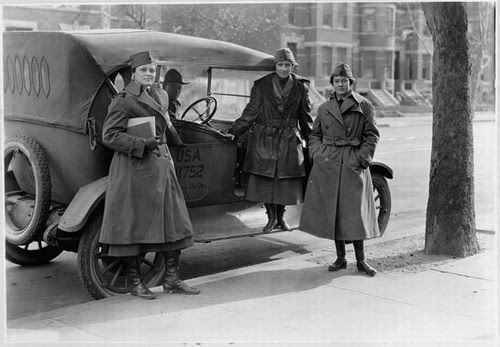
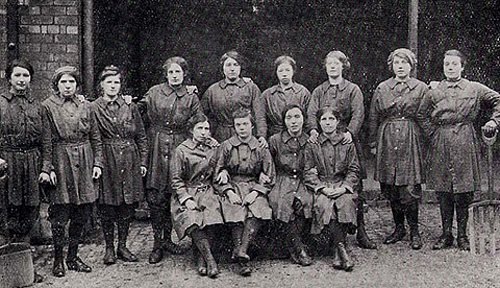
Women in WWI Picspam

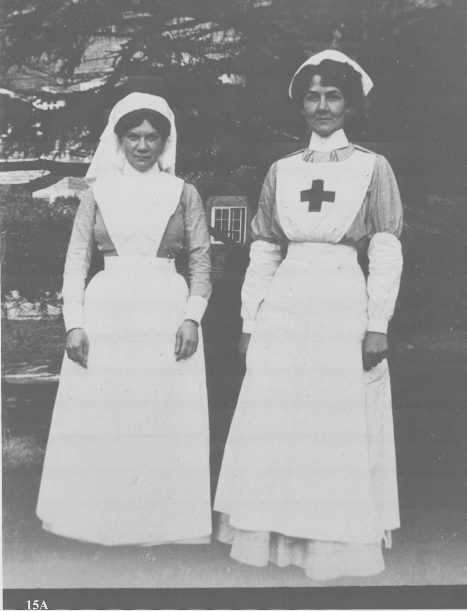
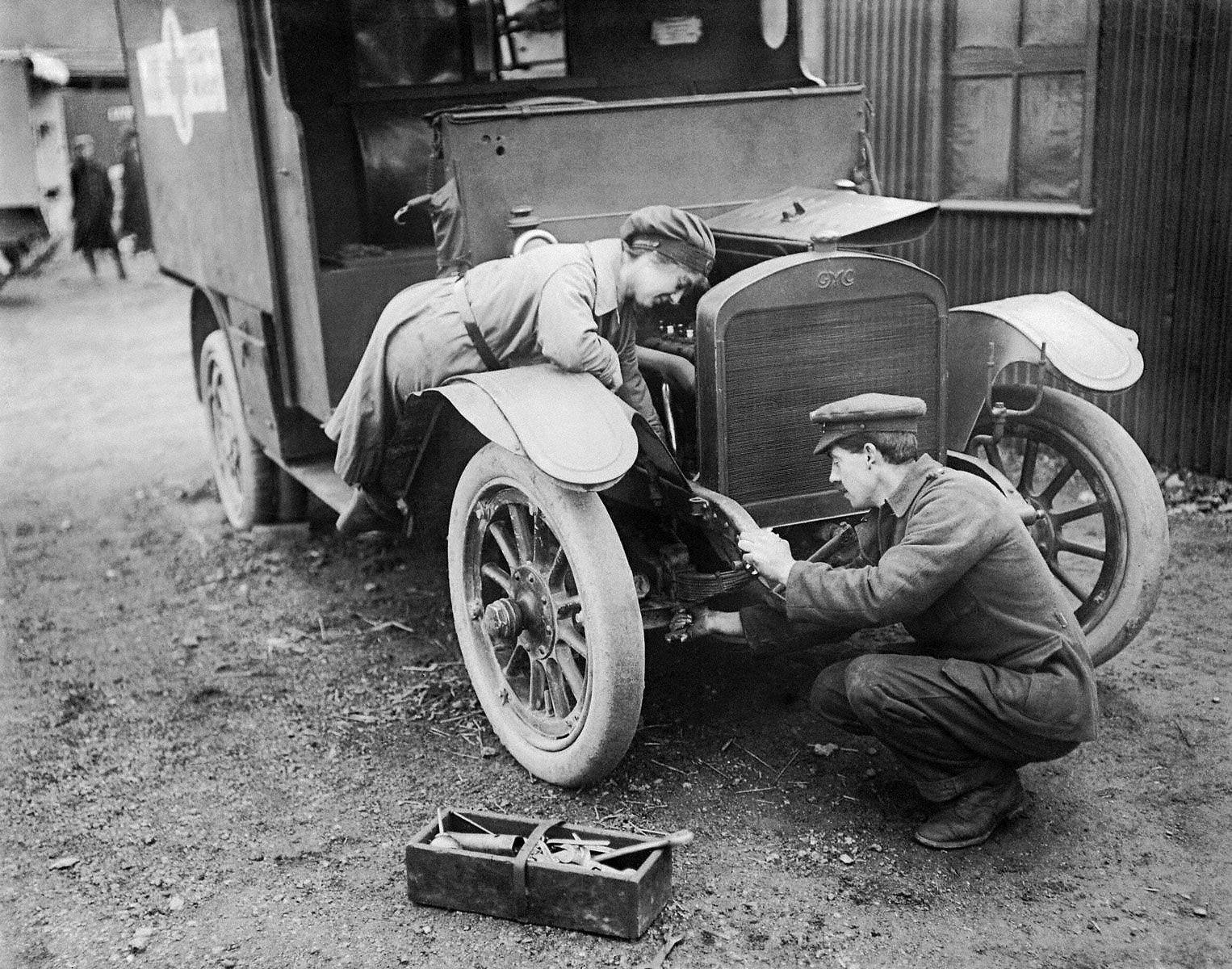
Women served in many capacities during World War One.

Nurses.

VADs.

Drivers.

Radio Corps.

Fundraisers.

Factory Workers.

Posted in images, research, women, wwi | Comments Off on Women in WWI Picspam

Readercon Linkgasm

For those who are interested, I’ve been collecting some links to reports on Readercon, which took place July 8-11, 2010. These are in no particular order, but grouped by topic. There are lots more than this. I recommend checking out Icerocket’s Blog Search if you want more and have a few days to read.

General Reports and Comments

First, My summary report.

Rose Fox’s report. Gwynne Garfinkle on her first Readerson; and reports from Barbara Krasnoff and Inanna Arthen and K.A. Laity and Matthew Kressel.

Greer Gilman on some joys of Readercon, and Michael Swanwick shares the coolest thing he saw at Readercon.

The best panel quotes from Readercon, and more quotes, collected by Caitlín R. Kiernan. Beth Bernobich offers possibly the best quote of the con when she reports on “The Closet Door Dilated” panel.

Reports on Specific Panels and Talks

Andrea Hairston on “Sexuality and Gender in Contemporary F&SF.”

Kate Nepveu reports on “Fanfic as Criticism”.

Andrew Liptak on “New England, At Home to the Unheimlich” panel.

Cecilia Tan’s report on Alternatives to the Pay Per Copy System of Author Compensation.

Nora Jemisin on Brainstorming Immersive Inclusive Worlds.

Kestrell Verlager posted her talk on “What Writers Still Get Wrong About Blindness” in three parts as well as some panel notes.

Critic Graham Sleight’s talk on And so…. “… it’s remarkable that, in certain contexts, we put discrete entities like shots in a movie together into narrative. I think it’s even more interesting when you consider sentences in a prose narrative.”

Stacey Mason on the Non-Western Fantasy panel.

DXMachina reports on a number of panels.

Report on the Shirley Jackson Awards for horror.

Photographs

Ellen Datlow’s photographs and Scott Edelman’s photographs and Tempest Bradford’s photos of attendees making sad faces.

I’m a guest later this week at the Novelists, Inc. blog. I’ll have a direct link on Friday the 23rd, the date of the post.

Posted in conferences, guest, links, sf/f | Comments Off on Readercon Linkgasm

Charles Sorley, "To Germany"


To Germany

You are blind like us. Your hurt no man designed,
And no man claimed the conquest of your land.
But gropers both through fields of thought confined
We stumble and we do not understand.
You only saw your future bigly planned,
And we, the tapering paths of our own mind,
And in each others dearest ways we stand,
And hiss and hate. And the blind fight the blind.

When it is peace, then we may view again
With new won eyes each other’s truer form and wonder.
Grown more loving kind and warm
We’ll grasp firm hands and laugh at the old pain,
When it is peace. But until peace, the storm,
The darkness and the thunder and the rain.

–Charles Sorley

Posted in sorley, wwi poetry | Comments Off on Charles Sorley, "To Germany"

Charles Sorley, "Such, Such Is Death"

Such, Such Is Death

Such, such is Death: no triumph: no defeat:
Only an empty pail, a slate rubbed clean,
A merciful putting away of what has been.

And this we know: Death is not Life, effete,
Life crushed, the broken pail. We who have seen
So marvellous things know well the end not yet.

Victor and vanquished are a-one in death:
Coward and brave: friend, foe. Ghosts do not say,
“Come, what was your record when you drew breath?”
But a big blot has hid each yesterday
So poor, so manifestly incomplete.
And your bright Promise, withered long and sped,
Is touched, stirs, rises, opens and grows sweet
And blossoms and is you, when you are dead.

–Charles Sorley

Posted in sorley, wwi poetry | Comments Off on Charles Sorley, "Such, Such Is Death"

Mansfield Park Revisited, Part the Third

My final notes on my last re-read of Mansfield Park.

Mansfield Park can be read online at Gutenberg.org.

#

November 18, 2004

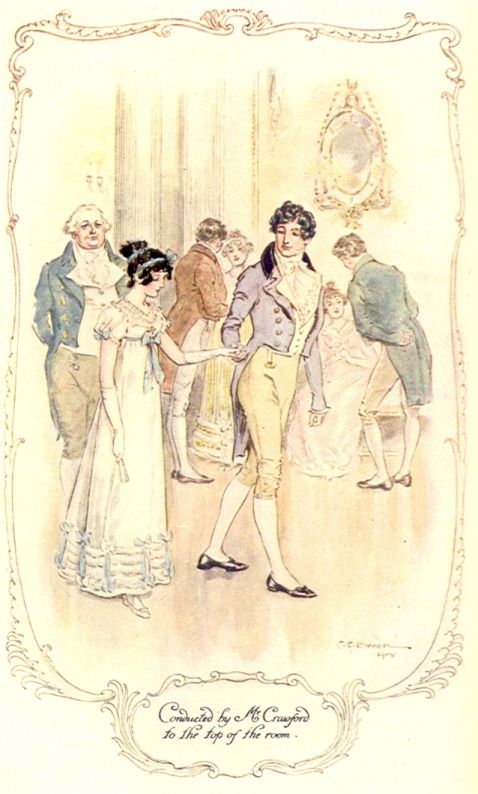
After finishing my reread I confess I’m a bit puzzled about Henry Crawford. Either he was a great actor (it is a plot point that he is a good actor) and managed to fool not only Fanny and Edmund but his own sister, or he’s simply inconsistent. I could believe him flirting with the Bertram sisters and playing them off of each other for his own rakehell amusement. I could also buy him trying to change by falling for Fanny, even if that change was not to be permanent. What I didn’t buy was that, so suddenly after he’d made headway with Fanny, that he should throw her over and run off with Maria Bertram. After all the effort he’d expended? Even if he’d wanted to make Fanny suffer, he did so in a way that meant he wasn’t there to observe it. So far as the book tells you, nobody sees him again, once he and Maria go their separate ways. I feel he’s more the slave of the plot than anything else. I felt Austen might have had her tongue in her cheek about Henry, making him a caricature of the Wicked Seducer.

The last chapter, in which Austen narrates how the various characters ended up, amused me greatly. She seemed so obviously to be playing, reinforcing the moral lessons discussed throughout the novel by Edmund and Fanny, and doing so just in the manner that would please her readers, at least those who were reading the novel for those very reasons.

I am pretty sure this will never be my favorite Austen novel, but I’ve enjoyed the reread.

#

Does anyone else have any comments on Mansfield Park?

Posted in austen, mansfield park, reading | Tagged | Comments Off on Mansfield Park Revisited, Part the Third