Mansfield Park Revisited, Part the Second

More on my most recent re-read of Mansfield Park, from several years ago.

Mansfield Park can be read online at Gutenberg.org.

#

November 15, 2004

I had a couple more thoughts on the rereading I’ve done so far. First, Edmund criticizes the behavior of Mary Crawford and blames her upbringing for it; but he never makes the same point about his brother and sisters, who also exhibit poor judgement on several occasions. He does not approve of them acting, or of the play they choose, but he does not bring his mother into the argument at all, even though she is present and his father is not. And in the end, Edmund goes along with his siblings.

Edmund feels entitled to direct Fanny’s behavior, but not that of his siblings, so in that way he treats her as poorly as Mrs. Norris does; Fanny goes along with him, but when they met she was much younger, and very alone, and received no attention from anyone else.

The text of the play Lover’s Vows which the characters in Mansfield Park plan to enact is very enlightening, if you’ve never read it before.

November 17, 2004

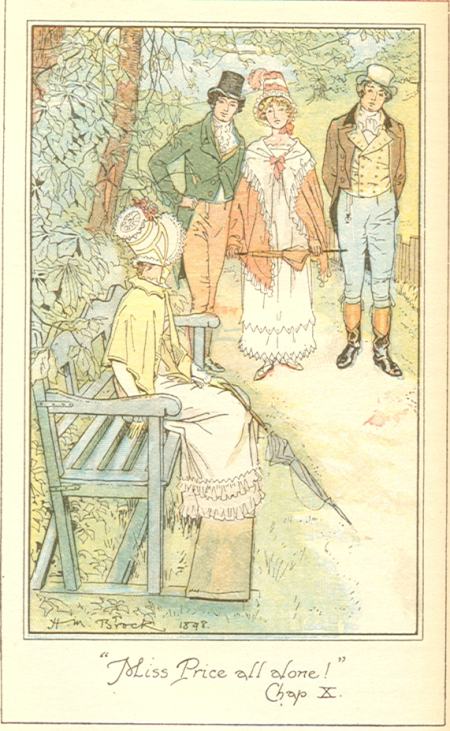
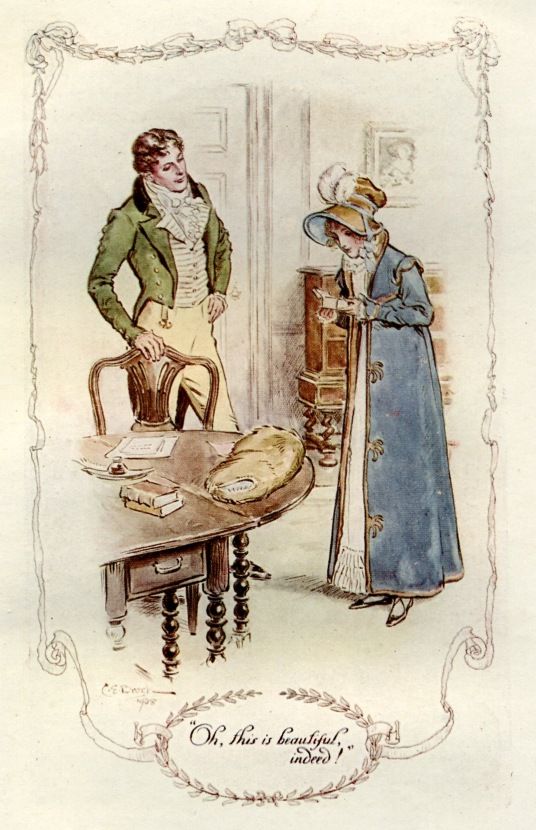
I’ve finished the section in which the young people attempt to act the play “Lover’s Vows,” and the section in which Henry Crawford decides he is in love with Fanny, asks her to marry him, and she refuses him, only to be pressured by Sir Thomas and Edmund, and later by Mary Crawford.

No one in this book understands anyone else; the only two people who are shown to have perfect felicity are Fanny and her brother William, but their bond does not depend entirely upon understanding of each other to flourish, and their times together, though intense, are widely separated while William is at sea. Fanny understands Edmund except in his feelings about Mary Crawford. Edmund, though he shares many opinions with Fanny, doesn’t understand her feelings against Henry Crawford at all. Sir Thomas wishes Fanny to be happy, but he doesn’t take the trouble to find out what that would really entail; his own thoughts on the matter are sufficient. Fanny is the poor relation in this as in everything else.

While Mary encourages Fanny to marry her brother, she uses as examples two marriages that did not end felicitously, with seeming disregard for how this reflects on the advice she’s dispensing; she’s too full of the vision of romance, not only where her brother is concerned but also blocked by her romantic feelings toward Edmund.

Everyone in this book is self-absorbed in one way or another.

#

More tomorrow.

Posted in austen, mansfield park, reading | Tagged | Comments Off on Mansfield Park Revisited, Part the Second

Mansfield Park Revisited, Part the First

I recently located the journal entries I made when I last reread Jane Austen’s Mansfield Park, way back in 2004. I reproduce them here for your enjoyment.

#

November 12, 2004

I’ve just begun my first reread of Jane’s Austen’s Mansfield Park. It was the last of the Austen novels I read, excluding juvenalia, back in the spring of 1990. The paperback copy I’m reading from is the same one that traveled with me that year to England, the Netherlands, Belgium, and France. The corners of the front cover are a little bent, and something dug into the back cover and left deep dents, probably in the suitcase; I think I finished it early in the trip, because I remember in Paris I was reading Umberto Eco’s The Name of the Rose, and on the plane home I read Maxine Hong Kingston’s The Woman Warrior and a Charles DeLint novel, The Riddle of the Wren.

Funny how I remember all that.

November 15, 2004

Mansfield Park was the last of the Austen canon I read, and for me it was the most difficult to get through. Fifteen years later, it still reads more slowly than the others, I think, but I don’t mind so much; this time, I’m watching Austen’s characterizations with great attention. Many of the characters in this book are not likable, at least not to me, but I understand each one very well through a few key actions and statements. Nothing in this book is random. Every sentence is making the world of Mansfield more and more real to the reader.

In our world, Fanny is a wimp who never speaks up for herself, and Edmund is a wet blanket who proses on about a narrow compass of morals that he thinks everyone should follow; they deserve each other, since they’re mostly in agreement about everything anyway. Yet in the world of the book, Edmund and Fanny are the only truly unselfish characters, except perhaps for Mrs. Grant, whom we don’t see enough of to really judge.

In the world of each character, they are the center of the universe, and this is as it should be, because isn’t that true in real life? It’s Fanny’s hard luck that she’s barely even the center of her own life; yet it’s a powerful commentary on Austen’s society that Fanny is as she is. Fanny is totally dependent on the charity of others; if she offends, she might be cast out, and she’s had no preparation whatsoever for living in any manner other than that of poor relation; there’s no Georgette Heyer hero waiting to take her up into his carriage. It’s no wonder Fanny is such a shrinking violet. Yet her beloved older brother William makes a career for himself in the Navy, underlining the fact that men had options.

I don’t like Miss Crawford, either, but in her own way, in her own world, she at least thinks for herself. It’s Edmund’s opinion that her upbringing has led her to think poorly; neither he nor Fanny believes Miss Crawford forms her opinions independently, attributing her faults to her uncle and aunt. Individualism is frowned on; behavior must be molded by the past and guided by figures in moral authority such as guardians and clergymen. It’s also interesting to note that nowhere in the book do the characters discuss the royal family or Parliament or anyone so far away as being in any way responsible for society’s mores. Everything is on the familial level, which might seem shallow unless you consider, as I do, the families to be English country society in microcosm.

I admit I don’t have deep historical knowledge of this place and period, but from reading Austen, it’s amazing how much I feel I understand.

#

More tomorrow!

Mansfield Park can be read online at Gutenberg.org.

Posted in austen, mansfield park, reading | Tagged | Comments Off on Mansfield Park Revisited, Part the First

Punctuation & Style

I participated in a panel at Readercon last weekend that was all about punctuation. We were asked to bring examples of prose that used punctuation in interesting ways. I chose examples that I thought used a wide variety of punctuation, all of it intended to have specific effects. We didn’t end up using any of those examples for the panel (and it turned out I was the only one who’d brought any, anyway!).

So here are some of the examples that I found interesting to study.

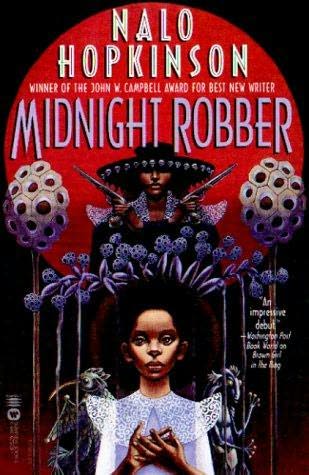
Nalo Hopkinson, from Midnight Robber:

Plang-palang! Plang-palang! Cockpit County was in the full throes of Jour Ouvert morning revelry. People beat out their own dancing rhythms with bottle and spoon, tin-pan and stick. What a racket! Bodies danced everywhere: bodies smeared with mud; men’s bodies in women’s underwear; women wearing men’s shirt-jacs and boxers; naked bodies. They pressed against the car, pressed against one another, ground and wound their hips in the ecstatic license of Carnival.

Ysabeau Wilce, from Flora Segunda:

And she was sure to mention, too, how sad it was that I had failed her so close to my Catorcena. My Catorcena was only a week off. It’s a big deal, turning fourteen, age of majority, legally an adult, wah-wah, suitable now to be received by the Warlord, wah-wah, and so it’s celebrated in big-deal style. There’s an assembly where you have to make a public speech about your family’s history and obligations and the responsibility of adulthood. There’s a reception where the Warlord greets you by name, thus acknowledging you as his loyal subject. It’s all very tedious, overwrought, and complicated–a big whoop-de-do.

Molly Gloss, from Wild Life:

The rain went on until we were thoroughly wringing wet and our boots sloppy; until every depression in the ground, every bunker in the rocks, every hollow among tree roots was inches deep with muddy water and floating detritus. Then the sky lightened to Quaker gray, and steam began to rise from the ground – a startling illusion of vulcanism – and it was the end of rain for the time being. (Why do you suppose one feels the clamminess of clothes more miserably when the rain has stopped than while it is still falling?)

Jane Austen, from Emma:

The event had every promise of happiness for her friend. Mr. Weston was a man of unexceptionable character, easy fortune, suitable age, and pleasant manners; and there was some satisfaction in considering with what self-denying, generous friendship she had always wished and promoted the match; but it was a black morning’s work for her. The want of Miss Taylor would be felt every hour of every day. She recalled her past kindness—the kindness, the affection of sixteen years—how she had taught and how she had played with her from five years old—how she had devoted all her powers to attach and amuse her in health—and how nursed her through the various illnesses of childhood. A large debt of gratitude was owing here; but the intercourse of the last seven years, the equal footing and perfect unreserve which had soon followed Isabella’s marriage, on their being left to each other, was yet a dearer, tenderer recollection. She had been a friend and companion such as few possessed: intelligent, well-informed, useful, gentle, knowing all the ways of the family, interested in all its concerns, and peculiarly interested in herself, in every pleasure, every scheme of hers; one to whom she could speak every thought as it arose, and who had such an affection for her as could never find fault.

Posted in writing craft | Comments Off on Punctuation & Style

Fanfiction and Feedback

I’ve been meaning to post about fanfiction for a while, not really in connection with recent online discussions of literary fanfiction. Instead I want to talk about one particular reason why people write fanfiction. They write fanfiction for feedback, and for community.

I’ve been involved with fandom since I was a pre-teen. I read my first Star Trek fanzines in middle school and was unimpressed, I think because the stories didn’t resonate for me. At that time, fanfiction was on paper. You had to be “in the know” to even know the stories existed, much less to know how to obtain them. (I learned through a club, and through conventions.) If you wrote fanfiction, you did not have the distribution that’s possible with fanfiction that’s posted on the internet. You were writing for a very limited audience.

Some fanzines were published in series. If your story appeared in the first issue, and anyone bothered to comment on it, and the fanzine had a second issue, months or even years later, you might get a sentence or so of feedback. When I wrote fanfiction in college, that feedback was like gold. No, platinum. Because I was writing for myself–I love writing–and to explore aspects of the off-the-air television show over which I obsessed, but I also craved discussion. Partly of the show, but more and more of writing.

By the time I was in graduate school, in the early 1990s, fandom was on the internet, mostly in forums and mailing lists. I joined a mailing list and we began to exchange stories via email. Longer stories were posted to the list in parts, usually ending in dramatic cliffhangers.

Feedback was often instantaneous. Even if you posted your story in the middle of the night, someone, somewhere, was awake and reading. Long discussions might be sparked by a story, on all aspects of the writing, not just its relation to the show’s canon. In fact, often the stories were very, very far from reproducing episodic television format. Those interested in writing for its own sake found each other quickly, and formed strong bonds. I learned it was all right to geek out about writing. I wasn’t the only one.

That was what I loved most about writing fanfiction. I enjoyed writing for the paper zines–I couldn’t afford to buy them, but writers received contributor copies–but it was the quick, sincere feedback on the mailing lists that was most valuable to me. If not for those mailing lists, I might not be a professional writer today.

Posted in fanfiction, genre | 6 Comments

Charles Sorley, "A Letter From the Trenches to a School Friend"

A Letter From the Trenches to a School Friend

I have not brought my Odyssey
With me here across the sea;
But you’ll remember, when I say
How, when they went down Sparta way,
To sandy Sparta, long ere dawn
Horses were harnessed, rations drawn,
Equipment polished sparkling bright,
And breakfasts swallowed (as the white
Of eastern heavens turned to gold) –
The dogs barked, swift farewells were told.
The sun springs up, the horses neigh,
Crackles the whip thrice-then away!
From sun-go-up to sun-go-down
All day across the sandy down
The gallant horses galloped, till
The wind across the downs more chill
Blew, the sun sank and all the road
Was darkened, that it only showed
Right at the end the town’s red light
And twilight glimmering into night.

The horses never slackened till
They reached the doorway and stood still.
Then came the knock, the unlading; then
The honey-sweet converse of men,
The splendid bath, the change of dress,
Then – oh the grandeur of their Mess,
The henchmen, the prim stewardess!
And oh the breaking of old ground,
The tales, after the port went round!
(The wondrous wiles of old Odysseus,
Old Agamemnon and his misuse
Of his command, and that young chit
Paris – who didn’t care a bit
For Helen – only to annoy her
He did it really, K.T.A.)
But soon they led amidst the din
The honey-sweet — in,
Whose eyes were blind, whose soul had sight,
Who knew the fame of men in fight –
Bard of white hair and trembling foot,
Who sang whatever God might put
Into his heart.
And there he sung,
Those war-worn veterans among,
Tales of great war and strong hearts wrung,
Of clash of arms, of council’s brawl,
Of beauty that must early fall,
Of battle hate and battle joy
By the old windy walls of Troy.
They felt that they were unreal then,
Visions and shadow-forms, not men.
But those the Bard did sing and say
(Some were their comrades, some were they)
Took shape and loomed and strengthened more
Greatly than they had guessed of yore.
And now the fight begins again,
The old war-joy, the old war-pain.
Sons of one school across the sea
We have no fear to fight –

And soon, oh soon, I do not doubt it,
With the body or without it,
We shall all come tumbling down
To our old wrinkled red-capped town.
Perhaps the road up llsley way,
The old ridge-track, will be my way.
High up among the sheep and sky,
Look down on Wantage, passing by,
And see the smoke from Swindon town;
And then full left at Liddington,
Where the four winds of heaven meet
The earth-blest traveller to greet.
And then my face is toward the south,
There is a singing on my mouth
Away to rightward I descry
My Barbury ensconced in sky,
Far underneath the Ogbourne twins,
And at my feet the thyme and whins,
The grasses with their little crowns
Of gold, the lovely Aldbourne downs,
And that old signpost (well I knew
That crazy signpost, arms askew,
Old mother of the four grass ways).
And then my mouth is dumb with praise,
For, past the wood and chalkpit tiny,
A glimpse of Marlborough –!
So I descend beneath the rail
To warmth and welcome and wassail.

This from the battered trenches – rough,
Jingling and tedious enough.
And so I sign myself to you:
One, who some crooked pathways knew
Round Bedwyn: who could scarcely leave
The Downs on a December eve:
Was at his happiest in shorts,
And got – not many good reports!
Small skill of rhyming in his hand –
But you’ll forgive – you’ll understand.

–Charles Sorley

Posted in sorley, wwi poetry | Comments Off on Charles Sorley, "A Letter From the Trenches to a School Friend"

Readercon 2010

I have a new free read posted on my website, in PDF format: Camille, Henri, Maxime, an erotic outtake from The Duchess, Her Maid, The Groom & Their Lover. It was removed from the original submitted manuscript for pacing reasons. If you’ve ever heard me say, “I removed the sodomy for pacing reasons,” this is the scene to which I was referring. It’s an odd feeling for me to read over it now, particularly since I just finished an entire book with Maxime as the hero. The Duke & the Pirate Queen isn’t the same kind of novel at all, despite being set in the same world. Or maybe it is. I don’t know. Maybe I’ll know once I have some distance from it.

Otherwise, today I’m attending Readercon, the conference on imaginative literature, twenty-first edition, and taking part in a number of panels, discussions, and the like.

My schedule is here.

You can read the panel descriptions here.

Recent Readercons past, the short version:

2009: No heat wave, no breakdowns, no tow truck, no last-minute boatlike rental car, no desperate attempts to keep driver awake! The drive was…uneventful. Shocking.

2008: Tom Purdom told me of the Age of Pulp, “when writers were iron and stories were wooden.” Geoff Ryman pushed our luggage trolley. Andy Duncan signed my arm. Ellen Kushner ate my french fries.

2007: No one ever believes that Laura Kinsale’s plots are real.

Posted in conferences | Comments Off on Readercon 2010

Carezze Di Luna releases!

I’m on the road today, traveling to Readercon with friends Judith Berman and Michael Swanwick. If you’re going to the con, my schedule is posted here.

Today is the release date for the first translation of The Moonlight Mistress. The Italian title is Carezze Di Luna. I love this adaptation of the original cover.

Look inside the book!

Mentre scoppia la Prima Guerra Mondiale, l’avvenente chimica Lucilla Daglish s’innamora di Pascal Fournier, uno scienziato che nasconde un inquietante e sbalorditivo segreto. Quando lui le rivela di compiere studi sui lupi mannari, facendola entrare in contatto con quelle creature selvagge e pericolose che si aggirano fra gli umani ignari, per Lucilla niente sarà più lo stesso. Da quel momento sarà attratta in un vortice di passione e pericolo, di sensualità e inganno, di amore e morte, in un crescendo di rocambolesche avventure, insidie soprannaturali e passioni proibite.

There’s some commentary on the book (in Italian) at this blog.

Posted in foreign editions, moonlight mistress, promo | Comments Off on Carezze Di Luna releases!

Readercon 2010 Schedule

This is what I’ll be doing while everyone else is at RomCon! I’ll be at Readercon 2010 this weekend. For the special events, I’ll be participating in the Meet the Pro(se) party and the marathon reading of Theodore Sturgeon stories.

Here’s my panel and talk schedule:
Axes of Identity in Speculative Fiction
Friday 5 pm, ME/CT
Andrea Hairston, Victoria Janssen (L.), N.K. Jemisin, Vandana Singh, Kestrell Verlager
“[H]ow can you talk about one structural barrier without at least mentioning how… barriers for others are advantages for you? … We all have races and genders and class levels and levels of ability. All of our identities contribute to our positions in society…this is not a radical notion.” — Thea Lim, commenting on Newsweek’s failure to mention race in a retrospective article about feminism. Writers like Nalo Hopkinson in The Salt Roads and Larissa Lai in When Fox Is a Thousand refuse to elide these intersections, presenting queer characters of color front and center to their stories. Speculative fiction also offers opportunities to create new axes of identity, like those experienced by the dadalocked narrator of Nnedi Okorafor’s Zahrah the Windseeker or the information-immune protagonist of Geoff Ryman’s The Child Garden. What other works of imaginative literature have portrayed or explored the complexity of social standing generated by our multiple axes of identity? What does an awareness of these intersectionalities add to both the text and our understanding of it?

The New YA Golden Age
Friday, 7:30 pm, Salon G
Paolo Bacigalupi, Judith Berman, Victoria Janssen (L), Alaya Dawn Johnson, Konrad Walewski
In her intellectual epic The Children’s Book (2009), A.S. Byatt interprets the “Golden Age of Children’s Literature” — including such authors as Rudyard Kipling, Kenneth Graham, J.M. Barrie, E. Nesbit, and H.G. Wells — as a direct outgrowth of the Edwardian obsession with childhood, itself a kind of national nostalgic regression. “The Edwardians knew they came after something…There were so many things they wanted to go back to, to retrieve, to reinhabit.” At Readercon 18, we declared, “This is a golden age for young adult speculative fiction.” If this statement still holds true, what are the driving forces behind our present high-water mark? Environmental factors, market forces, changes in categorization — or what are they putting in the zeitgeist these days? This time around, are we looking backward or forward?

Bookaholics Anonymous
Friday, 9:00 pm, RI
Victoria Janssen et al.
A great way for folks attending their first Readercon to meet some of the regulars and get into the spirit of the weekend.

The Career of Nalo Hopkinson
Saturday, 11:00 am, Salon G
Elizabeth Bear, Gemma Files, Andrea Hairston, Victoria Janssen, Gary K. Wolfe (L)
Fanfic as Criticism (Only More Fun)
Saturday, 12:00 pm, Salon F
Victoria Janssen (L), Alaya Dawn Johnson, Erin Kissane, Kenneth Schneyer, Cecilia Tan
Fanfiction is being produced online at a rate of millions of words per month. Fanfiction can expand on a shorter work, change a work’s themes, or even attempt to “fix” things the author is felt to have done “wrong” (e.g., provide a backstory to explain otherwise undermotivated behavior). These dynamics are not unheard of outside of Internet fandom communities — Virginia Woolf’s Mrs. Dalloway attempts to “fix” James Joyce’s Ulysses (which itself retells Homer’s Odyssey). In what ways can fanfiction be a valuable part of the criticism of a text? Can it appeal as criticism to readers outside the fanfiction community? If so, how can they find the most interesting works?

Great War Geeks Unite
Saturday, 2 pm, ME/CT
Victoria Janssen
Have you written a story or novel set during World War One? Read fiction of the period, or set in the period? Do you have a love for trench warfare, poison gas, and puttees that passeth all understanding? Then this is the discussion group for you to geek out with. What is the imaginary speculative WWI novel you’d most love to read?

Kaffeeklatsch, Victoria Janssen
Saturday, 3 pm, Vineyard Room
Theodore Sturgeon Marathon Short Story Reading
Sunday, 10:00 AM, Room 730
Victoria Janssen reads “Scars” and “Blue Butter”

Not Quite the Punctuation Panel
Sunday, 11:00 AM, ME/CT
John Crowley, Samuel R. Delany, Ron Drummond (L), Victoria Janssen, Barry Malzberg
We think of an author’s style as being about vocabulary and word choice, but sentence structure can be equally important. Barry N. Malzberg and Alan Garner are examples of writers whose unique, fresh, and immediately identifiable styles are largely the product of the rhythms of their characteristically structured sentences. Try using a comma in place of a semicolon, you immediately sound like John Crowley. We’re not confident that the possessors of such prose styles can have much to say about how they do what they do, so we’ll discuss this from the point of view of readers. Our panelists have brought examples of writers who fit this description for our delectation and analysis.

Find out more about my fellow program participants here.

Posted in conferences, sf/f | Comments Off on Readercon 2010 Schedule

Top 5 Angsty Heroes

I love angsty heroes. You might have guessed that about me at some point. Ahem.

Anyway, my top five:

1. Any Laura Kinsale hero. I mean, how can you top the boy prostitute who becomes a ninja? Or the vertiginous highwayman? Go on, try. I dare you.

2. Any Carol Berg hero, despite them probably being dead from their injuries after she gets through with them. They suffer, yet also manage to kick butt, and get happy or semi-happy endings. Song of the Beast is a standalone and good to start with. The hero has just been released from seventeen years of being tortured. Not kidding.

3. Gerald Tarrant, from C.S. Friedman’s Coldfire trilogy: Black Sun Rising, When True Night Falls, and Crown of Shadows. His angst has to do with being immortal and powerful and killing his whole family to get that way, yet he is still strangely moving to me. His powerful emotional relationship with a straight-arrow priest might be part of it.

4. Bentley, in Liz Carlyle’s The Devil You Know, even though I guessed he’d been sexually abused long before any one in the book did. The hotness was him coming out the other side of trauma.

5. I can’t not mention Francis Crawford of Dorothy Dunnett’s Lymond Chronicles, which begin with The Game of Kings and continue in Queens’ Play and so on for six books total, of which the most supremely angsty is Pawn in Frankincense, but don’t bother trying to read them out of order, it is totally impossible. Francis is in an angst category all his own, making over-the-top into brilliance. I still can’t believe Dunnett got away with what she got away with in this series. She is the mistress to whom all writers of angstful historical epics should aspire.

How about you? Who are your favorite angsty heroes?

Posted in reading, romance novels, sf/f | 8 Comments

How To Begin Writing blah blah blah

I’ve been rooting around in my backbrain trying to figure out how I begin writing a new story. I mean the writing part, not the coming up with ideas part.

These days, since I’ve been writing novels to deadline, it’s easy to tell when I’m going to start a new story. I start the new story after the old story is finished. The subject of my story is dictated by what I’ve discussed with my editor already: “it’s a sequel” or “it’s a paranormal historical.” I turn in a synopsis and perhaps chapters before I officially begin writing the book, so I’ve started before I’ve started, if that makes any sense. There’s always the chance I’ll have to abandon one idea and choose another that’s more to the publisher’s liking (which happened for book two of my first contract). I’m okay with that, since the publisher is the one paying for my novel.

Blah, blah, blah. The content of this post is actually reflecting my process in beginning a new story. I ramble a lot. I might have an idea, but the idea isn’t the story. I don’t really count the story as begun until I’ve actually written a scene, until there are words on my computer screen or in my notebook. The characters, the setting, the story itself aren’t a thing to me until they’re out of my head and in the world.

When I sit down with a blank page in front of me, it can be terrifying. So unless I’ve had an opening sentence in my head for days, I just…begin. With blah, blah, blah.

Posted in writing, writing process | Comments Off on How To Begin Writing blah blah blah