Voirey Linger – Guest Post

I’m elsewhere today! You can find me talking about my top five favorite Marriage of Convenience novels at Monkey Bear Reviews.

Read a 100-word story I wrote here.

I’m also a guest poster today at the Novelists, Inc. Blog on “Real Writers Have Business Cards?” Please drop by and check it out!

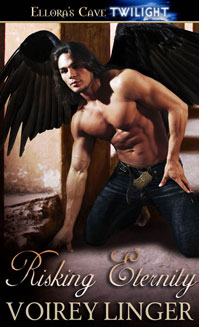
Now please welcome my guest, Voirey Linger, as she chats about the paranormal element of her new novella, Risking Eternity.

#

Information for an erotic romance can come from funny places. Sometimes you find exactly the little bit you need in a place you never expect.

My world building is usually pretty basic. I like to set things in a contemporary setting, a city that can be just about anywhere. I set up the characters in a world I already know. When writing angels, this took me back to my roots as a pastor’s kid.

I grew up in a home that was an odd balance of Christian Fundamentalist and Liberal Christianity. Creation and science were balanced on a fine edge and there was a constant pull between staying rooted in Biblical beliefs and living in a modern world.

When the idea of the angel books came to me, it made perfect sense to throw that same tug-of-war between the conservative values and modern life into the mix.

As part of this balance, I needed to cement the world of an angel, make it as simple and natural as the human world. I dug up all kinds of internet information and read multiple books on secular Angelology, but nothing seemed to fit the natural order of how things worked in my head.

When researching paranormal elements, there are many myths, legends and traditions to draw on for world building. The information I found on angels was vast, varied and often contradictory. On one hand it left me very confused in terms of what was ‘right’ but on the other it gave me the freedom to simply create what I wanted without worrying about being correct.

So I went back to my roots, where I first learned about angels. I went to Christian tradition and the Bible.

Yes, the Bible as research for an erotic romance.

There are areas where I wander a bit, filled in my own imaginings, other places I had to choose between Bible scholars deductions and some of the old traditional beliefs, but that’s to be expected in writing fiction.

In the end I simply chose information fit my storyline as long as I could find something in the Jewish-Christian tradition that supported it. This tradition is wide-spread and at least partially familiar in much of the English-speaking world today. With Risking Eternity, I tried to tap into these deep-seated roots.

My hope is that the result is easy for a reader to assimilate and accept. I want to push a but, suspend disbelief, and never hit a point where the reader has to stop and choose to accept a detail.

Did I succeed? I don’t know. That’s up to the reader to determine.

#

Thanks, Voirey!

Posted in guest, sf/f | 1 Comment

Worms Are Eating In My Brain, Swamps, Etc.

I often think of my writing process—the part that goes on inside my head—as composting. The worms of my brain take in information, process it, and expel it. (Okay, so maybe not the tastiest metaphor….) Maybe it’s more like stuff fermenting in a swamp?

Never mind.

My job as front person is to feed information to the worms.

I haven’t been writing a lot lately. I need to write; I’m on deadline; but it’s been hard for me to settle down to it. Since I journal about my process, I know this usually means I need food/information and processing time. In between sessions of forcing myself to write despite lack of energy for it, and making notes/organizing what I’ll be writing next time I sit down to write, and going to the gym in the hope something will be shaken loose, I’m reading a lot. Books are food for my worms.

I can’t always tell what I should be reading. My worms and I don’t speak directly. Also, they can’t speak because they’re worms. And imaginary worms, at that. So I just…read what I feel like reading, with the idea that it’s sort of like when you get a craving for citrus fruit or iron-rich meat. If I crave it, maybe I need it.

Last weekend, I made myself write. Friday night, when I had a writing date, every word was difficult. Saturday morning, the words flowed beautifully. Sunday, I was back to banging my head on the keyboard.

I’ll be interested to see how my writing goes this weekend, whether every sentence is squeezed out like…never mind…or whether my fingers will fly along the keyboard. The scary thing is, no matter how the writing feels at the time, it all seems to be about the same in the end. I might have felt terrible while writing a particular scene, and it will usually read just as well, or better, than the scene that flowed like water.

The important part is that I sit down and do it. All that worm excrement has to go somewhere.

Posted in writing process | Comments Off on Worms Are Eating In My Brain, Swamps, Etc.

My TBR or The Andes?

My To Be Read book piles are scary. I suspect pretty much everyone who loves books has a TBR; if they’re not the sort who keep physical books around, or the sort to equivalently load up their e-readers, I would bet lots and lots of money that almost every reader out there has at least a mental list of books she would like to read someday.

My TBR consists of four boxes atop a footlocker. With some loose books on top. And a stack atop a nearby bookshelf, which is also full of TBR, all of it nonfiction. And a box completely full of short story collections. And various books on the shelves, mingled in with other books I have already read. And that little box I tried to hide beneath the couch. That’s not counting my wishlists, of course.

Does my giant collection make me stop buying books? Or even consider stopping? No. Because there might be an apocalypse, and I would definitely need something to read after civilization collapsed. After I read them, I could use them for insulation, or perhaps stitch covers together to make clothing. Best of all, I might be able to trade books for…more books.

I am trying to do better about getting rid of books. These days, I continually remind myself it’s all right not to finish reading a book if I’m not enjoying it. As soon as I’ve finished reading a book, or even when I’m close to the end of one, I try to think about whether I should keep it or share it. (“Share” feels better to me than “get rid of.”) I’m trying to be more ruthless about sharing books I didn’t adore.

I only have so much room in my apartment, after all. And I need room for the To Be Read.

Posted in reading | 2 Comments

Taking the Bookmark Plunge

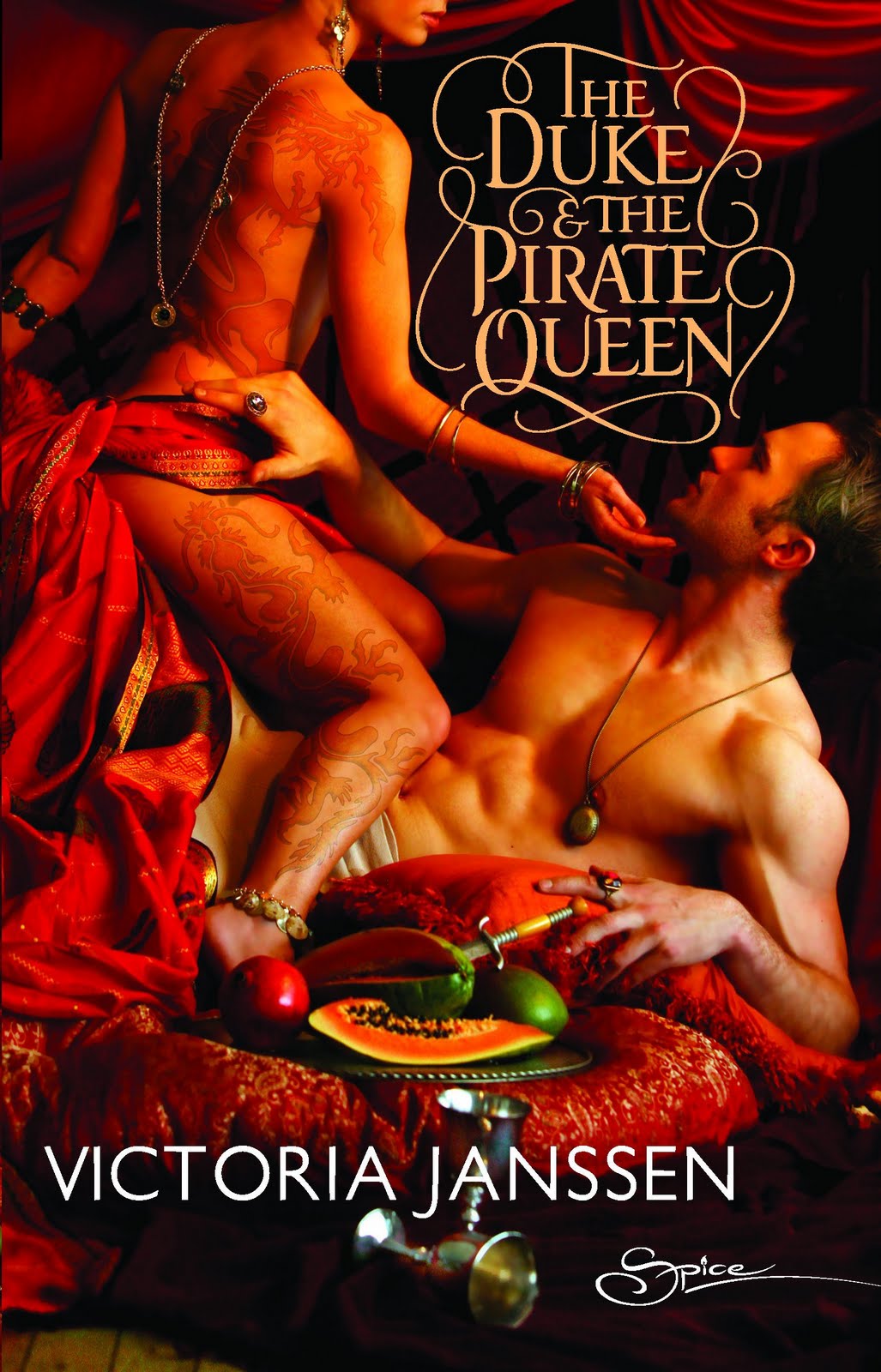
After much pondering and asking people, I decided to have bookmarks made for The Duke and the Pirate Queen. I am very much not an artist, so I hired Jax Cassidy of Jaxadora Design to make pretty ones that utilized the book’s cover. I chose Iconix to do the printing.

Jax completed my designs with a couple of days, tailoring them to specifications for Iconix, and Iconix sent me a quote within an hour or two of me uploading the designs; at my request, they held the invoice until I’d also uploaded postcard designs, so I could pay for both at once and have them shipped in one batch. Awesome service.

Why am I telling you all this? Because it’s the first time I’ve ever had bookmarks made. It’s an experiment. And I plan to report on my experiences.

The first thing I learned was that, yes, someone who knows about design can do a much better job than I can! You get what you pay for.

The second thing I learned was that it’s handy to have some little text items to include on the bookmark: descriptive blurb, review quotes, brief summary of the book. Left to my own devices, the back wouldn’t have had any information but my website URL.

The third thing I learned is that most reviews, even ones that loved a book, don’t yield short, punchy quotes suitable for use on bookmarks. Unless I am doing it wrong. I sort of knew that blurbs were an art form.

I’m planning to make the bookmarks available to bookstores and librarians, so if you’re affiliated with one of those, let me know and I’ll send you some!

I will probably bring some to RWA Nationals, as well. I know the audience there will be mostly writers, but writers also read. And I will have plenty of bookmarks.

Related post: Online Promotion: Is It Worth It?

Posted in business of writing, promo | 6 Comments

"On the Female Vampire," Evie Byrne Guest Post

Please welcome my guest, Evie Byrne!

#

On the Female Vampire

A monster is monstrous because it violates accepted boundaries. Often these boundaries are physical. Creatures of the twilight world like minotaurs, werewolves, insectoid aliens, selkies, sirens and mermaids cause fascination and discomfort because they are cross the reassuring threshold that separates human from animal. Vampires are generally human-formed, but still they manage to be more transgressive than any other monster. They violate boundaries right and left. They’re neither dead nor alive. They occasionally shift form. They live on blood–which makes them cannibals, which, needless to say, is a big boundary–or perhaps it makes them parasites, which aligns them with the insect world–or maybe it makes them demons, which aligns them with the spirit world. And when they’re not invading your body, they’re invading your mind. When you submit to them, you submit body, mind and soul. They own you. They’re slavers. They break all of our laws, conventions and beliefs–and tempt us to break them too.
For a vampire, feeding is sex. It’s a penetrative act of possession. One so powerful that used to eclipse intercourse. Dracula ruins Lucy far more completely than any determined rake. Anne Rice’s vampires, as I recall, don’t have sex. Having experienced the ultimate act of penetration and surrender, they loll around in sensual, bisexual languor. But those are old school vampires. Something has shifted in the perception of vampires of late. Vampires in popular literature and entertainment have become more sexual, more heterosexual and almost exclusively male.

The vampires of today’s romances are masculine, desirable heroes, relieved of both sexual ambiguity and the stench of the grave. This new breed of male vampire is generally isolated and sympathetic in his misery: Mr. Rochester with fangs. He’s an alpha male of an extreme sort, coldly handsome, immortal, preternaturally strong, supernaturally persuasive, and fitted with penetrative equipment both upstairs and downstairs, all the better to claim you–if you’re the one and only woman for him. This makeover strips much of the shivery terror from the mythos, but the trade off is that it makes room for hot fantasy.

But what of the vampire heroine? Female vampires are scarce on the ground, any sort of female vampire, much less a romantic heroine. They occasionally appear as slutty minions in vampire gangs, or as a minor antagonist. And of course, in some romantic vampire tales the hero vampire will elevate his love to immortality by turning her, but that is the end of the tale, not the beginning.

My take on this–and please do feel free to argue otherwise–is that while we’ve normalized male vampires enough to make them romantic heroes, female vampires remain too trangressive to be heroines.

Let’s take a step back. In the 19th century, when all vampires were monsters, female vampires were perhaps even more vile than their male counterparts. Being the weaker sex, they could not hunt fairly. They fed either through sexual guile or by preying on children–making them lower than low. Painters and poets of that age were enraptured with idea of the female vampire as a seductress. Victoria posted a Baudelaire poem about a female vampire on this blog just a couple of weeks ago, and if you didn’t see it, it’s well worth a read. [http://victoriajanssen.blogspot.com/2010/05/metamorphoses-of-vampire-charles.html]

For these sensitive 19th century poet types, the female vampire was the embodiment of feminine devourer who, if left unchecked, sucked dry the masculine life force. She was definitely an erotic figure, but that eroticism was laced with repugnance and the fear of emasculation. One minute she’s slinking up to you, cleavage bared, and next thing you know, you’re not hanging around the Montmartre cafes with your friends anymore. You’re working as a clerk and helping out with the housework.
But I digress.

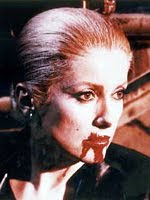
The sexual power of the female vampire threatens social norms. Earlier I spoke of the penetrative aspect of feeding. It’s inherently a sexual act. Yet while the male vampire may feed on men, he seduces women. (That is, unless you’re reading specialized erotic fiction.) The female vampire tends to be more openly bisexual, so voracious in her appetites that she cannot be constrained by gender. This perception is strong, and continues from the earliest female vampires to today. Miriam Blaylock, as portrayed by Catherine Deneuve in The Hunger (1983), is a sleek, glamorous, ruthless bisexual hunter. She takes both Susan Sarandon and David Bowie as lovers–and eats a child in the bargain as well. To me, she has always been the modern archetype of the female vampire.

Stepping back to the present again, to this time when the male vampire has become a sympathetic hero, the gulf between the female vampire and the male vampire has widened even further. He has special needs. She’s a monster.

I’m not saying this is a bad thing. I’m just saying the terrain has changed. I can’t address all vampires in all genres, only the vampire tales written today by (mostly) female authors for a (mostly) female audience under the banner of romance. In this genre, the prospect of being devoured by your lover is eroticized, as it was for those 19th century gentlemen, but now it is not framed as repugnant. Instead, it is the ultimate form of acceptance and bonding.

That sexual dynamic only works one way, however. It’s hot when an alpha vamp claims his mate through blood and sex, but that power relationship cannot be flipped. When a female vampire penetrates her human lover, it somehow makes him less of a man. Her claiming of him might make for good horror, but it doesn’t add up to satisfying romantic fiction.

The double standard goes on. The intense predatory drive that makes a male vampire sexy doesn’t translate in the same way for a female vampire. That same drive makes her a dangerous, unbalanced stalker. Similarly, a male vampire is usually portrayed as handsome and aware of his magnetic attraction, but he’s not vilified for it–in fact, it’s part of his appeal. Whereas when a female vampire uses her seductive powers, its trickery. Doing so breaks the unwritten commandment that a romantic heroine be modest: either she doesn’t know she’s ravishing, or doesn’t care. Only wicked women use their looks like a blade.

It’s all about reader identification. The best part of reading a romantic fantasy is imagining what it would be like if you–ordinary, human you–found yourself face to face with a creature of the otherworld. How would you react? Could you love such a being? We enjoy experiencing a romance through the eyes of a woman whom we can relate to–an ordinary woman who finds herself in extraordinary circumstances. It is much harder to relate to a heroine who is a powerful, ruthless, bloodthirsty, and possibly immortal.

And that’s not because we don’t appreciate a powerful female, but rather because being unable to identify with her takes some of the fun out of this particular kind of reading experience. One of the oldest and most compelling storylines is the one in which an ordinary person tests herself against powers and mysteries beyond her imagination–and earns love along the way. That kind of story always hits the spot. There’s good reason for its enduring popularity.

So as much as I like a lady vampire, I don’t expect to see them crowding romances as heroines any time soon. And having thought about this for a while, I’ll admit I’m okay with that. I like the idea that they can’t be domesticated into do-gooder heroines who settle down into a happily-ever-after. Like their progenitor, Lilith, they embody the darker side of female power, and that stuff is too powerful to be bottled.
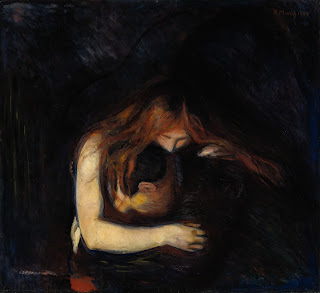
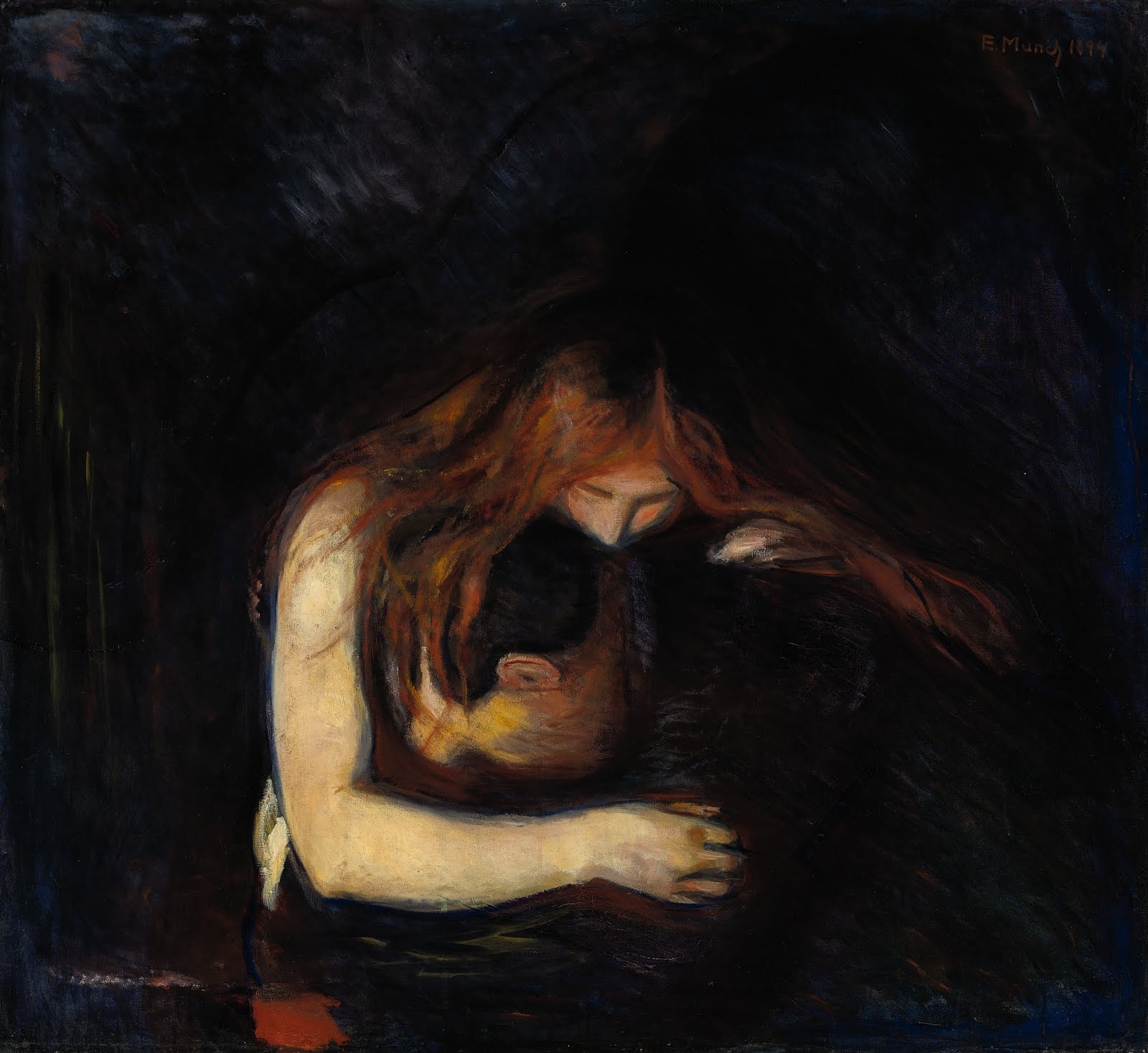
Love and Pain by Edvard Munch, 1894

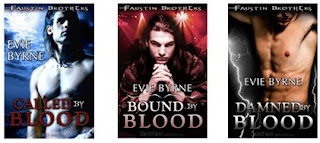
Evie Byrne is the author of three hot vampire romances: Called by Blood, Bound by Blood and Damned by Blood. Link. In the spirit of full disclosure, she admits that while two of her heroines are down-to-earth, regular humans, her third heroine is a vampire who is as wicked as the day is long.

#

Thanks so much for the great post, Evie!

Anyone have any comments on female vampire characters?
Posted in guest, vampires, women | 10 Comments

Edgell Rickword, "Trench Poets"

Trench Poets

I knew a man, he was my chum,
but he grew blacker every day,
and would not brush the flies away,
nor blanch however fierce the hum
of passing shells; I used to read,
to rouse him, random things from Donne–

Like “Get with child a mandrake-root.”
But you can tell he was far gone,
For he lay gaping, mackerel-eyed,
and stiff, and senseless as a post
Even when that old poet cried
“I long to talk with some old lover’s ghost.”

I tried the Elegies one day,
but he, because he heard me say:
“What needst thou have more covering than a man?”
Grinned nastily, and so I knew
The worms had got his brains at last.
There was one thing that I might do
to starve the worms; I racked my head
for healthy things and quoted Maud.
His grin got worse and I could see
He sneered at passion’s purity.
He stank so badly, though we were great chums
I had to leave him; then rats ate his thumbs.

–Edgell Rickword

Posted in rickword, wwi poetry | Comments Off on Edgell Rickword, "Trench Poets"

Charlotte Mew, "Absence"

Absence

Sometimes I know the way
You walk, up over the bay;
It is a wind from that far sea
That blows the fragrance of your hair to me.

Or in this garden when the breeze
Touches my trees
To stir their dreaming shadows on the grass
I see you pass.

In sheltered beds, the heart of every rose
Serenely sleeps to-night. As shut as those
Your guarded heart; as safe as they form the beat, beat
Of hooves that tread dropped roses in the street.

Turn never again
On these eyes blind with a wild rain
Your eyes; they were stars to me.–
There are things stars may not see.

But call, call, and though Christ stands
Still with scarred hands
Over my mouth, I must answer. So
I will come–He shall let me go!

–Charlotte Mew

Posted in mew, poetry | Comments Off on Charlotte Mew, "Absence"

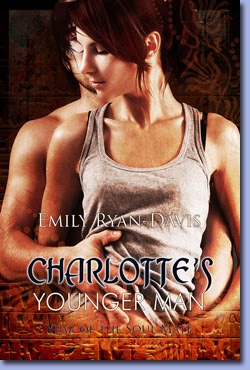
Writer, Know Yourself – Emily Ryan-Davis Guest Post

Please welcome my guest, Emily Ryan-Davis!

#

Writer, Know Yourself

Good morning, faithful Victoria fans. I’m a fan, too (she’s a lovely person and her characters fascinate me) so I’m pleased to be able to say you and I already have something in common.

I’m here today because Victoria generously volunteered a little of her cyberspace for my promotional efforts. Between the initial offer and now, however, I’ve decided not to do the promotion thing. I’d much rather talk about myself and my grasp of craft, and invite you to talk about yourself and your grasp of craft, than talk about my books. So. That’s what I’m going to do today. If you want to know what I can write or where to find it, Google will help you out.

So…I’ve been thinking about self-awareness a lot lately, in part because I’ve been observing beginner-author yearning for an experienced eye, for confidence in the decisions they make about what they’re writing or going to write, and for an end to the frustration of realizing they’ve made a self-uninformed decision. While writer self-awareness might not technically be a craft issue, I consider it as important as understanding of mood, theme, motif, story pacing and all that other stuff you can learn about from any number of books. And because my ego knows no bounds, since I decided self-awareness is as important as story structure, I’m going to treat it as a craft topic today.

About me: I don’t plot. Honestly, I care very little about plot, much to my critique partners’ dismay. Characters fascinate me. They could exist in a void for story purposes, their story progression taking place over the course of hours without any real-life sort of time allowance to lend realism, and I would be perfectly happy, both as a reader and as a writer.

Right alongside my plotfail, I also suffer from detail and logic problems. I just don’t care about the logic if it’s in the way of exploring my characters’ emotional transition from broken to…maybe a little less broken, ideally via an intensely sexual route. Again, my preference as a reader and as a writer. (If you’re an author reading this and you ever hear I skipped the middle of your book in order to read the end, please don’t take it personally; my habits are not necessarily commentary on the quality of your product.)

So I don’t plot and I have no head for details or logic. Or organization of details and logic. I do have a deep-seated penchant for whining and panicking when my characters dig in their heels and stop talking in an attempt to force me to give them some plot and details. I also have an immense appreciation for praise: go ahead. Love and adore me. It’s even OK if you criticize me as long as, underneath it all, you still love and adore me and are aware I’m going to resent your suggestion that I add some plot because it’s going to ruin the rhythm of my prose. I’m also bossy and not as generous with my praise as I expect others to be with theirs.

I’m not all flaws, though. There’s some awesomeness mixed in here. I’m a great speller. I barely stutter over query letters. I consider myself a master at nagging an editor without coming across as a nag. And I might be in love with the sound of my own prose, but I am totally not the only one.

Granted, the flaws outweigh the awesomeness. I’ve come to the conclusion the only reason I’ve managed to acquire and keep critique partners is honesty. Since I’ve figured out these things about my writer/reader self and have learned how to vocalize them, I’ve been better able to pinpoint my needs, explain my failings in advance, and warn people of what they’re getting as part of the package.

Self-awareness is working out pretty well for me. I find myself less frequently stalled in the middle of stories I think I want to write even though they’re not the kinds of stories I really want to write; sometimes people even come to me for advice or answers, despite my general lack of helpfulness.

How’s your self-awareness? Do you spend much time mulling over your high points and low points? Do you ever falter from what you know about yourself and decide you can change and be something different? (Boy, do I. Witness just about every one of my stories that try to wrestle with more than two characters and a miniscule plot.)

I’m inviting you to make use of Victoria’s blog comments for the purpose of talking about yourself. Tell me all about your flaws and your awesomeness. Don’t bother to check your ego at the door. I figure if you discover something about yourself today, you’ve learned something you’re not going to find in a how-to book. And maybe we’ll discover we have something in common besides mutual enjoyment of Victoria’s awesomeness!

#

Thanks, Emily! I’m looking forward to reading the comments on your post.

Posted in guest, writing process | Comments Off on Writer, Know Yourself – Emily Ryan-Davis Guest Post

Teaser from The Duke & The Pirate Queen

Today, I give you a tiny teaser from The Duke & the Pirate Queen, which is coming out in December, 2010.
#

Maxime heard the ship’s bell ring two quarter hours before the cabin’s door opened again. The cabin girl, Norris, poked her head in, then slid around the door and shut it behind her, reaching for a basket on the deck. When she saw Maxime, she stopped and looked at him incredulously.

“Is this your rope?” Maxime asked, mildly.

Her mouth opened, then closed.

“You can have it back, if you like. Though I’m afraid you’ll have to untie it from me yourself.”

Norris clutched the basket to her flat chest. “I…the captain borrowed it? My line?”

“She did.”

“You’ll have to ask her about untying it, then.” Norris grinned and slipped out again, this time with the basket.

Maxime cursed, but without much vigor. He returned to trying to lift his feet. The deck braces to which he was hitched showed no hint of movement and the sturdy decking didn’t even creak, no matter how hard he pulled. The knots on his wrists, he’d quickly learned, drew tighter if he struggled, and there was no accessible end for him to attack with his teeth.

“Being kidnapped,” he said, “is much more dull than I would have expected.” Perhaps things would improve once the ravishing began. If it began. He was beginning to have his doubts.

#

Another teaser, featuring the book’s heroine, Imena Leung.

Posted in free read, promo, the duke | 3 Comments

Promotional Goodies Questions

I’ve been pondering options for promotional items I could give away that would be related to The Duke and the Pirate Queen. I would really, really like some input into these ideas, so please feel free to comment at length.

Here are my ideas so far:

1. The usual suspects – postcards or bookmarks. Bo-ring, or usual because they work?

2. Temporary tattoos, which would fit in with the pirate idea. Except, tattoos of what exactly? Are they any use as promotional items if they don’t include the book title?

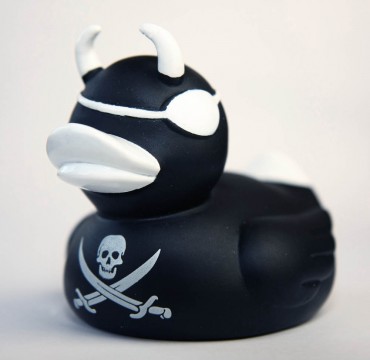
3. Pirate duckies. Possibly with labels stuck on, so one could then lose the labels and forget where the duckies came from. But oh so cute.

4. A single large giveaway of “pirate loot,” which would entail getting entrants to email me and then drawing a name. Would people just enter and forget? I think people would enter even if they had zero interest in the book.

5. Something else. Feel free to enlighten me on possible answers to this one.

Posted in business of writing, promo, the duke | 13 Comments