Suzy McKee Charnas – Guest Post

Please welcome my guest, one of my favorite writers ever, Suzy McKee Charnas!

#

Delighted to be invited here — since I’m just fresh off a new vampire story, and, er, “sparkling” with stuff to say! I’ll be be on a panel at the local SF convention this August, Bubonicon, called “Bite Me: when did vampires get sparkly and romantic, and why?”

Here’s a warm-up:
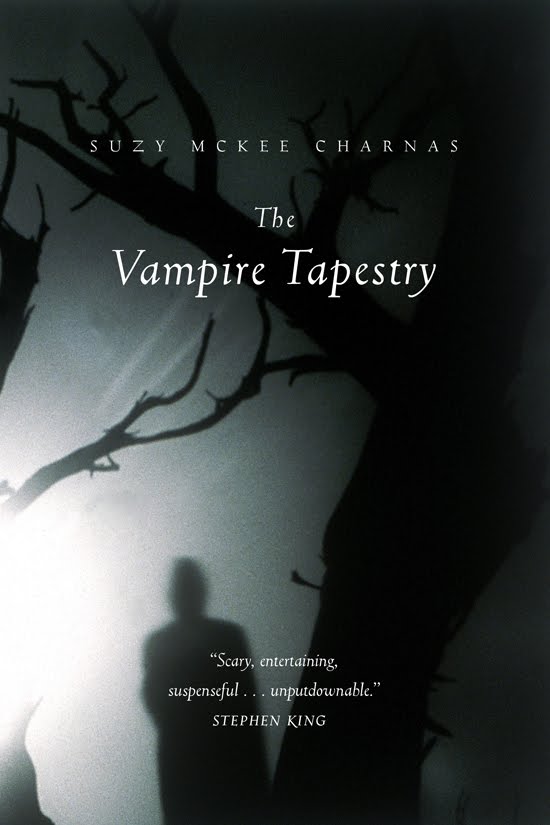
For me as a reader, the vampire has always been not just old (and therefore wise and sophisticated as well as, probably, decadent) but grown up (and male — but that’s another story). If he wasn’t going to be just a well-barbered werewolf in a tux (or some other popular monster, prettied up), then he needed at least some of the qualities of his great popular prototype, Count Dracula. And there was always a strong sexual allure– but it was edgy, not all warm and cuddly, because death — and “worse than death” — was always a strong possibility.

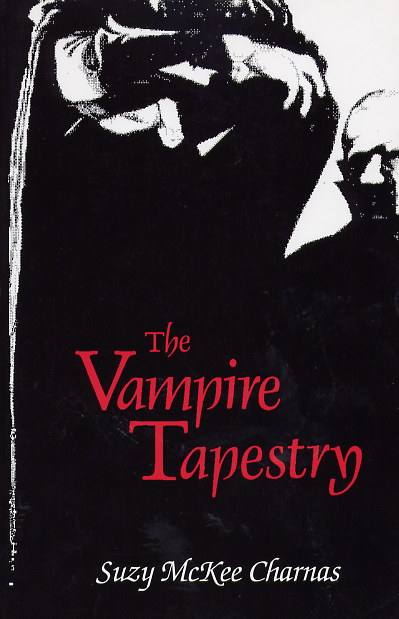
And that’s the way I wrote my own first vampire, Dr. Edward (yes, Edward — I got there first!) Lewis Weyland, in a “cult classic” (whatever that means): The Vampire Tapestry. He’s brilliant, attractive, an occasional (and remorseless) killer, and NOT looking for a soulmate to come live with him forever (like that’s something anybody sane would want — ETERNITY, with someone who’ll eventually be about as sexy to you as your college roommate).

But — the possibility of the romantic angle was always there, too, as it is with all sexy monsters, for very good cultural and psychological reasons (some of you may know this essay). And lately, as sexual activity has become the norm earlier and earlier for modern kids, youth’s romantic idealism (“my one and only true, perfect love”) and sentimentalism (“my lovely puppy that bites, but only to protect his beloved me“) has over-whelmed dangerous old vampire and coated him with fairy-dust. Presto: the sparkly vampires of what sometimes looks to me like our very own cultural Twilight. He’s broody, handsome, not interested in anything or anyone but Me, and he’s in High School.

So, there came along a challenge — to write a vampire story for a collection to be called Teeth (YES, I hope they change the title!) aimed at the Young Adult market and due out next year. The idea is to catch the attention of young readers stuck on Twilight and show them that the greater world of written vampires is wider than Sparkleworld.

I bit. I didn’t know exactly what I was going to do, but it was definitely going to minus the fairy dust.

So I’m visiting a local antiques mall that a friend runs in her “retirement”, and all of a sudden I get it — my story’s setting: my vampires were going to show up at the mall, avid seekers of collectibles among the “trash and treasures” typical of these places; and my late-adolescent hero, Josh, working there for the summer, will have to deal with them, up close and oh-so-personal.
And — well, you’ll have to read the story (“Late Bloomer”) to find out, but I can tell you this much: I loved writing modern vamps who are obsessed not with “Ooohh, oh, me so lonely and angsty” but with a vigorous, fiercely competitive kind of Antiques Roadshow life (well, without the “life” part). The research for this story was wonderful to do — hanging out at the antiques mall people-watching (plus the behind-the-scenes goodies). I also had a great excuse to interview my grandkids (both finishing high school) about music, so that I’d know who this boy would be listening to, and who he’d be desperate to be.

Which, thanks to my stepson giving me an iPod for my last (70th) birthday, has brought me into a whole new world of great music, to listen to while on the treadmill at the gym!

I love vamps; I never come away from writing about them with empty hands. Takers they are by nature, but they also keep on giving — they can’t seem to help themselves.

#

Thanks, Suzy! I can’t wait to read “Late Bloomer.”

Posted in guest, vampires | 1 Comment

"Cold, Brooding and Dead" – Cate Hart – Guest Post

Please welcome my guest, Cate Hart, blogging on some of her favorite vampires in movies and books.

#

Cold, Brooding and Dead: Vampires and Why We Love ‘Em

I think I can pinpoint when my love of vampire stories began. I’d have to blame it on the movie Lost Boys. After that, I was obsessed. I think what made Lost Boys so popular was that the vampires were edgy, young and looked like rock n roll stars with motorcycles. And Jason Patrick and Kiefer Sutherland.

The first vampire novel I read, ironically, was Dracula by Bram Stoker. There’s a reason the novel has become a classic. The love story is timeless, and Dracula is the original, misunderstood bad boy. Dracula wants what he cannot have, Mina and to live in London among society, craving for normalcy.

When I venture into a bookstore, I gravitate toward the paranormal stories, and generally, I walk out with one that has a vampire in it. I find myself comparing the author’s world or creature against the original, Dracula. He set the par – a member of the nobility, a remote castle, extremely rich, handsome, powerful…well, you get the picture. I love reading new twists on this, and sometimes, it’s just a modern update. For instance, Carlisle Cullen is handsome, rich, and member of an elite profession – doctor.

The Historian is one of my favorite books. It’s wonderful tale that reintroduces readers to Dracula but with the current trend, even on the History Channel, to take a well known story or event and bring scientific truth or historical accuracy to it. Though, The Historian isn’t a romance, it’s a great vampire read that solidifies Dracula as the reigning monster.

I never had a chance to read Anne Rice’s vampire series–I was in college at the time. But I did see the movies Interview with the Vampire and Queen of the Damned. Anne Rice introduced us to the brooding vampire with a conflicted conscious. Before Louis, readers accepted that the vampire was the monster. Anne showed us that the monster might have a heart.

These days, a blog post about vampires cannot not mention the phenomenon known as Twilight.

Two years ago, I was sucked into reading the book. I didn’t think I would like it, and it took several weeks after a friend recommended it for me to finally buy it. But once I started, I couldn’t read the series fast enough. Then of course Robert Pattinson happened, and the rest is history. But I still wonder what it was about Twilight that made the story so compelling. Many people, including myself, don’t like the way the heroine was written–appearing weak, infatuated, and easily controlled. But I think it’s the actual love story that has moved so many people. That and perhaps the unique spin on the actual vampires.

I just started reading PC and Kristen Cast’s House of Night series. This YA series has such a unique take on the vampires. I really like the world they have created. Yet another spin on the traditional vampire lore. In the House of Night, the teenage vampires are fledgling and more human than vampire. But each student has some special ability, and the heroine has been chosen to be the next leader.

I also love the Vampire Diaries, written by LJ Smith about a decade before Twilight. I love the two brothers, Stefan who wants to be normal and doesn’t feed on humans, and Damon who is deviant and does drink human blood. I also like that Smith used most of the traditional lore about vampires, like sunlight burning them, a stake through the heart, and compelling people to do their bidding. But Smith put a spin on the Salvatore brothers. They both have a ring that allows them to walk around in the daylight. I’m a Team Damon fan more than Stefan, perhaps, because Damon is the bad guy. But underneath that, Damon is proving to be just as good as Stefan when it comes to helping the heroine Elena. Both brothers are brooding, but Damon is certainly the bad boy.

Someone, an agent perhaps, mentioned what happened to the good ol’ days when vampires were evil and must be destroyed? When did we start to want the bad guy to really be the good guy? I think the switch must have come somewhere around the time of Buffy and Angel, Stephan and Elena, and Louis’s brooding. Before then, literature and film portrayed vampires as the monster, those horror story creatures out to upset the balance in humanity. But with Interview there was a different vampire, one with remorse for he was doing. So if vampires could have remorse, then maybe they had other feelings? And why not be able to want to love. Isn’t that what we all want, to fall in love and be loved in return? Loved no matter what we are, or have become. For me that is the draw to vampires to see that inner struggle against “their true nature.” And to see the heroine grapple with what their hero truly is and still love them in return, vowing to be able to change their ways.

#

Thanks, Cate!

Anyone have any favorites she didn’t mention?

Posted in guest, reading, vampires | 1 Comment

Gemma Files, "Everything Old is New Again" – Guest Post

Please welcome my guest, Gemma Files!

#

Everything Old is New Again
By Gemma Files

Back when I was a kid, in much the same way that I would have been utterly startled to be told that even an incredibly mainstreamed version of Rap music would eventually occupy most slots on a computer-file equivalent of the Billboard Top 100, the idea that vampires would have become the go-to monster of the Milennium’s turn would have amazed me beyond measure. And yet: Everywhere you look, these days, it’s a cornucopia of fangs–though usually coming firmly attached to a very specific type of vamp, ie the pale, sexy, mournful, conflicted kind so stringently popularized by books, movies and TV series like Twilight, Buffy the Vampire Slayer and True Blood.

Oh, every once in a while you get a throwback to the pre-Anne Rice tropes—-Steve Niles’ 30 Days of Night graphic novel springs to mind, along with the movie it inspired. But in my chosen genre, the vampire–once a Horror mainstay–has become so much of a joke that when guidelines routinely warn against submitting anything featuring the “classic” monsters, vampires are assumed to go right up the very top of that list. Vampires, like werewolves (and, increasingly, fairies), have been relegated to the ever-expanding Paranormal Romance sub-genre, with categorical emphasis falling extra-heavy on the latter part of that compound, rather than the former.

So the question becomes not “Can one still write vampires and succeed?”, because obviously, one can…but rather “Can one still write vampires which startle, discomfit, surprise, let alone scare?” Can one possibly keep the vampire fresh as both a monster and as a character, even now it’s become so amazingly ubiquitous?

My thesis is that the best way to break free from the Bram Stoker/Anne Rice/Stephanie Meyer paradigm is by re-examining the roots of the legend–a creature neither dead nor alive, which subsists on something stolen from human beings, possibly conjured to explain the effects of various natural occurences and diseases–and simultaneously opening yourself up to alternate visions of “the vampire” from around the world: The Gaki of Japan, the Strix of Ancient Rome and the Bruxsa of Portugal, the Lamia of Ancient Greece, the Jiang Shih of China, the Baital of India, the Ekimmu of Ancient Mesopotamia, the Langsoir, Pontiannak, Polong, Pelesit and Penanggalen of Malaysia, the Civatateo of Mexico, the Obayifo of Africa and the Loogaroo of the Caribbean, etc.

What is it they take from us, and how do they take it? Maybe blood is too easy a substance, too intimate, to actually scare us anymore. In the Philippines, for example, the Aswang is a shapeshifter that delights in sucking unborn children straight out of their mothers’ wombs using a long proboscis; ironically, an Aswang is often the result of a botched attack by another Aswang, which only succeeds in robbing the foetus of its humanity. But what if the vampire in question robs you instead of memory, or time, or ability–like the Leannan-Sidhe of Ireland, which inspires poets to do their best work while simultaneously sucking their life-force from them? And how are their table manners? The Ekimmu tears its prey apart, arriving and leaving through solid walls, while the work of the Lamia, Jiang Shih, and even the Strix or Obayifo can easily be mistaken for that of simple wasting diseases, tropical or otherwise—the same impulse which once conflated tuberculosis, or “consumption,” with vampirism.

One way or the other, there’s no mistaking any one of these alternate forms of vampirism for the pseudo-civilized, almost “expected” tropes of Sookie Stackhouse’s universe. Even something as apparently simple as the Bruxsa, a vampire-witch hybrid which seals its transition from human to monster by killing its own children, then becomes a type of night-flying bird like an owl or raven–think about the horrific impact of a woman sitting at her kitchen table whose head suddenly swerves ninety degrees, so she can confront the person sneaking up on her. Or the Langsoir, who also often travels in an owl’s shape, whose beautiful black hair parts to reveal a “feeding mouth” on the back of her neck; in order to defeat her, her nails must be cut and stuffed into this same orifice. Sort of beats a stake all to hell for originality, doesn’t it?

Each of these “new” types of vampire is actually A) not new at all and B) fairly easy to research, especially in the age of Google. So look around, and go to town; no one ever lost points for originality, that I know of. And the norm was made to deviate from…as all good vampires certainly know.

#

Thanks, Gemma!

Gemma Files is an award-winning horror author who’s published two collections of short fiction and two chapbooks of poetry. Her first novel, A Book of Tongues: Volume One in the Hexslinger Series, is available from ChiZine Publications.

Posted in guest, research, sf/f, vampires | 4 Comments

"Not Your Grandma’s Vampires" – M.K. Mancos – Guest Blog

Please welcome my guest, M.K. Mancos!

#

Not Your Grandma’s Vampires
By MK Mancos

Since childhood, I’ve loved the idea of vampires. I sat in front of the television in glazed-eyed wonder as the Universal Monsters wreaked havoc on mankind. Bela Lugosi brought such class and panache to the undead that for a long time he was a hard act to follow.

Over the years, there have been many who have portrayed the Count in all his fiendish glory; Frank Langella and Gary Oldman to name just two. Or how about the hot and sexy star of the short-lived series Moonlight, Alex O’Loughlin, as he played Mick St. John? But no matter who has played a vamp on screen, they have all brought something unique to the role.

Should it be any different with written characters?

When I sat down to write a vampire novel, I knew I wanted to step out of the box–or coffin as the case may be. No matter my love for the classic, the tried and true tropes just didn’t tempt me enough to want to go there with my own characters. I wanted something fresh and different.

Enter the hosts.

To me, sci-fi is the perfect vehicle to place a vampire. Not sci-fi as in “the world is a product of technology run amuck” or “people go around in Jeston-mobiles courtesy of Spacely Sprockets,” but rather the mechanics of turning vamps is not that of damnation, rather experiments gone afoul.

Well, I guess it’s more fantasy since my scientists are alchemists and the journey started during the St. Bartholomew’s Day massacre. Anyhow, I digress. What I wanted was something totally different than anyone else out there had written to date. Really, my vamps are pseudo-vampires and not your garden variety blood sucker, though they do suck down quite a bit of the old O positive.

The Hosts are the vehicles for entities who were pulled across a dimensional gateway during an alchemical rite. Not even they know or understand the nature of the symbiotes who have adhered to their souls. Not all of the entities are the same, save for the power to make the host immortal and the need to consume blood. They are a mysterious species whose true nature I may or may not ever reveal.

Here’s a blurb to the first book, The Host: Shadows:

Sometimes the things that go bump in the night are there to protect the innocent.
Four hundred years ago, Tristain St. Blaise worked as an apprentice for alchemist Benito Achilles. An experiment went terribly wrong, fusing an entity to Tristain’s soul, turning him from an enlightened man of reason to one of dark passions. Now, to find some measure of redemption, he wears the mantle of a hired killer, protecting innocents and ridding the world of men like Achilles.

Angelia Lightheart has worked hard to purge her life of unhealthy relationships. One night in a dark Manhattan alley, she is saved from a would-be rapist by a man who seems able to look through her very soul into the weary heart she hides from the world. As Angelia and Tristain fall in love, his work as a contract killer brings him face to face with the one responsible for his immortal state, endangering not only their love, but Angelia’s life.

(Available from Samhain Publishing, Nov. 2008)

As I write the second book, The Host: Bloodlust, I find my hosts’ powers are expanding and growing, which is good. There is nothing worse than a stagnant vampire. Tends to make the blood congeal.

Like I said in the title: these aren’t your grandma’s vampires. But they are sexy and lots of fun.

#

Thanks, Kat!

Posted in guest, vampires | 3 Comments

Lydia Parks – Guest Post

Please welcome my guest, Lydia Parks!

#

Thank you, Vickie, for inviting me to be your guest. I’m thrilled to be here, even if only virtually.

I know readers and aspiring authors like to hear how published authors got started. (I know this because I’ve been both! Yes, and I’m still a reader.) I’m happy to tell you my (semi-goofy) story.

I didn’t start out to be a writer. Actually, I’m an engineer. One fateful night, I sat down to watch television–it was a cold winter night in Alaska, so it seemed like the thing to do–and I caught the first episode of “Forever Knight.” Yow! Talk about a show before its time! I was a fan of Anne Rice’s Interview with the Vampire, and this show was created just for me. It had all the sexual conflict and darkness with a cast of wonderful Canadian actors. I was hooked. Big time.

This happened in 1992 when the Internet was a new thing. My DH was one of the first people I knew who managed to hook in. As the Net grew, I discovered a group writing fanfiction for Forever Knight (stories that use the show’s characters–the “episodes that were never filmed” concept). I jumped in and started writing. We all shared our stories with others online we’d never meet (or so we thought, but that comes later). When the show was cancelled after three seasons and most of the characters killed off, we all went into mourning. Then a couple dozen of us got together and wrote “Season 4.” It was a blast, and I was picked to write an episode. I can’t remember the name of it at the moment…maybe it’ll come to me. Anyway, each “author” was assigned an editor, and mine turned out to be a real editor from New York. Once we’d finished the episode, she suggested I write a romance novel, so I did. I wish I knew who that editor was. I’d like to thank her.

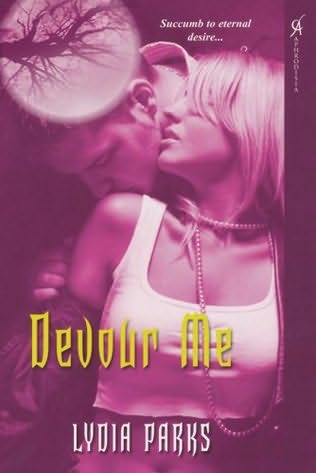
There’s more to the story–hours of heartache, a hundred or so “dear author” rejection letters, the long, hard road of learning to write a novel, the excitement of selling, etc.–but I won’t go into all the details. I managed to sell some romance novels and a couple of mysteries, and then was asked to try my hand at erotica. “Erotica?” I thought. Hmm. Hot sex, dark alpha characters…vampires! Of course! So I started with the Nathan Cotton series (published by eXtasy Books), then sold some hot, juicy vampires to Aphrodisia (Addicted and Devour Me). I also have a vampire in a Nocturne Bite (“Shadow Lover”) from Silhouette.

Maybe because of where I started, I’m a semi-purist when it comes to vampires. I’m not into the Nosferatu kind of vampires, all warty and pointy-eared, but definitely the Nick Knight version. My vampires can’t go out in the sun and they aren’t part-anything-else. A stake through the heart definitely does them in. And most of them can’t stand garlic. They exist in the normal world, not a fantasy place filled with other super-naturals. One thing they all want is human blood, and it’s always a very sexual experience for both vamps and humans when they take it. I just love the angst-ridden vampire image, even if he isn’t always full of angst. It’s all about the Hunger.

My latest story out from Nocturne Bites, “Marked” – which is available right now on eHarlequin.com – isn’t about a vampire, but a shape-shifter. It’s set in New Mexico and has a Native American flavor (thanks to a good friend who agreed to be my advisor). I really like the story. Maybe because it, too, has the hunger factor. He doesn’t want to drink her blood…he just WANTS HER!

What I’ve realized about vampire (or shape-shifter) erotica is that it’s no different than any other writing. If there’s no conflict, it isn’t interesting for me as either an author or a reader. I’m not saying that reading hot sex isn’t fun, it’s just that I can’t read 200 pages of hot sex without a good story in there, too. Vampires present an automatic element of conflict; he wants her but he might kill her if he gives in to his desires. That’s pretty strong conflict. However, if you can give the conflict a twist, you’ll have a much stronger story. He’s a vampire…if he takes her, he loses his only chance to see the sunlight again…she’s actually a vampire hunter…she thinks he killed her father…get creative! What’s the worst thing that could happen to him? The answer should be “her.” Romance is a great basis for erotica, with or without vampires.

Oh, and I promised you the rest of the story. For my 39th birthday (I’m not telling you how long ago it was, but the photos are fading), I got to meet my favorite vampire: Geraint Wyn Davies who played Nick Knight. What a hunk, and an absolutely fabulous person! A good friend and I went to a crazy weekend event with 80 women and Ger. I must admit, I had a blast, but it was kind of a strange thing to do. Several of us got together to swap stories about what we’d told our friends and family we were spending the weekend doing: business meeting, friend’s wedding, therapy. Too funny. Anyway, I met a bunch of the people I’d been sharing fanfiction with. I even got to sign a few stories–my first autographs! I’ll always remember that weekend more than just a little fondly.

One thing I got from that event was an important lesson: know that the people reading what you’re writing are real, they’re out there somewhere, and you just might meet them! [toothy grin with fangs]

If you want to find out about any of my vamps or other creatures, please visit my website. I love to hear from readers!

Thank you again, Vickie! [hugs]

“He was brought across in 1228…preyed on humans for their blood…”

#

Thanks, Lydia!

Any other fans of television vampires out there? And do they inspire you to write?

This is the first post in a little Vampire Blogging Festival I’m hosting. My upcoming guests include:

5/18 – M.K. Mancos
5/19 – Gemma Files
5/20 – Cate Hart
5/21 – Suzy McKee Charnas
6/2 – Anna Katherine
6/4 – Evie Byrne

Posted in erotica, guest, television, vampires | 10 Comments

Jane Eyre in the Carnival Mirror

Finally, I’m going backwards to the scenes surrounding Jane and Rochester’s wedding day, and tying those into the repeated reflections of Jane in Bertha and in Rochester himself.

Several times throughout the novel, Jane’s true feelings escape the barriers she sets around them; she first lets her true feelings free when she expresses her anger at Mrs. Reed, forms barriers under the influence of Miss Temple, then has a surge of emotion after Miss Temple leaves Lowood to marry, and then much later when she weeps in the orchard at Thornfield. Jane describes this as “I said—or something in me said for me, and in spite of me….”  I’m not the only one to make a connection between this and Bertha’s insanity! I also think you can make a connection with Rochester, who is constantly battling between what society says is required of him, and what he needs to survive with a whole soul. “It would not be wicked to love me,”  he says, and she replies, “It would to obey you.”  This is reinforced, later, with St. John Rivers–it would be wicked for her to marry him when he did not love her, and when he would allow only obedience from her. Jane is right when she decides that would result in her death, either physical or of the soul.

Jane and Rochester both have turbulent needs, and need the other both for self-mastery and to allow freedom of their souls. Rochester says, “You master me,”  and Jane makes of him “an idol”  while still struggling to maintain her selfhood. They understand each other very well, particularly in their flaws; more than once Rochester expresses Jane’s thoughts, and she reads his motives and moods with uncanny skill. They’re both very manipulative! The ultimate expression of Jane’s selfhood is when she leaves Rochester, reinforcing that she cannot let him compromise her principles, which to her are equivalent to sanity. She says, I care for myself.”  (It’s interesting that she is physically opposite to Bertha. Jane is tiny and pale, Bertha is big and corpulent, and compared to Blanche Ingram, who is “dark” with olive skin and dark hair.)

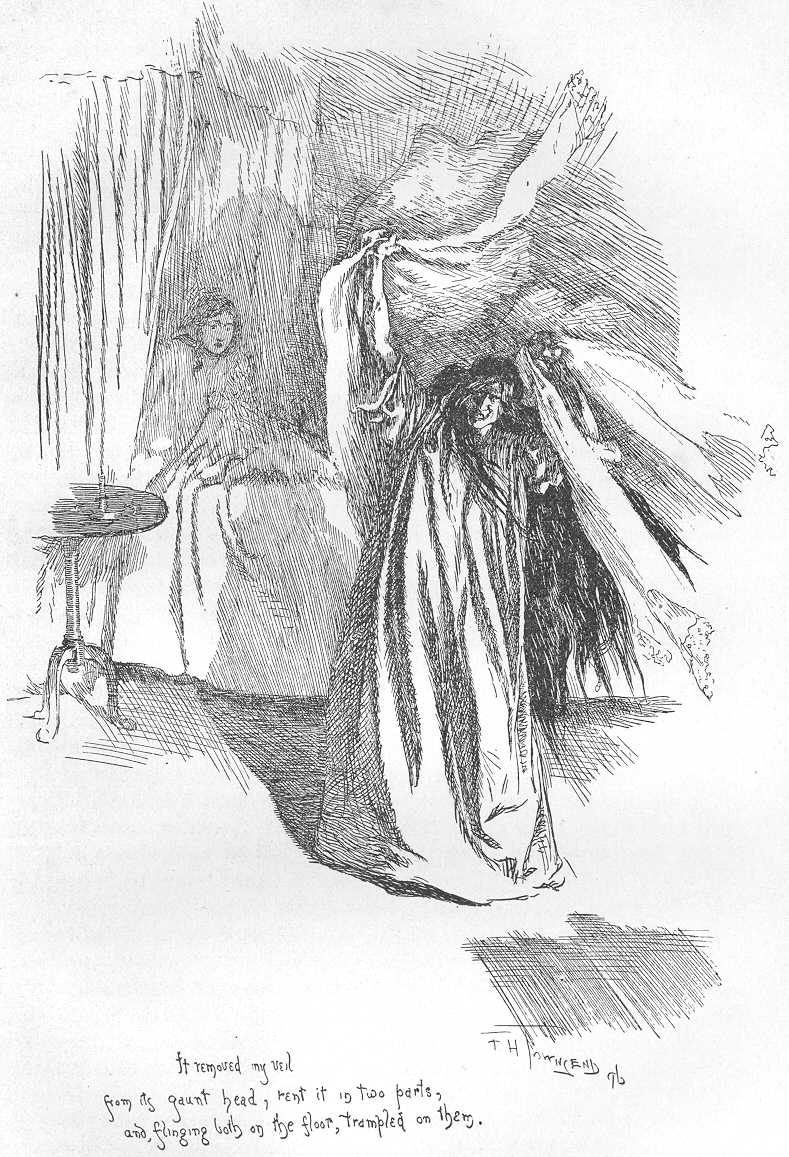
Mirrors: when Bertha appears in Jane’s room to destroy the fancy wedding veil Rochester had bought, Jane sees Bertha’s reflection in the mirror. Back in the Red Room where her Uncle Reed died, child-Jane notes that the mirror world looks “colder and darker.”   On the morning of the wedding, Sophie makes Jane look in the mirror. Jane sees “almost the image of a stranger” in dress and veil, the plain veil Jane had made herself. She dreams of the Red Room again, and of the Moon as a Mother; perhaps in the mirror’s other world?

After Bertha’s existence is revealed to Jane, and Rochester is telling his story, it’s a really long monologue at times, very tell not show! That section gives a different pov on many preceding events; the Male Other reveals his thoughts so he’s no longer a “romantic” mystery, ironic because in most other ways Jane already knows him so well. They are so close, in fact, that the supernatural event of her hearing his heartfelt cry of “Jane! Jane! Jane!”  is believable. (Jane attributes this event to Nature itself, which I find interesting; it could possibly be linked to the Moon as mother.)

Rochester and Jane being separated for a time is repeated often in romance novels that follow; the couple must be severed for a time, reminded of their solo selves, before they can truly be together as equals.

Finally, near the novel’s end, when Jane is walking through the forest towards Ferndean, I couldn’t help but think the description of the path was very vulvic, or perhaps symbolic of the deep emotional depths of the psyche: “grass-grown track descending the forest aisle, between hoar and knotty shafts and under branches arches…it stretched on and on, it wound far and farther…all was interwoven stem, columnar tunk, dense, summer foliage–no opening anywhere.”  Deep within Jane is her connection to Rochester, and his to her. It’s a good thing they end up together.

Comments?

All of the tagged Brontë posts, in reverse order.

Posted in brontë, reading | Tagged | 2 Comments

Jane Eyre A-Wandering in Search of Family

I left off yesterday when Jane departs Thornfield for Gateshead, where her Aunt Reed lies dying. Mrs. Reed’s dislike of Jane is finally explained more fully; she was jealous of her husband’s affection for his sister, Jane’s mother, and of his apparent preference for the baby Jane over his own children. Presumably, she resented the monetary outlay to take Jane in; and I wondered if Mr. Reed asked her permission before bringing home another baby? Since I suspect most of the work of raising the child would fall to Mrs. Reed and her servants, despite Mr. Reed’s fond attention to his niece. I don’t think Mrs. Reed was a nice person, but she did have reasons for her behavior.

The sisters Georgianna and Eliza Reed, Jane’s cousins, provide a little parallel to Jane and Rochester, especially their talk in the garden, when Eliza tells Georgianna she needs to stop relying on others for her entertainment and happiness, and find strength within herself only. Jane seems to agree in principle with Eliza, as she strongly believes in self-respect, but she also seems to like Georgianna a little better, because she doesn’t shy away from emotion. It goes back, I think, to when Jane desperately wanted love as a child. She still highly values emotional bonds.

I’m going to jump forward a little here, to the period after Jane’s left Rochester. Her Wanderings in the Wilderness, friendless and repulsed at every turn, hiding even her own name, hark back to her early life at Gateshead, in which the Reeds fend her off emotionally and in John’s case, abuse her, as well as harking back to her physical starvation at Lowood. Physical and emotional hungers throughout are equated to a degree, and are opposed to security/safety/love which she finds with Helen Burns, Miss Temple, Rochester, and the Rivers sisters. When Jane first sees Mary and Diana Rivers, they are relishing the study of German, which harks back to Helen Burns’ love of history. I wondered if the author was thinking of her own siblings as she wrote these characters. St. John Rivers stands as an emblem of what Jane’s life would be without love and freedom, in opposition to how her life would be with Rochester. Near the end of the book, Jane even states explicitly that to be with him is to sacrifice “famine for food.”

The dream of a wailing child, which Jane has repeatedly before the Reeds’ misfortunes, repeats before her abortive wedding to Rochester, and is reflected again when she spends the night gazing upon Adele as she sleeps, and in the morning herself weeps over the child. It might also connect with the occasional low moans or growls she hears from Bertha Mason Rochester.

One final thought I had concerns Adele. Jane’s actions towards Adele throughout are in opposition to how Jane was treated by Mrs. Reed. Jane affirms it is not the child’s fault that she is illegitimate, and repeatedly defends and praises her to Rochester, whose feelings about Adele are ambiguous. In the end, Jane makes sure Adele is provided not only with physical care but love as well. Adele and Jane’s relationship with each other is like a microcosm of the whole book.

Side notes: I wondered more about Grace Poole this time through. Is she, like Mrs. Fairfax, a relation of some kind? She’s obviously highly trusted. She’s once referred to as “Mrs. Poole,” by Leah I think, which makes me think she’s a widow. We eventually learn she has a son.

I was searching for significance in everything as I re-read, for example the “Bridewell” charade. I didn’t always come up with anything!

Richard Mason calls Rochester “Fairfax” rather than “Edward.” Jane doesn’t notice that Rochester calls Mason both “Richard” and “Dick,” a sign of their intimate relationship (brother-in-law). Later, she refers to Rochester as “Fairfax Rochester,” and Rochester calls himself “Fairfax” at least once.

It speaks well of Rochester, I think, that he did not send Bertha to an asylum, which at the time was a horrible fate. His motives might not have been pure, but that action helps me sympathize with his character more.

And still more tomorrow!

All of the tagged Brontë posts, in reverse order.

Posted in brontë, reading | Tagged | Comments Off on Jane Eyre A-Wandering in Search of Family

Jane Eyre Advertises, Will Travel

I’m a guest poster today at the Novelists, Inc. Blog on “Promotional Drops in the Online Bucket.” Please drop by and check it out!

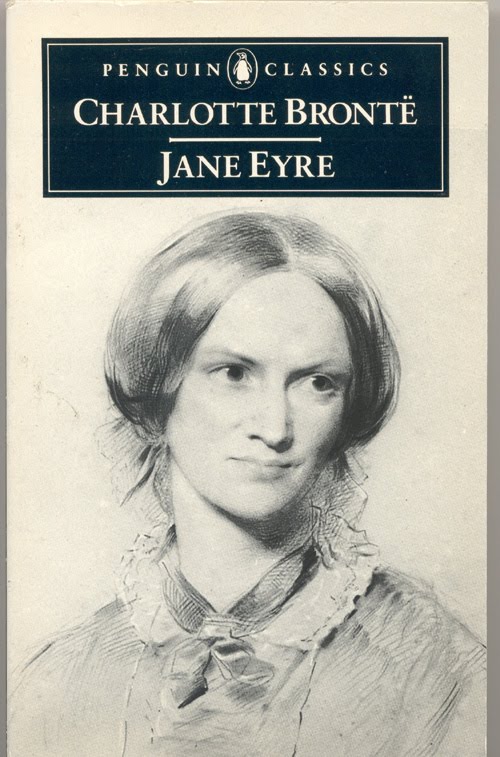
I recently re-read Jane Eyre in conjunction with Jessica of Read React Review, and am posting about it today, Saturday, and Sunday (there will be a discussion on her blog beginning May 23rd). That’s a photo of my tattered copy to the right, which I’ve now had to reinforce with tape. I never read Jane Eyre until after I’d graduated college. I finally did thanks to a dear friend who’d first read it at age eight and loved it beyond the telling. This was, I think, my third or fourth read of the book, but it’s the first time I’ve read it this closely. Note my posts will not be strictly linear, so if you haven’t read the book, I apologize in advance for any confusion.

The main new insight I had on this read was how much Rochester is a sort of future or alternate version of Jane; I also felt sometimes that Brontë was using his character to comment on what womens’ lives were like, and how they might escape their roles. For example, when Jane decides to leave Lowood, she can’t really hope for total happiness because she can’t even imagine it; she can only go so far as ask for “a new servitude.” Later, Rochester (obliquely referring to his marriage to Bertha, who’s now insane) insists that he has a “right to get pleasure out of life.” His comment is like the next step in feminist thought! As a man (and older as well), he has the confidence to go farther than Jane yet dares. In that conversation, Rochester also talks about remorse; his dialogue could easily have been shifted to a woman trapped in an unwise marriage.

After Bertha sets Rochester’s bed on fire, the emotionally intense scene between Jane and Rochester, followed by his abrupt leavetaking the next day, is echoed in thousands of romance novels down the road. “My–” He stopped, bit his lip, and abruptly left me.” He keeps Jane at a distance after that, though she does not wallow in abandonment. She immediately takes steps to try and sever her emotional ties to Rochester and find a new life for herself in a new place (she thinks of advertising for a new position).

When Rochester disguises himself as a fortuneteller, he seems to be trying to draw Jane into an admission that she cares for him; I think his attendance on Blanche Ingram is for a similar reason–he wants to make Jane jealous, so she will admit she loves him. Both actions are cruel; he’s fooling both women in different ways, but I suspect he feels justified because he’s trying to save himself with Jane. Rochester confirms some of this impression himself, later on. Later in the book, Jane tells him he can’t find salvation in another person; he must seek it within. In one of the many doublings/mirrorings in the novel, this statement is echoed by Eliza Reed to Georgianna Reed.

Another interpretation of the fortuneteller scene, possibly happening at the same time, is that Rochester is trying to entice Jane into reaching for happiness instead of fearing to want anything for herself and remaining static. (As a child, Jane says she’d do anything to be loved. As an adult, she’s much more cautious.) Also, Rochester might again be representing what a woman could be if she had a man’s place in society. “I wish to foster, not to blight.” I could be stretching a bit here, but that’s what it made me think!

Rochester constantly uses diminutives when speaking to Jane, but what stuck out most to me is “elf” and the various other supernatural appellations. Jane is more than merely human to him; she’s a hope for a life he’d thought unattainable. So while he sees her as human and tries to manipulate her at times, he’s also a bit in awe of her.

Jane describes Rochester as “familiar to me as my own face in a glass; as the speech of my own tongue.”

In the scene after Bertha has stabbed her brother Richard, all sorts of things happen which the re-reader understands but Jane does not; right then was Rochester’s opportunity to tell Jane he’s married, but he can’t bring himself to do it; I think he’s too afraid she will reject him (as she eventually does). He wants to cling to the illusion of the life he could have had if he’d never married Bertha. After Mason is gone, Rochester is clearly clinging to what is “real, sweet, and pure,” both Jane and the garden, which early on she described as “orderly.” Despite Rochester’s opinion of her, Jane herself struggles for order continually, to master the wild passions she expressed as a child and that still come out in her fey artwork.

In the garden, Rochester tells Jane, in a theoretical way, about his wife. It’s almost a proposal of marriage (in the aspect of asking for ultimate trust), and makes an interesting comparison with his actual proposal later. He really fears losing Jane, and that is his strongest motivation. Not only does she like him for himself, I think she reflects some of that liking back to him, so he’s more able to like himself. He says she improves him; she feels he should seek improvement within, not from her. At the end of that conversation, Rochester taunts Jane with Blanche; it’s a kneejerk reaction to what he sees as rejection (she hurt me, so I will hurt her). Jumping ahead in the story, when he actually proposes, again he teases her and leads her along until she confesses she wants him; only then, presumably feeling safe in her affection, does he embrace her and propose marriage.

And then, Jane is the one who leaves, when she learns her cousin John is dead and her Aunt Reed not long for the world. Jane and Rochester are friends again before she goes–I love their cute banter over her travel money, when he tries to give her a gift but she refuses, and he angles for a kiss but doesn’t get it.

When she returns, many things are different, not least Jane, who reconciles herself to lack of ties with her Reed cousins.

Tune in tomorrow and the day after for more!

I welcome comments if you’ve read Jane Eyre or had an interesting experience while re-reading another favorite.

All of the tagged Brontë posts, in reverse order.

Posted in brontë, reading | Tagged | Comments Off on Jane Eyre Advertises, Will Travel

Reading and Reading Again

In the last couple of years I’ve started to become fascinated with the study of reading and narrative. I partly blame a friend who specializes in a related academic discipline. I haven’t read a lot about theories of reading yet (amusing irony!) but I have some academic books in my Giant Wishlist of Doom.

I’m going to ramble on a bit about the vague scraps of ideas I’ve acquired so far.

One of the theories is that the experience you have while reading a book is different from the experience you have of that book after you’ve finished reading it. My understanding is this: while you’re reading the book, you’re absorbing it as something incomplete. The narrative draws you forward because you expect to get answers to questions posed by the narrative; the story can surprise you. You don’t have the whole picture because in your mind the whole picture doesn’t, can’t, yet exist. Once you’ve finished reading the book, it can be more of an object; you can experience the novel as a structure with bounds instead of a linear narrative that stretches forward into a blank future. I’m not sure I agree with the linear part, since many novels aren’t strictly linear, what with flashbacks, the reader remembering foreshadowing they encountered earlier in the story, narratives that jump around in time, that sort of thing. But anyway. I might not understand what theorists mean by “linear,” either. Or rather, I do have a vague idea of how “linear” goes along with flashbacks and foreshadowing and such, but I can’t write it down coherently yet. Maybe later.

Another idea is that, because you don’t have the whole picture of the book first time around, re-reading is different cognitively. When you’re re-reading, your primary attention doesn’t have to be on finding answers to questions. You can’t be surprised in the same manner, so your mind is freer to engage with the novel in a more critical way. You can rethink your interpretations of the text, or look for patterns in the narrative, or simply catch things you missed before.

However, I think a major reason to re-read a book is purely for pleasure. You enjoyed the book the first time, and perhaps the second; now you want to experience that pleasure again. The pleasure is only deepened when you can think more critically about the book.

For the next three days, starting tomorrow, I’m posting about my re-read of Jane Eyre. I seem to recall it was summer the first time I read it. Now, it’s spring. Some days are still chilly, but they’re bright and flowers are blooming. Nothing could be more unlike the beginning section of Jane Eyre, when the weather is so bad outside they can’t take a walk, and the emotional weather inside is even more turbulent.

Since I know the book well, I found I can enjoy reading even the parts that disturb or enrage me because there’s also enough room in my mind to think outside of the story. This time, for instance, I couldn’t help drawing comparisons between bullying young John Reed and Dudley Dursley in the early Harry Potter books (which didn’t yet exist the first time I read Jane Eyre). But more on my re-read tomorrow. Lots and lots more.

What’s your favorite book or books to re-read? And why?

All of the tagged Brontë posts, in reverse order.

Posted in brontë, reading | 2 Comments

Reading our Grandmothers

Jessica of Read React Review, one of my favorite blogs, recently mentioned that she had never read Jane Eyre and had decided to do so. I and several others volunteered to read or reread it along with her. I’ll be posting on my re-read Friday, May 14th through Sunday, May 16th, and hopefully will manage to put in links to some of the other posts, as well, as they appear – Jessica’s post is now scheduled for Sunday, May 23rd.

Because of the re-read, I started thinking about “the classics.” I’m not going to try to define “classics.” That way lies madness. Instead, I’m going to muse on the idea of there being “classic” romance novels; or maybe I should call them “precursors.” Pamela is often cited, and Pride and Prejudice, and of course Jane Eyre. Why are these important to modern romance readers and writers?

To me, Jane Eyre doesn’t fit the formula of the modern romance novel; if I had to slot it into a modern literary genre, I’d choose women’s fiction instead, because in addition to Jane’s relationship with Edward Rochester, the book includes complex relationships with her family, in more than one iteration. Rochester gets a lot of press, but the book is not about him, it’s about Jane. (And Gothic romance, and social commentary, and feminism, etc..)

However, fitting into modern genre conventions has nothing to do with why these precursors are important. To me, as a writer, a large part of their importance relates to the genre tropes that modern romances have in common with these books. Certain plot elements in precursor books still resonate today, and are still being used and recreated. How many modern romance novels include the hero and heroine misunderstanding each other, as in Pride and Prejudice, or falling in love without realizing their beloved has a major secret, as in Jane Eyre? Or Byronic heroes, like Jane Eyre? (She’s more of one than Edward Rochester, I think. She’s so tormented and angry and prone to dark fits of the soul!)

Writers keep using these novels’ ideas, reinterpreting them and dialoguing with them. Reading precursors, and also reading their modern descendents, to me is a form of conversation, us in the now with our sisters/mothers in the past (or fathers, in the case of Pamela). If you haven’t read these novels, you can’t follow the conversations. Reading them is as important as talking to a grandmother.

Among the classics I’ve never read are Wuthering Heights and Fanny Burney’s Evelina. Evelina will probably be the next precursor I read, though it will probably be awhile before I get to it. How about you? What precursors/classics do you love, or have never read, or would like to read?

Related post:
Reading for the Writer.

Posted in genre, reading, romance novels, writing | 3 Comments